

An insurance approved body shop is a collision repair facility that a specific insurance carrier has vetted, credentialed, and pre-authorized to handle claims on its behalf — which usually means faster paperwork, direct insurer communication, and a warranty backed by the shop itself. However, “approved” is only one signal of quality. Before you hand over your keys, you need to understand exactly how that approval works, what it does and doesn’t guarantee, and how to independently verify that a shop will restore your vehicle safely. This guide covers all of it, in far more depth than a typical collision-chain overview.
Insurance Approved Body Shop: The Complete Guide to Claims, Certifications, and Your Rights

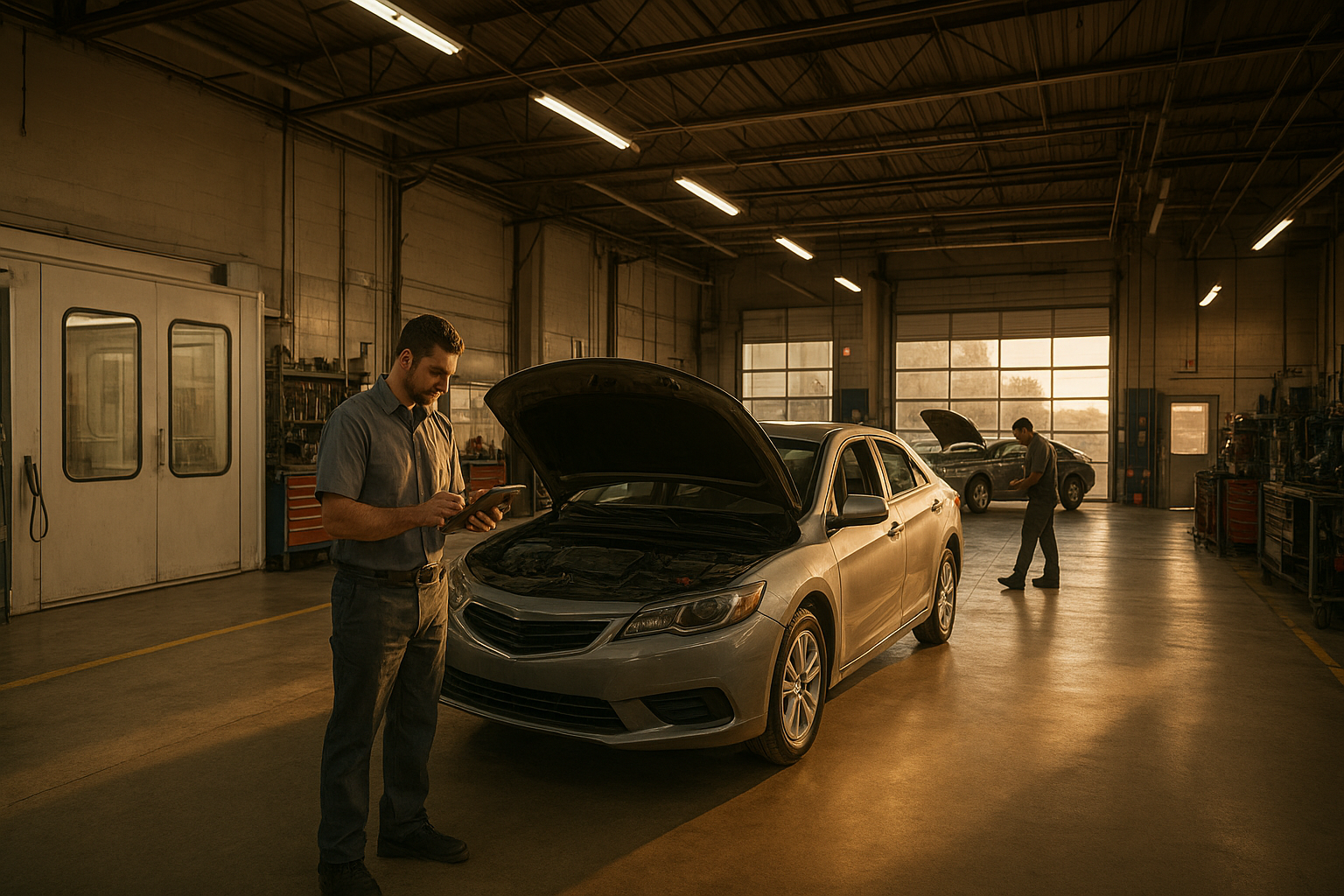
A modern insurance approved body shop ready to diagnose and restore your vehicle.
In this guide, you’ll learn: what “insurance approved” actually means, how Direct Repair Programs work, the full seven-phase repair process, the certifications and equipment that separate elite shops from mediocre ones, realistic timelines and costs, your legal rights during a claim, a 10-point evaluation checklist, common mistakes to avoid, and why a locally owned, specialty-certified shop often outperforms a large national chain.
What Does “Insurance Approved Body Shop” Actually Mean?
An insurance approved body shop is a collision repair facility that meets a particular insurer’s participation criteria. In most cases, these shops operate within a Direct Repair Program (DRP) — a formal agreement in which the insurer pre-authorizes the shop to write and process estimates directly. Insurers typically vet DRP shops for equipment standards, technician training records, cycle-time performance, customer satisfaction scores, documentation practices, and warranty policy.
For you as a vehicle owner, the benefits usually include a streamlined claims process, faster back-and-forth between shop and adjuster, less paperwork on your end, and often a lifetime workmanship warranty. In addition, many approved shops assign a dedicated insurance liaison who handles supplement requests and rental coordination — so those phone calls aren’t left to you.
However, insurer approval is not the only marker of repair quality. Many excellent independent collision facilities deliberately stay outside DRP agreements specifically to retain full control over parts sourcing and repair methodology. As a result, a shop’s absence from an approved list does not automatically mean inferior work — and, as detailed further below, you always retain the right to choose.
Insurance Approved vs. Manufacturer Certified: Two Different Labels
It’s worth distinguishing insurer approval from OEM (original equipment manufacturer) certification. An insurance approved body shop satisfies an insurance carrier’s business criteria. A manufacturer-certified shop — for example, one certified by Tesla, Honda, or Ford — has instead met that automaker’s specific tooling, training, and structural repair requirements. The strongest shops hold both: DRP status with multiple carriers and OEM certification for the makes they service most often. According to the Advanced Driver-Assistance Systems reference on Wikipedia, modern vehicles increasingly rely on cameras and sensors that require exact factory calibration — which is precisely why OEM-level training matters so much more today than it did a decade ago.
Bottom line: Treat “insurance approved” as one useful signal among several. Always verify OEM procedure compliance, technician credentials, equipment investment, and the shop’s actual repair history before making a final decision.
How to File a Claim and Get Into an Insurance Approved Body Shop
Before your vehicle reaches a repair bay, you have to navigate the claims process. Knowing each step in advance helps you avoid unnecessary delays and protects your rights from the very start.
Step 1: Report the Claim Promptly
Report your claim as soon as possible — ideally within 24 hours of the incident. Most insurers offer a mobile app, an online portal, or a direct phone line. Have your policy number, the date and location of the loss, a description of the damage, and the other party’s information ready. Specifically, note whether anyone was injured, because that detail changes how the claim gets routed internally.
Step 2: Receive Your Claim Number and a Suggested Shop List
Your insurer assigns a claim number and, usually, a claims representative. Write that number down immediately — you’ll reference it throughout the repair. At this point, the insurer may suggest several insurance approved body shops in its network. That list, however, is a suggestion, never a requirement.
Step 3: Choose Your Repair Facility
This decision belongs to you. You can pick a shop from the insurer’s approved list, or you can select an independent facility that isn’t on any list at all. Either way, the insurer must still pay for covered repairs up to your policy limits. If you’d like a structured way to compare options, this guide to choosing a body shop that guarantees OEM-correct repairs walks through the questions worth asking before you sign anything.
Step 4: Authorize the Estimate and Teardown
Once you drop off your vehicle, sign authorizations for the estimate and, if needed, teardown. A written authorization protects both you and the shop. At an insurance approved body shop working within a DRP, the estimate is typically shared with the insurer through a common platform, cutting down your administrative burden considerably.
Step 5: Confirm Rental Coordination and Drop-Off Timing
Finally, confirm how the rental vehicle will be arranged — many DRP shops coordinate pickup and return dates directly with the rental agency, timed to your repair’s actual start and finish. This single step prevents the common headache of paying out-of-pocket rental overage because a repair ran a day or two long.
Inside the Repair Process: Seven Phases at an Insurance Approved Body Shop
While details vary by insurer and shop, the repair workflow at an insurance approved body shop follows a structured, documentation-heavy process. Understanding each phase helps you ask sharper questions and set realistic expectations.

The insurance claim and collision repair workflow from intake to delivery.
Phase 1: Check-In, Photography, and Pre-Scan
At drop-off, the shop verifies your claim number, photographs all damage angles, and runs an electronic pre-scan of the vehicle’s onboard systems. Pre-scans reveal fault codes triggered by the collision, even when no dashboard warning light is on. This step matters because it drives a more accurate estimate from the very beginning.
Phase 2: Initial Estimate vs. Blueprint Estimate
You’ll first receive a preliminary estimate. The definitive figure — the blueprint estimate — comes later, during teardown, once panels are removed and hidden damage becomes visible. A quality insurance approved body shop documents any newly discovered damage through a formal supplement submitted with photos and measurements. This is routine, not a red flag.
Phase 3: Parts Selection Grounded in Safety and OEM Guidance
Parts are sourced according to policy language, safety considerations, and manufacturer guidance:
- OEM new parts — manufactured by the original automaker to factory spec.
- OEM remanufactured parts — factory-rebuilt originals meeting OEM tolerances.
- Quality aftermarket parts — third-party alternatives certified to match OEM fit and finish.
- Reconditioned or used parts — salvage-grade components, appropriate for select non-structural jobs.
For safety-critical components and anything tied to Advanced Driver Assistance Systems (ADAS), most automakers and reputable shops recommend OEM parts specifically. Sensor housings and mounting brackets must meet exact tolerances for proper calibration and crash performance. A trustworthy insurance approved body shop explains the reasoning behind every parts line, not just the price.
Phase 4: Structural Repair, Welding, and Mixed Materials
Modern vehicles combine high-strength steel, boron steel, aluminum alloys, and composite panels. Each demands specific procedures, welding equipment, and bonding agents. For example, aluminum cannot share tools with steel without causing galvanic corrosion. Consequently, a properly equipped shop keeps dedicated, isolated aluminum workstations entirely separate from steel repair bays, referencing OEM documentation throughout.
Phase 5: Refinishing, Color Matching, and Bake-Cure
Paint refinishing at a quality shop uses computerized color-matching alongside physical spray-out test cards to achieve an invisible blend. A bake-cure paint booth then controls temperature and airflow precisely, producing a durable finish that resists chipping, fading, and peeling over time.
Phase 6: ADAS Calibration and Post-Repair Scanning
This is arguably the most consequential phase in modern collision repair. Lane departure warning, automatic emergency braking, adaptive cruise control, and blind-spot monitoring all rely on sensors aimed to exact manufacturer specifications. After any repair affecting the front fascia, windshield, hood, suspension geometry, or wheel alignment, these systems must be formally recalibrated.
Specifically, there are two calibration types: static calibration, performed in the shop using target boards and manufacturer software, and dynamic calibration, performed during a road drive at specified speeds. A post-repair scan then confirms every fault code is cleared. Skipping either step can leave safety features silently impaired — a risk no reputable shop should ever take. The National Highway Traffic Safety Administration continues to publish guidance underscoring exactly why post-collision calibration is non-negotiable for ADAS-equipped vehicles.
Phase 7: Quality Control, Test Drive, and Delivery
Before your car is returned, a structured inspection checks panel gaps, paint uniformity, trim alignment, sensor status, and drivability. A test drive confirms handling feels normal and no warning indicators appear. At delivery, your advisor should review the complete invoice, warranty documentation, and care guidance for new paint.
Certifications and Equipment That Separate the Best Shops from the Rest
Because vehicle technology evolves quickly, ongoing investment in training and equipment is what separates a genuinely capable insurance approved body shop from one that simply displays a carrier’s logo. Look for these verifiable credentials specifically:
OEM Repair Procedure Compliance
Automakers publish detailed, model-specific repair procedures covering sectioning locations, weld patterns, rivet spacing, adhesive types, torque specs, and calibration sequences. A shop that subscribes to these manufacturer portals — and can prove it follows them — repairs to the exact standard the factory intended. In contrast, a shop repairing “by feel,” relying only on generic estimating software, may unknowingly compromise crash performance.
I-CAR Gold Class and Brand-Specific Certifications
I-CAR (the Inter-Industry Conference on Auto Collision Repair) is the collision industry’s primary training organization. I-CAR Gold Class — its highest team-based recognition — requires every role in the shop to complete ongoing annual training. As a result, Gold Class status signals continuous improvement, not a one-time award.
Beyond I-CAR, many automakers run brand-specific certification programs, such as Tesla Approved, Rivian Certified, or OEM programs from Ford, GM, and BMW. These require specific tooling and audited procedural compliance. If you drive a late-model or electric vehicle, seeking a shop with your brand’s certification is strongly advisable.

Precise ADAS calibration ensures advanced safety systems function correctly after collision repair.
Essential Equipment Investments
Ask about tooling before committing. A properly equipped insurance approved body shop should have:
- Frame bench with 3D measuring system — verifies structural alignment within millimeters of factory spec.
- Dedicated aluminum workstations — isolated from steel work areas to prevent contamination.
- OEM-capable scan tools — reads manufacturer-specific codes, not just generic OBD-II data.
- ADAS calibration targets and software — for both static and dynamic procedures.
- Bake-cure paint booth — temperature-controlled with dust extraction for consistent finish.
- Squeeze-type resistance spot welder (STRSW) — required for OEM-compliant welding on high-strength steel.
These investments reduce comebacks, help a shop meet insurer cycle-time targets, and — most importantly — ensure your vehicle returns to pre-loss condition safely. If you’d like a deeper look at how specialty equipment translates into a better repair, this overview of specialty auto body repairs that restore your car breaks down each category further.
How Long Will Repairs Take, and What Will You Pay?
One of the most common sources of frustration after a collision is a mismatch between expected and actual repair timelines. Understanding the variables that drive both duration and cost helps you plan more realistically.
What Drives Repair Time
Three variables largely determine how long you’ll be without your vehicle: parts availability, the need for sublet services such as calibration or wheel alignment, and supplement approval turnaround from your insurer. Mild cosmetic repairs — a bumper scuff, a dented door — often finish in two to four business days. Structural repairs, frame straightening, and ADAS-heavy jobs may take two to four weeks, particularly when specialty parts are backordered.
During high-demand periods, such as after regional weather events, even simple repairs can take longer than usual. Therefore, ask your shop for a milestone schedule at drop-off, including estimated parts arrival and paint timing.
What You’ll Pay Out of Pocket
Your direct cost typically equals your policy deductible, plus any non-covered items you specifically authorize — for example, choosing OEM parts when your policy specifies aftermarket equivalents. A transparent insurance approved body shop explains every choice up front and gets your written consent before any change that affects cost.
Similarly, if your policy includes a diminished value clause — meaning your car’s market value may drop even after a proper repair — raise this with your insurer when you file. Some states allow a separate diminished value claim against the at-fault party’s insurer.
Rental Vehicle Coordination
Review your policy’s rental reimbursement limits carefully, specifically the daily maximum and the total cap. Insurance approved body shops working within a DRP typically time rental pickup and return to match your vehicle’s drop-off and delivery dates, minimizing overage charges. Managing rental timing on your own with a non-DRP shop takes more vigilance.
Your Legal Rights When Choosing a Collision Repair Shop
Many vehicle owners don’t realize how much power they have in the claims process. As a result, they accept situations that are fully within their power to change. Understanding these rights ensures you get the repair your vehicle actually deserves.
Right to Choose Your Repair Facility
In virtually every U.S. state, you can choose any licensed collision repair facility, regardless of whether it appears on your insurer’s approved list. Your insurer cannot legally require a specific shop as a condition of coverage. In California, for instance, this protection is written directly into state insurance regulations, which require insurers to disclose your right to select your own repair shop. If you choose a non-DRP shop, however, you may need to manage more of the communication yourself.
Right to a Thorough and Accurate Repair
Your insurer must return your vehicle to its pre-loss condition — the state it was in before the accident. This obligation covers structural integrity, mechanical function, safety systems, and cosmetic appearance. If an estimate is insufficient, your shop has the right to submit supplements, and you have the right to advocate for them.
Right to Request OEM Parts
Depending on your policy and state regulations, you may have the right to request OEM parts, particularly for vehicles still under manufacturer warranty or for safety-critical components. Some states require insurers to disclose when non-OEM parts are used and to obtain your consent first. Ask your claims representative about your policy’s parts language before repairs begin.
Right to Dispute the Estimate
If you believe the insurer’s estimate won’t cover a proper repair, you can dispute it. Most policies include an appraisal clause — a formal dispute process where independent appraisers agree on a fair repair value. Consequently, you are never obligated to accept the first number offered if it doesn’t reflect the true cost of restoring your vehicle.
The Ultimate Insurance Approved Body Shop Checklist
Use the following criteria to evaluate any collision center thoroughly, whether or not it’s on an insurer’s approved list. The goal is a shop that consistently produces safe, accurate, durable repairs — not simply one that processes claims quickly.
1. Documentation Discipline
Ask to see sample repair files citing specific OEM procedures, with pre- and post-repair photos and scan reports attached.
2. On-Site ADAS Calibration Capability
Confirm whether calibration happens in-house or through a documented sublet partner, and whether alignment is checked whenever suspension geometry is affected.
3. Mixed-Materials Expertise
Verify that aluminum work happens in a dedicated, isolated area separate from steel repair, preventing long-term corrosion risk.
4. Paint Quality and Color-Match Process
Ask whether the shop uses spectrophotometer color matching, physical spray-out cards, and offers a written paint warranty — not just a verbal promise.
5. Lifetime Workmanship Warranty
A reputable shop offers a lifetime warranty for as long as you own the vehicle, and ideally one that transfers to a new owner if you sell.
6. Proactive Communication Standards
Confirm how updates are delivered and at which milestones — teardown completion, parts arrival, paint start, and pre-delivery QC, at minimum.
7. Verified Online Reputation
Look for reviews that mention estimate accuracy and paint match quality — not just speed. A shop with 4.8 stars and 300+ detailed reviews beats one with 5 stars and 12 reviews.
8. Insurance Coordination Experience
Ask how many carriers the shop routinely works with and how supplements typically get approved — a shop fluent in claims paperwork saves you real time.
9. Rental Coordination Support
Ask whether the shop actively schedules rental pickup and return around your repair timeline, rather than leaving that logistics burden to you.
10. Willingness to Walk You Through a Past Repair
Ask each shop to describe a recent, similar repair — what made it complex, how they validated the structure, and what the post-scan showed. Hesitation here is a red flag.
Common Mistakes People Make When Choosing a Body Shop
Even careful vehicle owners fall into predictable traps after a collision. Avoiding these mistakes puts you well ahead of most claimants.
- Assuming the insurer’s list is the only option. As covered above, it’s a suggestion — not a restriction on your right to choose.
- Skipping the certification check. A shop’s marketing claims mean little without verifiable I-CAR or OEM documentation.
- Ignoring ADAS calibration entirely. A car that “looks fine” can still have a miscalibrated camera that silently fails to trigger emergency braking.
- Accepting a verbal warranty. Always get workmanship and paint warranties in writing before you drive off.
- Choosing based on speed alone. The fastest estimate isn’t always the most accurate one; rushed blueprinting often leads to missed supplements later.
For a step-by-step framework that avoids these pitfalls entirely, see this guide to choosing the right body shop for safer OEM repairs.
Local Specialty Shop or National Chain? Why Personalized Service Matters
Large collision chains market convenience and scale — multiple locations, standardized processes, and brand recognition. However, that scale often comes at the cost of continuity: you may speak with a different representative every time you call, and your vehicle may be one of dozens moving through the same bay that week.
A locally owned, specialty-certified insurance approved body shop typically offers something a national chain structurally cannot: the same advisor from drop-off to delivery, direct access to the technician who worked on your specific car, and a reputation built entirely on local word-of-mouth rather than nationwide advertising. For claimants who value clear, consistent communication over sheer footprint, this difference is significant. If you’re comparing your options for an upcoming claim, this guide to the best body shop for insurance claims breaks down exactly what to compare between local and national providers.
Frequently Asked Questions About Insurance Approved Body Shops
Do I have to use the insurance approved body shop my insurer recommends?
No. You can choose any licensed collision repair facility in virtually every state. Using an insurer-recommended shop may streamline paperwork and rental coordination. However, the final choice is entirely yours, and your insurer cannot penalize you for choosing a different qualified shop.
Will an insurance approved body shop always use OEM parts?
Not necessarily. Parts decisions depend on policy language, safety requirements, availability, and OEM position statements. For safety-critical and ADAS-related items, OEM parts are strongly advisable. Ask your shop to explain their parts rationale for each significant line item.
What happens if a shop finds more damage once repairs begin?
The shop submits a supplement request to your insurer, supported by photographs and documentation. This is a standard part of collision repair, not a sign that anything was missed initially — hidden structural damage often can’t be seen until panels come off.
Is the paint finish covered by a warranty?
Reputable shops offer a lifetime workmanship warranty covering paint and refinish for as long as you own the vehicle. Always get this in writing at delivery, and confirm whether it transfers to a new owner if you sell.
What is a Direct Repair Program, and should I use a DRP shop?
A DRP is a formal partnership between an insurer and a collision facility. DRP shops usually process claims faster because they communicate directly with the insurer’s systems. However, DRP status alone doesn’t guarantee superior repair quality — evaluate DRP and non-DRP shops using the same credential and equipment criteria.
How long does a typical insurance approved body shop repair take?
Timeline depends on damage severity, parts availability, and whether sublet services like calibration or alignment are needed. Minor cosmetic repairs often finish in two to four business days. Structural or ADAS-heavy repairs may take two to four weeks. Ask for a milestone-based timeline at drop-off.
Can I dispute my insurer’s repair estimate?
Yes. If the estimate won’t cover a proper repair, your shop can submit supplements with supporting documentation. If a disagreement persists, most policies include a formal appraisal clause — an independent review process that resolves valuation disputes without litigation.
Does choosing a non-approved shop cost me anything extra?
Generally, no — your insurer must still pay covered repair costs up to your policy limits regardless of which licensed shop you choose. You may, however, need to manage more of the paperwork and rental coordination yourself compared with using a shop already inside a Direct Repair Program.
Looking for a Trusted Insurance Approved Body Shop?
If you’re looking for an experienced team that combines seamless insurer coordination with OEM-compliant craftsmanship, explore the repair capabilities and customer support process at Brea Auto Body — insurance approved body shop services. Their site outlines repair capabilities, claims management, and how they guide your vehicle from initial estimate to final delivery.
Prefer to talk it through first? Reach out via the contact options on breaautobody.com to start your estimate and get expert guidance on claim documentation, rental coordination, and repair planning. Author: Brea Auto Body team. Last updated: 2026-07-07.

