

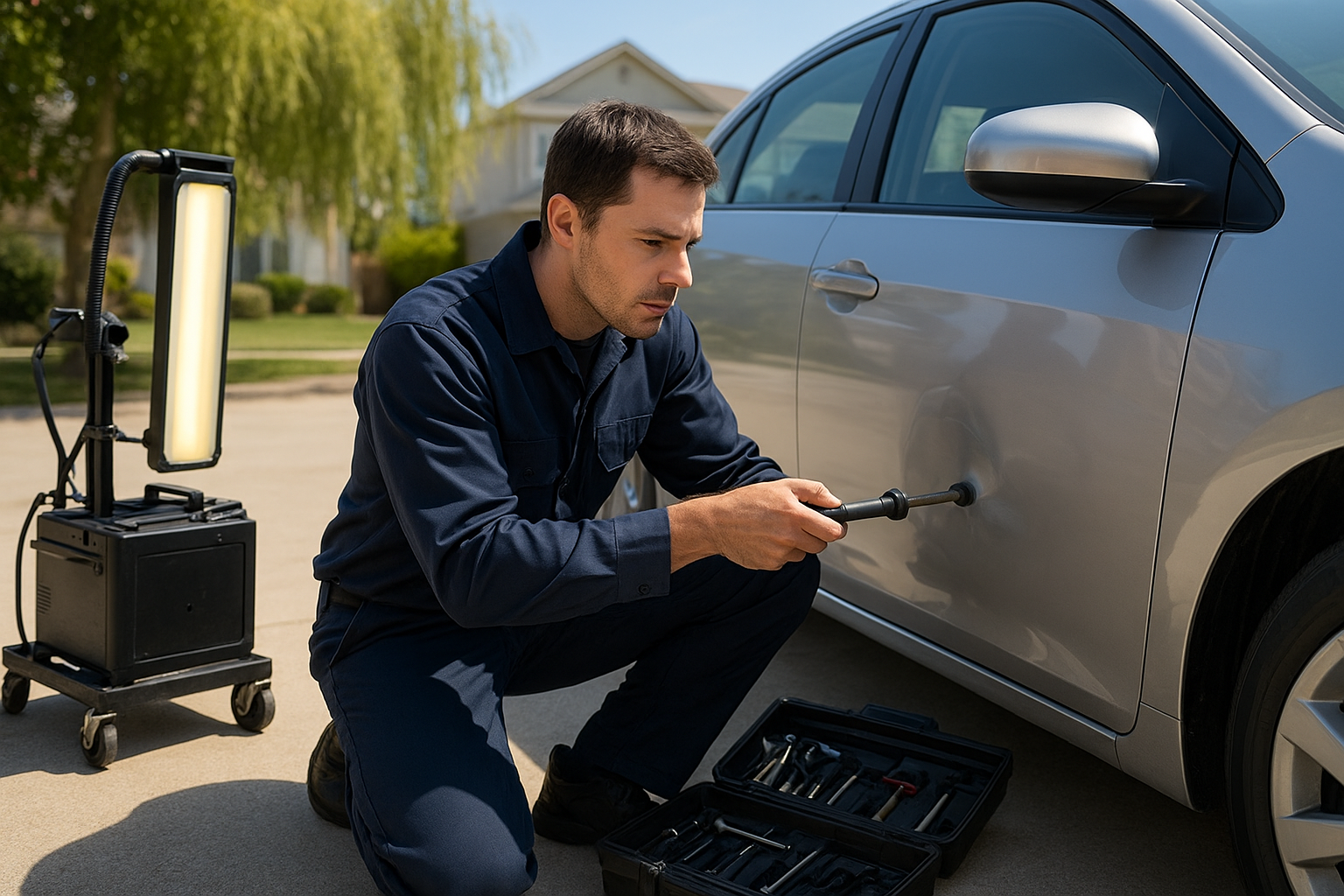
Mobile auto body repair is a service where a certified technician drives directly to your home, office, or parking lot and repairs cosmetic vehicle damage on the spot — no shop drop-off required. It’s a rapidly growing alternative to traditional body shops for drivers dealing with dents, scratches, and paint chips. But mobile repair has real limits. This guide covers everything you need to know: what mobile auto body repair is, exactly what it can and cannot fix, how much it costs, how to find a trustworthy technician, and when you genuinely need a full-service body shop instead. Author: Brea Auto Body — Last updated: 2026-07-07.
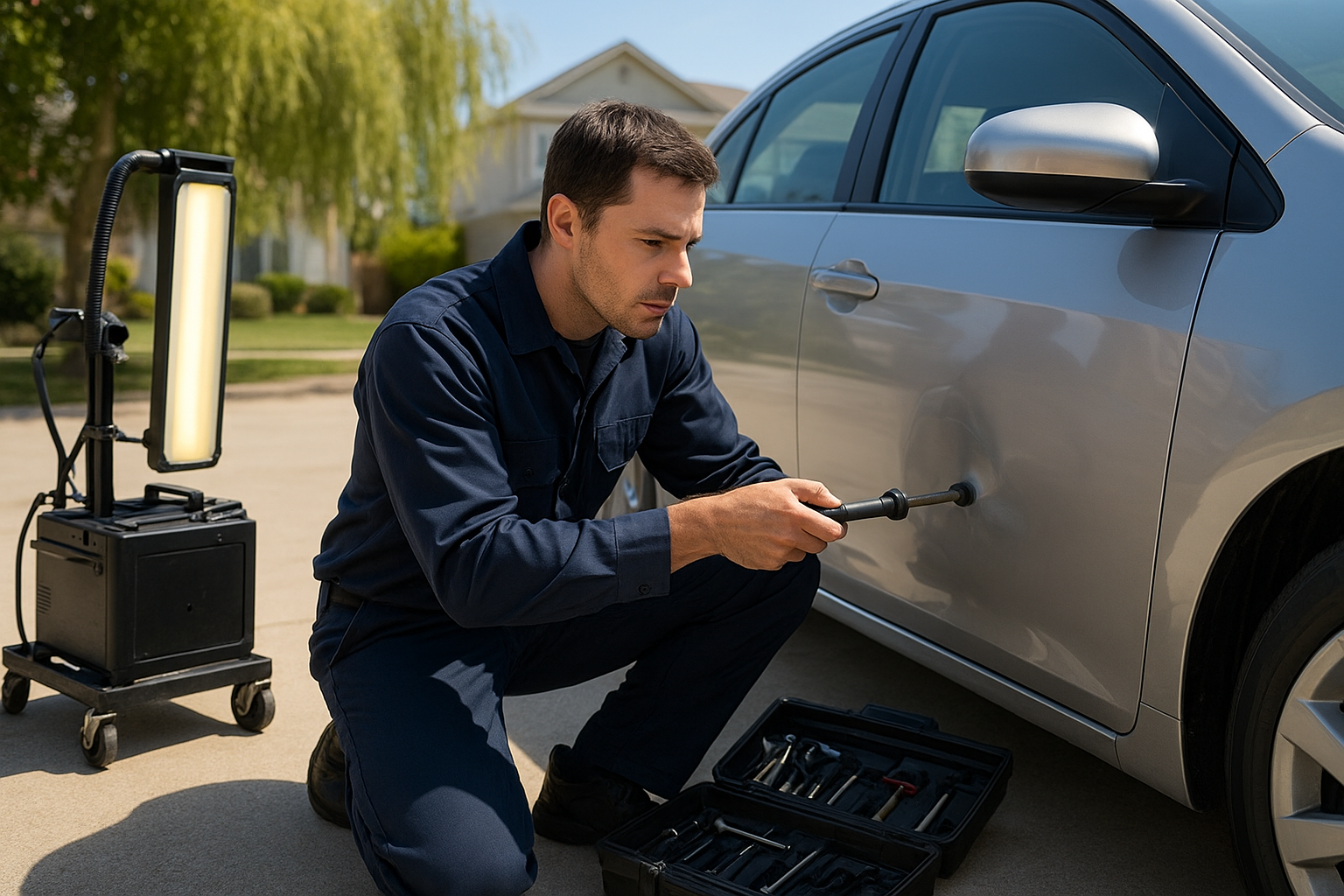
Mobile auto body repair brings professional dent removal and scratch repair directly to your driveway or workplace.
What Is Mobile Dent Repair?
Mobile auto body repair is a service model where trained technicians travel to the customer’s location — instead of requiring you to bring your vehicle to a fixed shop — and perform cosmetic repairs on-site using portable professional equipment. The most common technique used is paintless dent repair (PDR), which uses precision rods, picks, and reflective lighting to massage dents back into shape from behind the panel without touching the original factory paint.
According to the IBISWorld Auto Body Repair industry report, the U.S. auto body repair market exceeds $47 billion annually, and mobile on-demand services represent one of the fastest-growing segments — fueled by consumers who want repairs without sacrificing a day to a shop visit.
Mobile repair fills a genuine gap. For minor cosmetic damage, it’s often faster, cheaper, and far more convenient than a traditional shop. But the convenience comes with a trade-off: mobile technicians carry limited equipment compared to a full-service facility, which caps what they can realistically fix. Knowing those limits before you book is the key to getting good results. Read our auto body repair guide to compare shop capabilities and mobile options.
What Types of Damage Can Mobile Auto Body Repair Fix?
Mobile auto body repair technicians specialize in a defined range of cosmetic vehicle damage. The repairs they handle well include:
- Small, round dents with intact paint — The ideal case for PDR. Door dings from parking lots, minor hail damage, and ball impacts where the paint hasn’t cracked respond extremely well to mobile PDR.
- Hail damage across multiple panels — Experienced PDR technicians can address numerous hail dents in a single mobile visit, often saving significant time and cost versus shop repair.
- Surface scratches and paint chips — Light scratches that haven’t reached the metal and paint chips smaller than a quarter can be addressed with color-matched touch-up products applied on-site.
- Minor bumper scuffs — Light surface abrasions on plastic bumpers, where the bumper isn’t cracked or structurally compromised, may be buffed and touched up by a mobile tech.
- Windshield chip repair — Many mobile auto body techs also offer windshield chip injection to stop small rock chips from spreading into full cracks.
- Swirl marks and oxidation polishing — Some mobile providers offer paint correction services like clay bar treatment and machine polishing for vehicles with surface-level paint degradation.
What Mobile Auto Body Repair Cannot Fix
Understanding what mobile repair cannot do is just as important as knowing what it can. Mobile technicians are not equipped — and should not attempt — to address:
- Deep dents with cracked or creased paint — Once the paint has broken, PDR cannot restore the finish without body filler and repainting, which requires shop equipment.
- Frame and structural damage — Any damage that affects the vehicle’s frame, chassis rails, or unibody structure requires specialized frame-pulling equipment found only in a certified shop.
- Full panel replacements — Replacing a quarter panel, door skin, or hood requires a controlled shop environment with proper welding and paint booth conditions.
- Large-area repaints or blending — Matching factory paint across a full panel or blending color between adjacent panels requires a downdraft paint booth and professional mixing systems unavailable on mobile units.
- Airbag and safety system repairs — Deployed airbags, damaged sensors, or compromised ADAS (Advanced Driver Assistance System) cameras require certified shop repair and calibration.
- Collision damage involving other vehicles or structures — Any impact severe enough to move a panel out of alignment, damage mounting hardware, or affect body gaps needs a full-service facility.
Important: Attempting to use mobile repair on damage that requires a full shop repair doesn’t just produce poor results — it can mask underlying structural problems that affect your vehicle’s safety in a future collision.
How Much Does Mobile Auto Body Repair Cost?
Cost is one of the most common questions drivers have about mobile auto body repair. Pricing varies based on damage type, panel location, number of dents, and the technician’s market. Here’s a realistic breakdown:
| Repair Type | Typical Mobile Cost | Typical Shop Cost |
|---|---|---|
| Single small dent (PDR) | $75 – $175 | $150 – $350 |
| Larger or complex dent (PDR) | $150 – $400 | $300 – $700 |
| Hail damage (multiple dents) | $500 – $3,000+ | $1,000 – $6,000+ |
| Surface scratch touch-up | $150 – $500 | $300 – $900 |
| Minor bumper scuff | $100 – $300 | $200 – $600 |
| Windshield chip repair | $50 – $120 | $60 – $150 |
Keep in mind that the lowest mobile estimate isn’t always the best value. A low-priced technician who uses improper technique can cause paint damage, stretched metal, or cosmetic results that ultimately cost more to correct. Always compare written estimates and check for warranty coverage before committing.
Does Insurance Cover Mobile Auto Body Repair?
In many cases, yes — comprehensive auto insurance policies cover cosmetic vehicle repairs, including mobile services. Hail damage in particular is almost universally covered under comprehensive coverage. However: See our guide on choosing a body shop to understand insurer requirements and documentation.
- Coverage depends on your deductible. If your deductible is $500 and the repair costs $300, you’ll pay out of pocket.
- Some insurers require repairs to be performed at an approved facility, which may or may not include mobile providers.
- Mobile technicians often cannot produce the documentation and parts invoicing that insurers require for larger claims — another reason complex repairs belong at a certified shop.
- Always call your insurance provider before booking any repair to confirm coverage terms and avoid surprises.
How to Find a Reputable Mobile Auto Body Repair Technician
The mobile auto body repair market varies dramatically in quality. Finding a trustworthy, skilled technician takes a little research, but it protects you from poor work and wasted money. Here’s how to approach it:
- Assess your damage honestly before searching. Walk around the vehicle in good lighting. Note the number, size, and location of dents or scratches. Check whether paint is cracked, peeling, or missing. If the damage is purely cosmetic and confined to a small area, mobile repair is likely suitable. If there’s cracked paint, exposed metal, or any panel misalignment, go straight to a certified shop.
- Search with specificity. Use Google Maps and search “mobile auto body repair” or “mobile PDR” plus your city. Filter results by star rating (look for 4.3+) and read at least 15–20 recent reviews. Also check Yelp and the Better Business Bureau for complaint history. Avoid technicians with no verifiable online presence. See our bodyshop repair guide for choosing trusted providers and comparing services.
- Ask about certifications upfront. Reputable mobile technicians hold certifications from recognized organizations such as I-CAR, ASE (Automotive Service Excellence), or the National Paintless Dent Repair Association (NAPDRA). These credentials indicate formal training and a commitment to industry standards. Don’t hesitate to ask — a skilled professional will be happy to share.
- Request at least two or three written estimates. Never accept a verbal quote. A written estimate should specify the repair method, materials to be used, estimated completion time, total price, and warranty terms. If a technician refuses to put an estimate in writing, walk away.
- Verify liability insurance. Confirm the technician carries liability insurance that covers damage to your vehicle during repair. Ask for the insurer’s name and policy number if you have any doubt. An uninsured technician who damages your vehicle leaves you with no recourse.
- Ask to see a portfolio of completed work. Any experienced mobile auto body technician will have before-and-after photos of prior repairs. If they can’t or won’t show you examples of comparable damage they’ve repaired, treat that as a significant red flag.
- Confirm warranty terms in writing. Ask specifically: How long does the warranty last? What does it cover? How do I contact you if a problem appears after the repair? A reputable technician will provide at least a limited written warranty covering their workmanship.
If you’re unsure whether your damage qualifies for mobile repair or requires a full-service shop, consider getting an assessment from a certified body shop first — many offer free estimates and can give you an honest read on what your vehicle actually needs.
Mobile Auto Body Repair vs. a Full-Service Body Shop: A Complete Comparison
The choice between mobile auto body repair and a full-service shop comes down to the nature of your damage, your budget, and what outcome you need. Use this comparison to make the right call:
| Factor | Mobile Auto Body Repair | Full-Service Body Shop |
|---|---|---|
| Convenience | Comes to your location; no drop-off needed | Requires scheduling and vehicle drop-off |
| Damage scope | Minor cosmetic damage only | Minor to major, including structural |
| Paint matching | Touch-up grade; limited blending | Precision computerized color matching and full-panel blending |
| Frame/structural repair | Not possible | Fully capable with frame measuring and pulling equipment |
| Insurance claims | Limited; may not meet insurer requirements | Full claims handling, documentation, and direct insurer billing |
| ADAS/sensor calibration | Not available | Available at certified shops with calibration equipment |
| Warranty | Varies widely by technician | Typically comprehensive; often lifetime on paint |
| Repair time | 30 minutes to 3 hours on-site | 1 day to several weeks depending on scope |
| Cost (minor damage) | $75 – $500+ | $150 – $1,000+ |
| Result quality (minor damage) | Excellent for PDR-eligible dents | Excellent across all damage types |
The bottom line: for isolated, purely cosmetic damage, mobile auto body repair delivers genuine value. For anything involving paint booths, structural components, ADAS calibration, or an insurance claim, a certified full-service shop is the only appropriate option. In Orange County and the surrounding area, Brea Auto Body provides the full spectrum of repair services — from mobile-level cosmetic work to complete collision restoration — with certified technicians, precision paint matching, and comprehensive insurance claim support.
How Does Paintless Dent Repair Actually Work?
Since PDR is the core technique used in mobile auto body repair, understanding how it works helps you evaluate whether it’s right for your damage.
The PDR Process Step by Step
- Lighting assessment — The technician positions a reflective light board or LED bar against the panel. The distortion in the light’s reflection reveals the exact shape, depth, and edges of the dent.
- Panel access — The technician identifies the best access point behind the dent — often through a door opening, window slot, or removable trim piece — to position the PDR tool.
- Gradual pressure application — Using precision rods and picks, the technician applies controlled, incremental pressure from behind the panel, slowly pushing the metal back toward its original shape while constantly monitoring the reflection to assess progress.
- Crown reduction (if needed) — If the center of the dent has risen slightly above the panel surface (called a crown), the technician uses a tapping tool from the outside to carefully flatten it.
- Final inspection — The technician re-examines the panel under the light board from multiple angles to confirm the surface is fully restored and no distortion remains.
When performed correctly on eligible damage, PDR is virtually undetectable and preserves the factory paint — which is one reason it’s often the preferred method for lease returns and pre-sale preparation. However, it absolutely requires that the paint remain fully intact. Any cracking, chipping, or peeling disqualifies the damage from PDR and requires conventional body and paint repair instead.
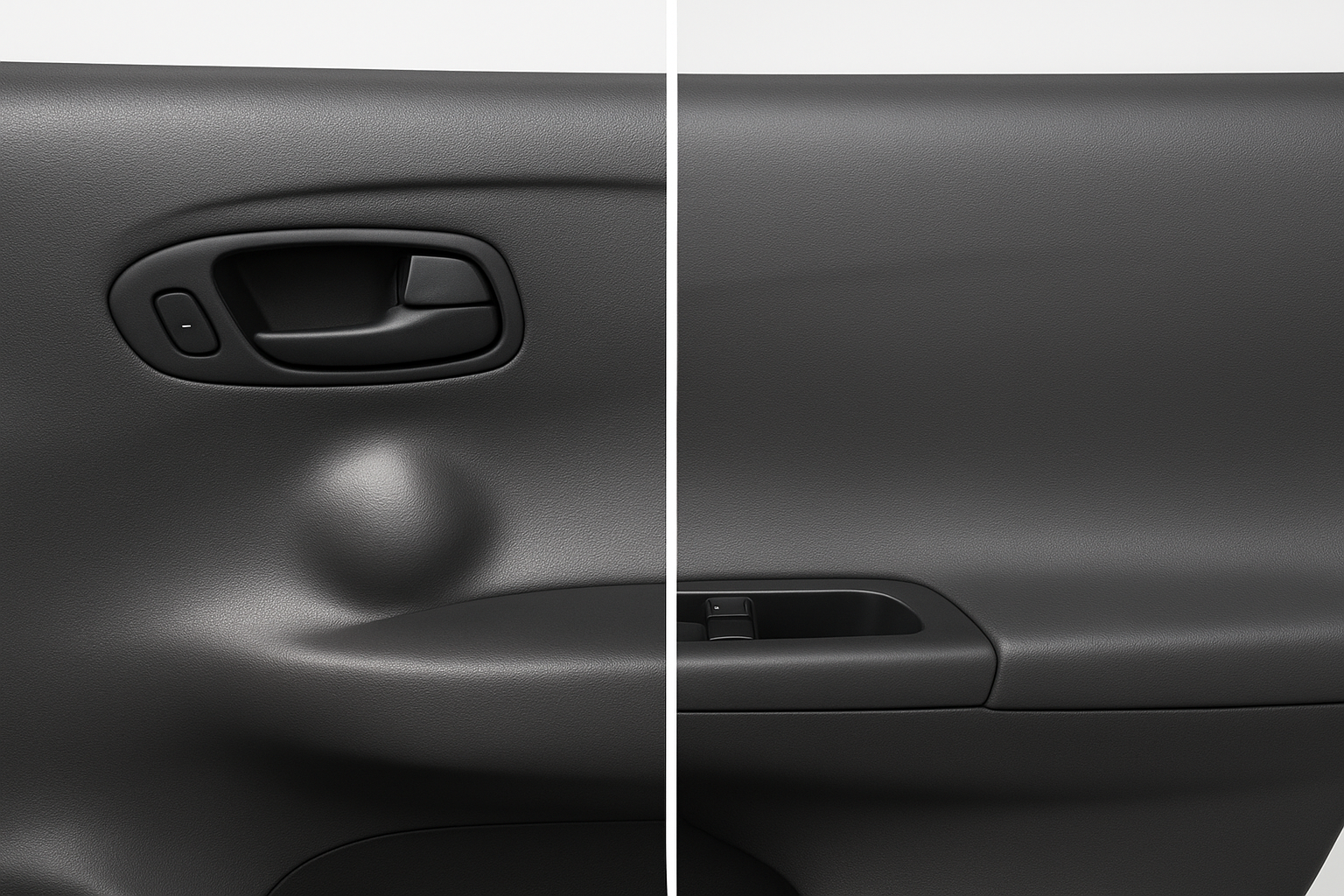
Paintless dent removal can produce factory-quality results for eligible dents when paint integrity is fully intact.
Mobile Auto Body Repair for Specific Damage Scenarios
Different damage situations call for different decisions. Here’s a scenario-by-scenario breakdown to help you decide whether mobile repair is appropriate for your situation:
Hail Damage
Mobile repair verdict: Usually appropriate. Hail creates numerous small, round dents — the ideal candidate for PDR. An experienced mobile technician can restore a hail-damaged vehicle to pre-storm condition in a single visit, often for significantly less than a traditional shop. However, if hailstones were large enough to crack paint or damage trim and glass, a full shop assessment is necessary first.
Door Dings
Mobile repair verdict: Strongly appropriate. Door dings from parking lots are the textbook use case for mobile PDR. They’re small, typically round, and rarely involve paint damage. This is exactly where mobile auto body repair shines.
Keyed or Deep Scratches
Mobile repair verdict: Limited; depends on depth. Surface scratches that haven’t reached the primer or metal can sometimes be polished out or touched up on-site. Scratches that have cut through to bare metal require proper feathering, priming, painting, and clearcoating — work that requires a shop environment for a quality result.
Fender Benders
Mobile repair verdict: Usually not appropriate. Even “minor” fender benders often involve more damage than is visible — misaligned panels, bent mounting brackets, hidden sensor damage, and paint cracking that requires blending. These situations call for a full shop assessment before any repair work begins.
Lease Return Prep
Mobile repair verdict: Appropriate for qualifying damage. Mobile PDR is widely used for lease-return preparation to address door dings and minor dents before the vehicle goes back to the dealer. Just be honest about the damage — attempting to mask paint damage or larger dents with mobile touch-up can result in rejection fees at turn-in.
Pre-Sale Vehicle Preparation
Mobile repair verdict: Appropriate for cosmetic improvement. Removing a few door dings before listing a vehicle for sale can meaningfully improve its perceived value. Mobile auto body repair is a cost-effective way to improve first impressions as long as the repairs are performed to a high standard.
Weather Conditions and Mobile Auto Body Repair
One practical limitation of mobile auto body repair that’s easy to overlook is weather dependency. Unlike a climate-controlled shop environment, mobile repairs happen wherever your vehicle is parked — which means ambient conditions directly affect repair quality.
- Temperature — Paint touch-up products and adhesives typically need temperatures between 50°F and 90°F to cure properly. Extreme cold slows or prevents proper curing; extreme heat can cause products to dry too quickly and produce uneven results.
- Humidity and rain — Moisture compromises paint adhesion. Mobile paint repairs should never be performed in rain or high humidity. PDR itself is less weather-sensitive, but paint correction work is not.
- Direct sunlight — Intense direct sunlight makes it harder to read the panel surface accurately during PDR, and can cause paint products to dry before they can be properly worked.
- Wind — Wind carries airborne dust and debris that can contaminate wet paint during touch-up repairs, leaving a gritty finish.
A reputable mobile technician will reschedule or decline to work if conditions are unsuitable. If a technician proceeds with paint work in clearly adverse conditions, that’s a red flag about their professionalism and the likely quality of the result.
When Mobile Repair Is Not Enough: Choosing a Certified Auto Body Shop
Certain vehicle damage situations make mobile repair not just inadequate — but potentially unsafe. Specifically, skip mobile auto body repair and go directly to a certified shop when:
- Your vehicle has been in a collision with another vehicle, a fixed object, or a structure
- There is any frame, unibody, or structural damage — even if it looks minor visually
- The paint damage extends across large panel areas that require blending or a full respray
- You need to file an insurance claim that requires documentation, parts invoicing, and certification
- The damage affects safety-critical systems — sensors, cameras, airbags, crumple zones, or ADAS components
- Panels are misaligned, gaps are uneven, or doors/hoods don’t close correctly
- The dent involves a high-line crease or a panel area that can’t be accessed from behind
According to the National Highway Traffic Safety Administration (NHTSA), improper vehicle restoration after damage can compromise structural integrity in subsequent collisions. A poorly repaired vehicle that looks cosmetically acceptable may fail to protect occupants properly in a future accident — a risk no amount of convenience savings is worth.
How to Choose a Certified Auto Body Shop
When your vehicle’s damage exceeds what mobile repair can handle, selecting the right certified shop is equally important. Look for:
- I-CAR Gold Class certification — the automotive industry’s highest shop-level training recognition
- OEM certifications from manufacturers like Honda, Toyota, or GM indicating the shop meets factory repair standards
- Modern frame measurement and pulling equipment to restore structural alignment
- A dedicated paint booth with temperature and humidity control for precision, dust-free repainting
- Computerized color matching systems for undetectable paint blending
- Written warranties on all repair work — especially paint
- Direct insurance billing and claims assistance to streamline the process for you
Drivers in Brea and Orange County can access all of these capabilities at Brea Auto Body, which handles everything from minor cosmetic repairs to full structural collision restoration. For area-specific options, explore car accident repair in Brea and car accident repair in Placentia, or learn more about choosing the right provider in our comprehensive guide on how to choose the best auto body shop near me. Body repairs guide
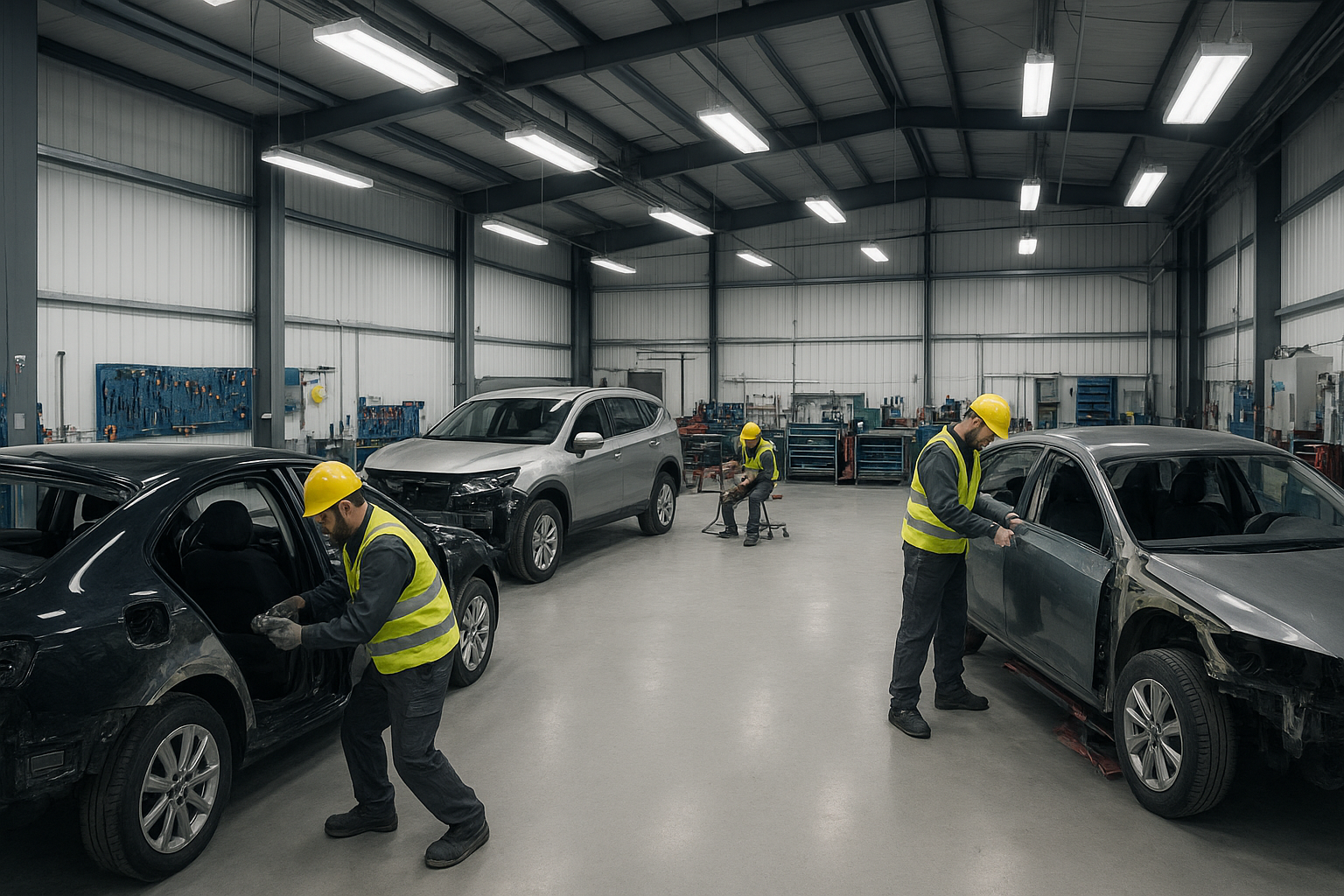
A certified auto body shop offers equipment, capabilities, and warranty coverage that no mobile service can replicate for complex damage.
Mobile Auto Body Repair: Pros and Cons at a Glance
? Advantages
- No drop-off required — technician comes to you
- Typically faster than shop turnaround for simple repairs
- Often less expensive for minor cosmetic work
- PDR preserves factory paint when done correctly
- Convenient for lease returns and pre-sale prep
- Excellent results for hail and door ding damage
? Limitations
- Cannot handle structural or frame damage
- No paint booth; touch-up quality varies significantly
- Weather-dependent for paint-related work
- Limited insurance claim support
- No ADAS or sensor calibration capability
- Warranty quality varies widely by technician
Frequently Asked Questions About Mobile Auto Body Repair
What is mobile auto body repair?
Mobile auto body repair is a service where a trained technician travels to your location — home, office, or parking lot — and performs cosmetic vehicle repairs on-site using portable professional equipment. The most common technique is paintless dent repair (PDR), which restores dents without disturbing the factory paint finish. It is best suited for minor cosmetic damage and is not a substitute for a full-service body shop when structural or collision damage is involved.
What types of damage can mobile auto body repair fix?
Mobile auto body repair works best on small dents with intact paint (PDR), door dings, hail damage, minor surface scratches and paint chips, light bumper scuffs, and windshield chip repair. It cannot address cracked or creased paint, frame damage, structural misalignment, full panel repaints, airbag repairs, or ADAS sensor calibration.
How much does mobile auto body repair cost?
Costs vary by damage type and location. A single small PDR dent typically runs $75–$175; larger dents cost $150–$400; hail damage can range from $500 to $3,000+ depending on severity. Surface scratch touch-ups run $150–$500 and windshield chip repair runs $50–$120. Always get a written estimate before authorizing work.
Is mobile auto body repair as good as shop repair?
For PDR-eligible dents — small, round dents with intact paint — a skilled mobile technician can achieve results equal to or better than a shop, while preserving the factory finish. For any damage requiring paint booth work, blending, filler, or structural repair, a full-service shop consistently produces superior, longer-lasting results.
How long does mobile auto body repair take?
Most mobile repairs are completed in one to three hours on-site. A simple door ding via PDR may take 30–60 minutes. Scratch touch-ups or paint chips can take longer if they require multiple product application steps with drying time between coats. Hail damage repairs involving many dents may take a full day.
Will my insurance cover mobile auto body repair?
Many comprehensive policies cover mobile auto body repair, particularly for hail damage. However, coverage depends on your deductible, your insurer’s approved provider network, and the type of damage. Some insurers require repairs at specific certified facilities. Always confirm coverage with your insurer before booking any repair.
Can mobile auto body repair be done in any weather?
PDR is relatively weather-tolerant, but paint touch-up and chip repair work requires dry conditions, temperatures between approximately 50°F and 90°F, and low humidity. Rain, wind, extreme heat, or cold can significantly affect paint adhesion and curing. A reputable technician will reschedule rather than risk a poor result.
What certifications should a mobile auto body technician have?
Look for technicians with I-CAR training, ASE certification, or membership in the National Paintless Dent Repair Association (NAPDRA). These credentials indicate formal technical training and adherence to industry standards. Always ask about certifications before booking, and verify that the technician carries liability insurance.
What are the limitations of mobile auto body repair?
Mobile auto body repair cannot address frame or structural damage, major collision repairs, cracked paint requiring body filler, full panel resprays, airbag or safety system repairs, or ADAS calibration. It is strictly a cosmetic service for minor, surface-level damage. Attempting to use mobile repair on damage that exceeds its scope can mask structural problems and compromise vehicle safety.
Is paintless dent repair the same as mobile auto body repair?
PDR is the most common technique used in mobile auto body repair, but the two terms are not interchangeable. Mobile repair can also include surface scratch touch-up, paint chip repair, bumper scuff repair, and windshield chip injection — services that go beyond what PDR covers.
When should I choose a full-service auto body shop over mobile repair?
Choose a certified full-service shop when your vehicle has collision damage, structural or frame issues, misaligned panels, cracked or large-area paint damage, a need for ADAS or airbag system repair, or when filing an insurance claim that requires documentation and parts certification. Mobile repair is the right choice only for minor, cosmetic-only damage with no structural implications.
Do mobile auto body technicians offer warranties?
Warranty policies vary significantly among mobile technicians. Reputable providers typically offer a limited written warranty on their workmanship. Always request warranty terms in writing before authorizing any repair. Understand exactly what the warranty covers, how long it lasts, and how to reach the technician if a problem develops after the repair.
How do I find a reputable mobile auto body repair technician near me?
Search Google Maps or Yelp for “mobile auto body repair” in your area and filter for providers with 4.3+ star ratings and at least 20–30 verified reviews. Check the BBB for complaint history. Ask about certifications, liability insurance, portfolio photos of previous work, and warranty terms. Alternatively, ask a trusted local certified body shop for a referral to a mobile technician they know and trust.
Conclusion: Is Mobile Auto Body Repair the Right Choice for Your Vehicle?
Mobile auto body repair is a genuinely valuable service for the right situations. When you have a door ding, a small hail-induced dent, a surface paint chip, or a minor bumper scuff with intact paint, a skilled mobile technician can deliver fast, professional, and cost-effective results without requiring you to leave your vehicle at a shop. For those specific scenarios, mobile repair earns its growing popularity.
But mobile repair has firm limits — and exceeding them doesn’t just produce poor cosmetic results, it can leave your vehicle structurally compromised and unsafe. Any time your damage involves a collision, structural components, large paint areas, safety systems, or an insurance claim, a certified full-service auto body shop is the only responsible choice.
For drivers in Brea and Orange County, Brea Auto Body provides the complete range — from precision cosmetic repairs to full structural collision restoration — backed by certified technicians, factory-grade paint matching, and comprehensive insurance claim support. When in doubt about whether your damage is a mobile job or a shop job, get a professional assessment first. The right answer protects both your vehicle and your safety. This article was prepared by the Brea Auto Body team; add an author bio and publish date on the page (see About page for credentials).

