

Electric Vehicle Body Repair: A 2026 Owner’s Guide to Safe, OEM?Correct EV Collision Repairs

Electric vehicle body repair starts with a controlled, high?voltage?aware environment.
Electric vehicle body repair requires more than a conventional collision fix when your EV has been in a fender bender—or something more serious. Complete collision repair guide Electric vehicle body repair demands high?voltage safety, specialized tooling, advanced materials knowledge, and rigorous diagnostics to restore safety systems and range. This guide explains what truly OEM?correct electric vehicle body repair looks like in 2026, so you can make an informed decision and get your EV back on the road with confidence.
Why electric vehicle body repair is different
Unlike ICE vehicles, EVs aren’t just gas cars without engines. Specifically, their battery architecture, high-voltage (HV) cabling, thermal management, and advanced driver-assistance systems (ADAS) change how collision repairs are planned and executed. Therefore, a qualified shop must understand:
- Safe power?down, isolation, and verification procedures for HV systems.
- Lightweight mixed?material construction (aluminum, ultra?high?strength steel, composites) that requires model?specific joining and corrosion control.
- ADAS sensor alignment, calibration targets, and software routines that restore safety functions post?repair.
- Battery handling, quarantine, and post?impact inspection criteria to prevent latent failures.
Skipping any of these layers can compromise occupant protection, degrade range, or leave critical safety features inoperative.
Safety first: isolating high voltage the right way
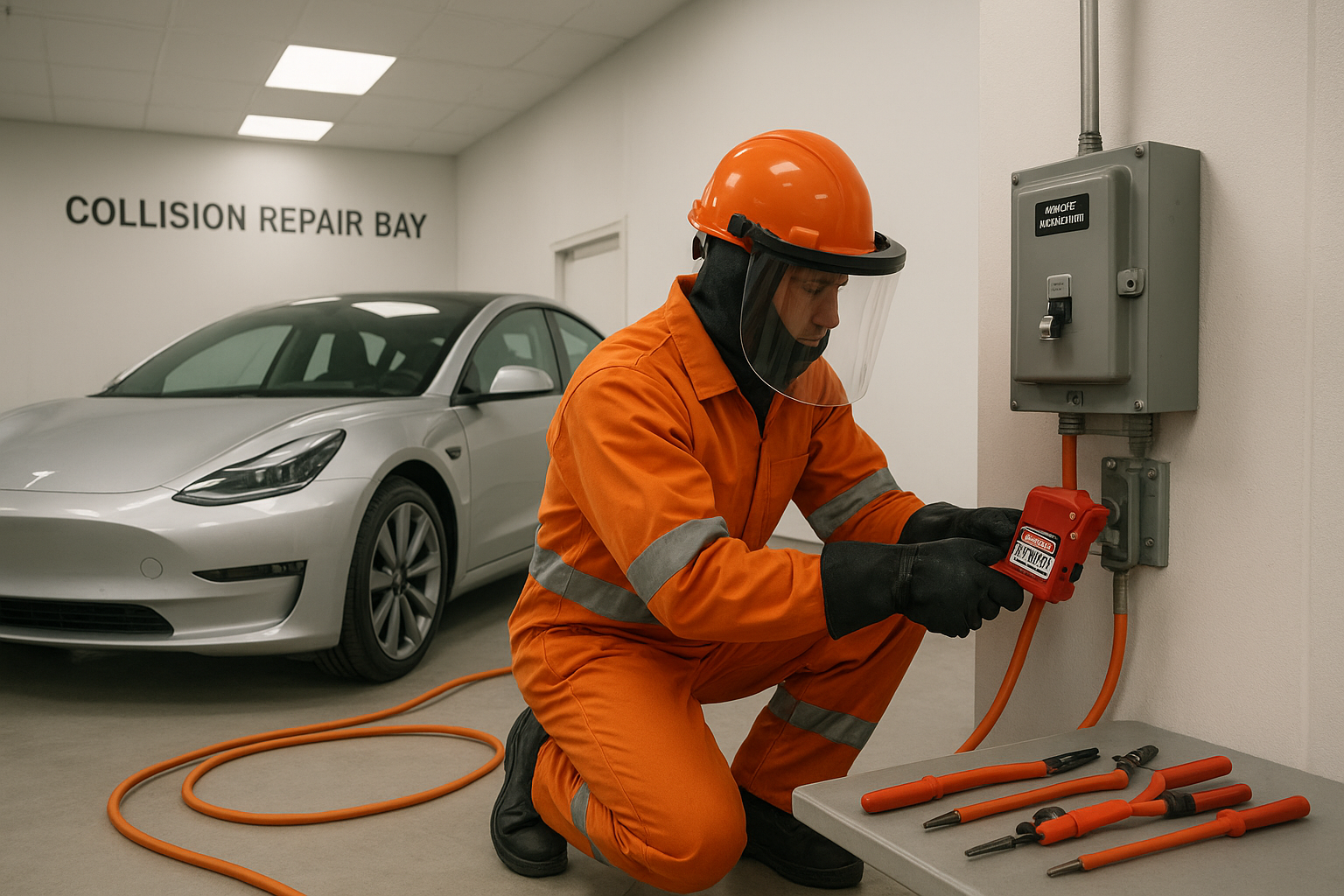
Before the first fastener is touched, a trained technician establishes a safe state. Typical steps include assessing state of charge, reviewing OEM repair information, performing a pre-scan to document fault codes, isolating the pack with the approved service disconnect, waiting the specified discharge interval, and confirming zero potential with a calibrated meter. The shop designates an HV quarantine area for suspect packs and keeps Class 0+ gloves, arc-rated PPE, and insulated tools on hand.

High?voltage isolation workflow that precedes any electric vehicle body repair.
These steps aren’t optional. They protect technicians and your vehicle, and they minimize the risk of thermal events during and after the repair. Ask prospective shops to walk you through their HV lockout/tagout process and show proof of current training.
Structure and materials: OEM procedures or nothing
Modern EVs blend aluminum, press?hardened steel, and structural adhesives to balance crash energy management and battery protection. Repairing these substrates isn’t guesswork. For example, Aluminum repair guide sectioning locations are tightly controlled; a single unauthorized cut through a martensitic reinforcement can weaken load paths. Likewise, the wrong joining method—riveting where adhesive?bonded rivets are specified, or welding aluminum without proper heat control—can introduce corrosion and reduce fatigue strength.
Insist that your collision center uses the latest OEM repair procedures for your exact VIN and follows material?correct techniques such as SPR/rivet?bonding, MIG brazing, or adhesive repairs where prescribed. Documentation matters: every panel replacement, adhesive cure, and torque value should be recorded in the file you receive at delivery.
Battery packs, thermal management, and post?impact decisions
Even minor impacts can transmit forces to the battery enclosure, coolant manifolds, and HV junctions. Signs like enclosure deformation, breached seals, or coolant odor require elevated scrutiny. In many cases, the safest route is pack replacement per OEM guidance, followed by leak checks and a post?repair battery health report. Logistics also matter—damaged packs are regulated for transport and storage; qualified facilities follow the correct containment, labeling, and shipment procedures.
A capable EV shop will also manage thermal pastes, gaskets, and torque patterns where battery chill plates intersect the body, and confirm firmware versions after service campaigns or module replacements.
Scanning, programming, and ADAS calibration
Because EVs integrate propulsion, braking, steering and safety sensing, diagnostics aren’t an afterthought. A complete repair includes pre- and post-scans, control unit programming, and precise calibration of cameras, radar, lidar, and ultrasonic sensors.

ADAS calibration and software validation ensure safety systems perform after EV body repairs.
Shops may perform calibrations in?house or partner with mobile specialists; either way, you should receive printouts or digital reports that show calibration status, alignment specs, and any firmware updates applied.
Refinish and energy management with EVs
Paint booths, bake cycles, and heat?soak times can impact battery and interior component temperatures. An EV?savvy refinish plan controls bake profiles, monitors temperatures, and removes sensitive modules when necessary. Many centers also employ low?VOC coatings and energy?efficient booth cycles to reduce environmental impact without sacrificing OEM finish quality.
Transparent estimating for EV collision repairs
Expect an estimate that clearly itemizes HV isolation time, scan/calibration operations, material?correct repairs, corrosion protection, seam sealing, and test?drive procedures. 2026 repair cost guide EV parts sourcing and lead times can differ from ICE models; your shop should set realistic expectations and provide proactive status updates.
How to choose an EV?capable collision center
The right facility combines training, equipment, and process control. As you evaluate options, look for tangible proof:
- Current technician training focused on EV safety and OEM procedures (for example, I?CAR EV?focused courses and OEM program certificates).
- Insulated tools, Class 0+ gloves, dielectric testing schedules, and documented lockout/tagout.
- Dedicated aluminum and clean workspaces to prevent cross?contamination; proper fume extraction.
- On?site or verified partner capability for ADAS calibrations with proper targets and floor space.
- VIN?specific OEM repair information access and repair file documentation provided at delivery.
- Battery handling policy, quarantine area, and compliant transport procedures for damaged packs.
If you want a proven partner, consider the EV body repair specialists at Brea Auto Body. Their focus on OEM?correct methods, safety, and documentation helps ensure your vehicle’s structural integrity, range, and driver?assist features are fully restored.

A purpose?built bay signals that the shop is ready for electric vehicle body repair from intake to calibration.
Want to learn more about what an EV?capable shop provides and book an estimate? Visit Brea Auto Body for electric vehicle body repair and get expert guidance tailored to your make and model.
What you’ll receive at delivery—beyond great panel gaps
At the end of an OEM?correct repair, the paperwork should be as confidence?inspiring as the paint finish. Look for a package that includes pre/post scan reports, calibration confirmations, alignment results, photos of critical repair stages, adhesive batch and cure logs (where applicable), corrosion?protection records, and a detailed invoice. This documentation can help preserve vehicle value, support warranty compatibility, and simplify future service.
The bottom line
EVs elevate the standard for collision repair. From high?voltage isolation to material?correct structural work and precise ADAS calibration, every step must meet or exceed OEM expectations. Choosing a shop that treats electric vehicle body repair as a disciplined process—not a set of shortcuts—protects your safety, range, and resale value.
Ready to put your EV in qualified hands? Schedule your electric vehicle body repair with Brea Auto Body and drive away with factory?level confidence.

