

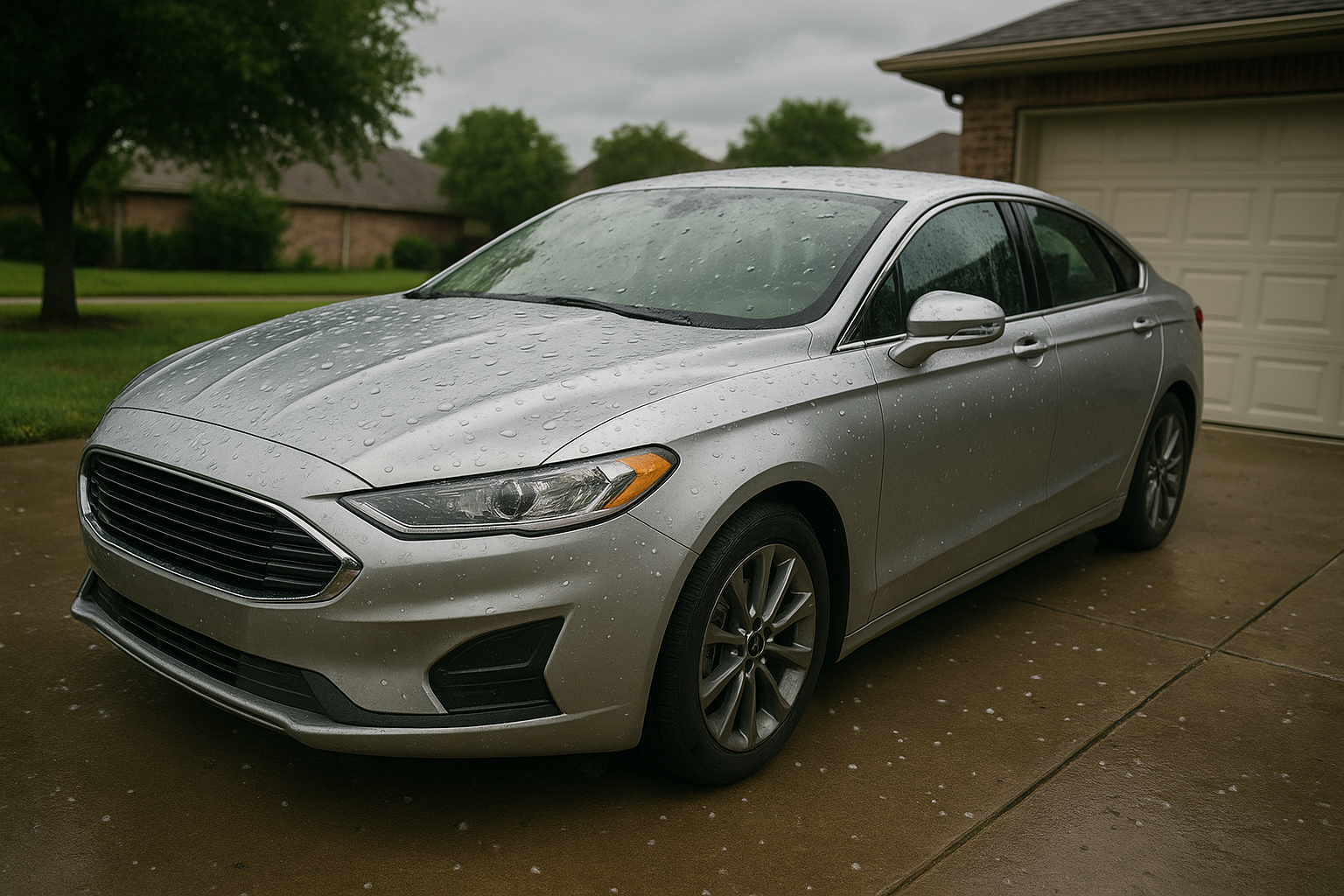
Hail Damage Repair: The Complete 2026 Driver’s Guide

A visual look at the aftermath before hail damage repair begins.
If your vehicle was caught in a storm, you need fast, reliable hail damage repair — and you need the right information before you hand over your keys. This guide covers everything: what qualifies as hail damage, how PDR compares to conventional bodywork, realistic 2026 cost ranges, how insurance claims work step by step, how long repairs take, and exactly what to look for when you pick your car up. Whether you’re in Plano, DFW, or anywhere storms roll through, this is the guide that answers every question.
What Counts as Hail Damage — and Why the Diagnosis Matters
Hail damage typically shows up as dozens — sometimes hundreds — of shallow dents scattered across horizontal panels: the roof, hood, trunk lid, roof rails, and the tops of doors and quarter panels. What makes hail uniquely complicated is that no two storms produce the same impact pattern. Variables that shape the outcome include:
- Hail size: Pea-sized hail (¼ inch) may leave barely visible dimples; quarter-sized (1 inch) or golf-ball-sized (1¾ inch) hail can crease metal and shatter glass. See the NWS hail size chart for reference.
- Wind angle and speed: Wind-driven hail hits vertical surfaces like doors and fenders — panels often overlooked in a quick visual scan.
- Panel material: Aluminum panels (common on hoods and tailgates) require different tool pressure and technique than steel.
- Paint condition: Pre-existing chips, UV damage, or thin factory clearcoat make cracking more likely during impact.
- Dent profile: A rounded, smooth dent is a PDR candidate. A sharp crease or torn metal edge is not.
Diagnosing hail damage correctly matters because it determines the entire repair path. A rushed or incomplete inspection — the kind done in a parking lot with no reflector board — can leave dozens of dents unmapped, leading to short estimates, underpaid insurance claims, and a vehicle that never looks right. A thorough hail damage assessment is the foundation of every good repair.
Hail Damage Repair Methods: PDR vs. Conventional Bodywork — Explained in Full
The two main approaches to hail damage repair serve different damage profiles. Understanding both helps you evaluate estimates and choose the method that protects your vehicle’s value.
Paintless Dent Repair (PDR): The Preferred Method for Most Hail
Paintless dent repair (PDR) is the industry standard for hail repair when paint is intact and dents are shallow and rounded. Technicians gain access behind each panel — through existing openings, by temporarily removing interior trim or lights — and use precision metal rods, pivot tools, and glue-pulling systems to massage dents out from behind. No filler, no sanding, no repainting.
PDR preserves your factory OEM paint, which is typically thicker and more durable than any refinished coat. It also avoids any future paint matching issues and keeps the vehicle’s originality intact — important for resale and for maintaining manufacturer warranties on the finish.
PDR Works Best When:
- Dents are smooth, rounded, and shallow — no sharp edges or creases
- Paint is fully intact — no chips, cracks, or flaking clearcoat
- Metal has not been excessively stretched or thinned
- Backside panel access exists via existing openings or with minor trim removal
- You want to preserve OEM paint and maximize resale value
Conventional Hail Damage Repair: When Repainting Is Unavoidable
When hail has cracked or chipped the paint, sharply creased the metal, or caused structural damage, conventional repair takes over. This process typically involves controlled pulling to reshape the panel, minimal application of premium body filler where needed, primer-surfacer layers, color-matched paint application, and clearcoat blending into adjacent panels for a seamless appearance.
In severe cases — especially with modern aluminum-intensive vehicles — a panel may be beyond economical repair and requires replacement, followed by full color match and blend. Modern paint mixing technology and skilled refinishing technicians can achieve factory-equivalent results, but the process takes longer and costs more than PDR alone.
Conventional Repair Is Needed When:
- Paint is chipped, cracked, or has lifted clearcoat from impact
- Dents are sharp, creased, or have torn the metal surface
- Aluminum panels are severely stretched beyond PDR correction limits
- Limited or no backside access exists on the damaged panel
- Panel damage requires full replacement (roof skin, hood, trunk lid)
- Glass, sensors, or structural components are also compromised

PDR vs. conventional hail damage repair — side-by-side comparison.
Glue Pull PDR: The Exterior-Access Technique
A specialized PDR variant worth knowing: glue pull repair uses heated adhesive tabs bonded to the outer surface of a dent. A slide hammer or pulling bridge lifts the metal from the exterior, which is ideal when backside panel access is limited or when removing interior trim would cause excessive disruption. Glue pull is commonly combined with traditional rod work for high-density hail fields on panels like the roof.
Hail Damage Repair Cost in 2026: Real Numbers by Damage Severity
Cost is one of the first questions drivers ask — and the honest answer is that hail damage repair costs vary widely based on multiple factors. Here’s what drives your final estimate:
- Dent count and size: A shop estimator using a reflector board and PDR mapping software can count dents panel by panel. More dents = more labor hours.
- Number of affected panels: Roof, hood, trunk, four doors, two quarter panels — each adds cost independently.
- Material: Aluminum panels require specialized PDR tools and more time than steel.
- R&I (Remove & Install): Trim, moldings, headliners, and light assemblies that must be removed for access are charged separately.
- Glass damage: Chipped or shattered windshields, sunroofs, rear glass, and side windows are billed at parts + labor.
- ADAS sensor recalibration: Vehicles with radar, cameras, or parking sensors in damaged panels require documented calibration after repair — a significant cost on newer vehicles.
- Shop labor rate and region: Metropolitan markets like DFW carry higher labor rates than rural areas.
If you carry comprehensive auto insurance, hail is a covered peril under virtually all U.S. policies. Your out-of-pocket expense is limited to your deductible — the insurer covers the approved estimate balance, plus any documented supplements. If your deductible is $500 and the approved repair is $4,200, you pay $500.
How to File a Hail Damage Insurance Claim: Step-by-Step
Navigating the insurance process doesn’t have to be stressful. Follow these steps to protect your claim and get the maximum approved amount for your hail damage repair.
-
Step 1: Document Every Inch of Damage
Photograph all panels in indirect natural light — overcast skies or shaded areas reveal dents better than direct sunlight. Take wide shots for context and close-ups showing individual dents, chipped paint, and cracked glass. Include your license plate in at least one photo to timestamp and ID the vehicle. Video walk-arounds are even better for showing scale and coverage. -
Step 2: Report the Claim Promptly
Contact your insurance company or file online as soon as possible. Provide the exact date, time, and location of the storm event. Your insurer will assign a claim number and let you know whether they want a drive-in estimate, a mobile adjuster inspection, or a direct-to-shop repair with their preferred network. -
Step 3: Know Your Right to Choose Your Shop
In almost every U.S. state, you have the legal right to choose your own repair facility — the insurer cannot force you to use their “preferred” shop. Choose a shop with certified PDR technicians, documented quality control, and experience handling insurance work. Your shop choice is one of the most important decisions in this process. -
Step 4: Get a Thorough, Blueprinted Estimate
A legitimate hail damage estimate involves a reflector board or specialized PDR mapping light, panel-by-panel dent counting, R&I item identification, glass inspection, and ADAS component review. Avoid shops that provide verbal or “eyeball” estimates without documentation. A thorough written estimate is both your repair roadmap and your insurance claim foundation. -
Step 5: Understand the Supplement Process
Hail damage often hides under trim, rails, and structural braces. As technicians disassemble your vehicle, they will discover additional dents and damage not visible during the initial estimate. Your shop submits these as supplements directly to your insurer for approval. A professional shop manages this process on your behalf — you shouldn’t have to fight for items that were genuinely hidden. -
Step 6: Review the Final Approved Estimate
Once your insurer approves the estimate (and any supplements), review it with your shop advisor. Confirm all affected panels are included, all R&I items are accounted for, and any glass, sensor, or calibration work is documented. This is also the time to confirm a rental vehicle arrangement if your policy includes rental reimbursement coverage. -
Step 7: Authorize Repairs and Confirm Completion
Sign the repair authorization and schedule your drop-off. Before driving away at pickup, conduct a thorough inspection using the quality checklist later in this guide. Your shop should walk you through the completed work, and all calibrations should be documented on the final invoice.
For a local, customer-first repair experience, schedule your hail damage repair inspection with Brea Auto Body to get a blueprinted estimate and understand your full options before committing.
How Long Does Hail Damage Repair Take? Realistic Timelines
Timeline is one of the biggest concerns drivers have — especially when they need their vehicle for work or family. Here’s an honest breakdown of what to expect from hail damage repair turnaround:
Light Damage (PDR Only): 1 – 3 Business Days
One or two panels with small, shallow dents repaired entirely via PDR. No paint, no parts orders. Fastest turnaround, especially if scheduled promptly before post-storm backlogs build.
Moderate Damage (Multiple Panels, Some Blending): 1 – 2 Weeks
Roof, hood, trunk, and doors with PDR plus some conventional blending or glass replacement. Parts may need to be ordered. Insurance supplement cycle can add a few days if not pre-managed.
Severe Damage (Full Vehicle, Paint, Glass, ADAS): 3 – 5 Weeks
Panel replacements, full repaint, windshield replacement, sunroof repair, plus ADAS camera and radar calibration. Paint curing time alone requires 24–48 hours minimum. Structural parts can have long lead times on newer models.
Post-Storm Peak Season Delay: Add 1 – 2 Weeks
After a regional hail event, every local shop fills up quickly. Filing your claim immediately and scheduling your estimate within 24–48 hours of the storm can save you from 2–3 week scheduling delays.
Ask your shop advisor to walk you through the specific timeline before you authorize repairs — and confirm what happens if additional damage is found during disassembly. A transparent shop provides written timelines and proactive communication throughout.
ADAS, Sensors, and Glass: The Modern Hail Damage Complexity
Vehicles manufactured in the last five to eight years introduce a layer of complexity that wasn’t part of hail repair even a decade ago: Advanced Driver Assistance Systems (ADAS). Cameras, radar sensors, lidar units, and ultrasonic parking sensors are often mounted in or near panels most frequently struck by hail — the roof, hood, bumper covers, and windshield.
When hail damages these areas or when repairs require removing and reinstalling components nearby, ADAS calibration becomes mandatory. Uncalibrated systems can cause:
- Lane departure warnings that trigger falsely — or fail to trigger when they should
- Adaptive cruise control that doesn’t detect vehicles at the correct distance
- Automatic emergency braking with incorrect sensitivity thresholds
- Blind spot monitoring that is blind to the wrong spots
Calibration must be performed by a technician with OEM-approved equipment in a controlled environment. Always confirm that calibration is included in your repair estimate and that you receive documented proof of completed calibration on the final invoice. This documentation also matters for future resale and for any warranty claims related to safety systems.
Windshield replacement after hail also triggers mandatory forward-camera recalibration on most vehicles equipped with front collision warning or lane-keeping assist. Never skip this step to save money — the liability risk far outweighs the calibration cost.
Before and After: What Great Hail Damage Repair Looks Like

Before-and-after hail damage repair using PDR — factory paint preserved.
When hail damage repair is done correctly, the results should be indistinguishable from a factory-new panel. Here’s what a quality result looks like — and how to verify it before you drive away.
Quality Inspection Checklist: What to Check Before You Drive Away
Never accept your vehicle back without conducting a proper inspection. Use these checkpoints — ideally inside a well-lit shop or under an overcast sky — to confirm the repair meets professional standards:
- Reflection test: Stand back and view each repaired panel under fluorescent shop lights or a straight line of light outside. Reflections should be perfectly straight and consistent — any ripple, wave, or distortion indicates remaining dents or metal that was over-worked.
- Paint consistency: If any panels were refinished, the gloss level, orange peel texture, and color match should be seamless next to adjacent original panels. Step back 10 feet and look for any color variation in different lighting angles (metamerism check).
- Panel gaps and alignment: Hood, trunk, doors, and quarter panels should have even, symmetrical gaps. Any misalignment suggests improper reassembly or an issue discovered during repair that wasn’t disclosed.
- Interior cleanliness: If headliner, pillars, or trim were removed for PDR access, they should be reinstalled cleanly with no marks, sagging, or loose clips. Check that no interior rattles develop on your drive home.
- All glass intact and sealed: Replaced windshields should have no bubbles along the seal edge. Side windows should open and close smoothly. Rear glass defrost lines should be intact.
- Sensor and electronics function: Test backup cameras, parking sensors, and any dash warning lights before leaving the parking lot. Confirm ADAS calibration documentation is on your invoice.
- Written warranty: Ask for the shop’s warranty terms in writing. Reputable PDR shops typically warrant their work against further dent movement; body shops warrant paint and refinish work. Know exactly what’s covered and for how long.
When Hail Damage Repair Isn’t Worth It: Total Loss Scenarios
Sometimes the honest answer is that repair isn’t the right financial path. Insurance companies calculate a vehicle’s actual cash value (ACV) — what it was worth the day before the storm — and compare that to the cost of repair. If repair costs reach a threshold (typically 70–80% of ACV, varying by state), the insurer may declare a total loss.
This is more common with:
- Older vehicles with low ACV and widespread hail damage
- Vehicles with significant pre-existing damage that reduced ACV before the storm
- High-trim or aluminum-intensive vehicles where repair costs escalate quickly
- Events with severe hail plus simultaneous flood or wind damage
If total loss is declared, you can negotiate the ACV with your insurer using comparable vehicle listings in your market. You may also have the option to retain the vehicle as a “salvage” title vehicle and accept a reduced settlement — though this significantly impacts future resale and financing options.
A reputable shop will provide a transparent estimate, communicate with your adjuster proactively, and help you understand whether repair, negotiation, or settlement serves your interests best — without pushing you toward a repair just to generate revenue.
How to Spot a Reputable Hail Damage Repair Shop — and Avoid the Bad Ones
After every major hail event, especially in storm-prone regions like DFW and North Texas, storm chasers — temporary pop-up repair operations — follow the hail path. They set up in parking lots, offer quick cash deals or “insurance handling,” and often disappear before the work quality can be evaluated. Here’s how to protect yourself:
Green Flags — Signs of a Trustworthy Shop
- Established physical location with verifiable address, website, and reviews spanning multiple years
- Certified technicians — look for ASE certifications, manufacturer training credentials, or PDR industry certifications
- Written estimates with itemized line items — not vague lump sums
- Clear communication on timeline, supplement process, and payment expectations
- Documented warranty on all repair work provided in writing
- Willingness to walk you through before/after photos of your specific vehicle
Red Flags — Walk Away From These
- No physical address or shop location — operating from a hotel parking lot or tent
- Offers to “waive your deductible” — this is insurance fraud in most states
- Pressure to sign authorization immediately without a written estimate
- No references, no Google reviews, or a brand-new business profile created days after the storm
- Inability to explain what specific repair method will be used on each panel
- Demanding a large deposit before work begins without a documented scope of repairs
Does Hail Damage Repair Affect Resale Value?
This is one of the most underasked questions in the hail repair process. The answer depends entirely on how the damage was repaired and whether it appears on the vehicle history.
PDR done correctly leaves zero paint record: Because the factory paint is preserved, no refinishing appears on paint thickness readings and no body work appears on Carfax or AutoCheck unless the insurance claim was reported. The vehicle’s value impact is minimal when PDR restores panels to factory condition.
Conventional repair with repainting does affect resale: Any refinished panel will show different paint thickness readings under a paint meter — a tool used by car dealers and savvy private buyers. A disclosed, professionally executed repaint has less impact than undisclosed, poor-quality work discovered at inspection.
Unrepaired hail damage is the biggest value killer: Deferred hail damage is visible on a used car inspection, shows up in used vehicle pricing guides as a deduction, and signals to buyers that maintenance was neglected. Repairing hail damage — especially with quality PDR — consistently recovers more value than the repair costs.
Frequently Asked Questions About Hail Damage Repair
Does comprehensive insurance cover hail damage repair?
Yes. Hail is a covered peril under comprehensive auto insurance in the United States. If you carry comprehensive coverage, your insurer pays the approved repair cost minus your deductible. If you only carry liability coverage, hail damage is not covered and repair is out of pocket.
Will filing a hail damage claim raise my insurance rates?
Generally, comprehensive claims (including hail) are considered “not-at-fault” events and have less rate impact than collision claims. However, policies and state regulations vary. Ask your agent before filing, especially if your deductible is close to the repair cost — in some cases, paying out of pocket for minor hail damage repair is the smarter financial move.
Can I drive my car with hail damage before getting repairs?
In most cases, yes — hail dents without cracked paint or broken glass don’t create an immediate safety hazard. However, cracked glass, damaged windshield wipers, and non-functioning safety sensors should be addressed before driving. Also, prolonged exposure of chipped paint areas to moisture can accelerate rust, so prompt repair is always recommended.
How do I know if my hail damage repair is complete and correct?
Use the quality inspection checklist in this guide: check panel reflections under straight light for distortion, inspect paint match and texture if refinishing was done, verify all trim and interior components are reinstalled correctly, test all sensors and cameras, and confirm ADAS calibration documentation is on your invoice.
What is the difference between PDR and traditional hail damage repair?
PDR (paintless dent repair) uses specialized metal rods and glue-pull systems to massage dents from behind a panel without disturbing the factory paint. Traditional repair involves sanding, body filler, primer, painting, and clearcoat. PDR is preferred when paint is intact; conventional repair is necessary when paint is damaged or metal is creased beyond PDR correction limits.
How long does hail damage repair take from start to finish?
Light PDR-only repairs take 1–3 business days. Moderate multi-panel repairs with some conventional work take 1–2 weeks. Severe hail with panel replacement, repainting, glass, and ADAS calibration can take 3–5 weeks. Post-storm scheduling backlogs can add additional time if you delay filing your claim.
Do I need to use the insurance company’s preferred shop for hail repair?
No. In nearly all U.S. states, you have the legal right to choose your own repair facility. Your insurer may recommend or prefer certain shops, but they cannot legally require you to use them. Choose a shop you trust based on reviews, certifications, and their estimate process — not the insurer’s convenience.
Your Next Step: Get an Expert Hail Damage Assessment
After any hail event, time matters. The longer you wait to document, file, and schedule — the longer the post-storm backlog, the longer you go without a proper repair, and the more risk of paint deterioration at any chipped or cracked spots. The right path forward starts with a thorough, no-pressure estimate from a shop that will blueprint your vehicle properly and advocate for a fair insurance settlement.
If you’re ready to move forward, our team is ready to help. Schedule your hail damage repair inspection with Brea Auto Body — get a panel-by-panel estimate, understand your insurance options, and lock in your repair slot before the post-storm rush fills the calendar.
Ready for a Professional Hail Damage Assessment?
PDR specialists. Transparent estimates. Proven results. We handle the insurance so you don’t have to.

