


Body shop pay plans are the compensation structures that decide how every member of a collision repair team — technicians, painters, estimators, and even managers — actually gets paid, and getting them right is one of the single biggest factors in shop profitability, staff retention, and repair quality. Whether you own a shop and are asking yourself how you should pay your team, or you are a technician sizing up a job offer, this guide gives you a far more complete answer than a quick industry Q&A ever could.
According to the U.S. Bureau of Labor Statistics, the median annual wage for automotive body and related repairers was approximately $49,610 as of 2023. However, actual take-home pay swings wildly depending on which pay plan a shop uses. Below, we break down every major structure — flat rate, hourly, hybrid, commission, and salary — plus the legal, cultural, and performance factors that determine which one is right for your shop.
What Are Body Shop Pay Plans?
Body shop pay plans are formal compensation agreements between a collision repair facility and the people who work there. Specifically, they define how wages are calculated — whether based on time worked, jobs completed, gross profit generated, or some combination of all three. Most shops rely on one of five primary models: flat rate, hourly, hybrid, commission-based, or straight salary.
Each model carries real trade-offs. Therefore, choosing the right plan requires understanding your shop’s volume, the skill level of your team, your local labor market, and the role each person plays. For a broader look at how compensation connects to daily operations, the complete guide to auto body repair on breaautobody.com covers the full repair process from intake to delivery. For a deeper walkthrough, see our Body Shop Near Me: A Complete, Local-Friendly Guide to Collision Repair You Can .

Understanding body shop pay plans helps technicians and shop owners align compensation with productivity goals.
The Flat Rate Pay Plan Explained
The flat rate system is the most widely used pay structure in the collision repair industry. Under this model, technicians are paid a set dollar amount per “flag hour” — a unit representing one book hour of labor assigned to a specific repair task. These book hours come from industry-standard labor time guides such as Mitchell, CCC, or Audatex, which assign predetermined time values to each repair operation.
For example, if a bumper replacement is assigned 3.0 book hours and a technician’s flat rate is $25 per flag hour, they earn $75 for that job — regardless of whether it took them two hours or four hours to complete. Consequently, fast and experienced technicians can earn significantly more than the posted rate, while slower technicians may earn less.
Advantages and Disadvantages of Flat Rate
Advantages:
- Rewards skilled, efficient technicians with higher earning potential
- Aligns technician incentives with shop throughput goals
- Predictable labor costs for shop owners when estimating jobs
Disadvantages:
- Income can drop sharply during slow periods with fewer available jobs
- May pressure technicians to rush, potentially affecting repair quality
- Less attractive to entry-level technicians who need income stability
Hourly Compensation in Collision Repair Shops
Hourly pay is straightforward: technicians earn a fixed rate for every hour they are on the clock, regardless of how many flag hours they produce. This model is common in dealership body shops and smaller independent facilities where work volume is less predictable.
In addition, hourly pay is often preferred for apprentice technicians who are still developing speed and confidence. It removes the financial pressure of flat rate and allows them to focus on learning correct procedures. However, it can reduce urgency among experienced technicians who have less financial incentive to maximize output.
Furthermore, shop owners must be careful with hourly pay because labor costs remain fixed even when production slows. This can squeeze profit margins during lower-volume months. As a result, many shops that start with hourly pay eventually transition to a hybrid or flat rate model as their volume grows.
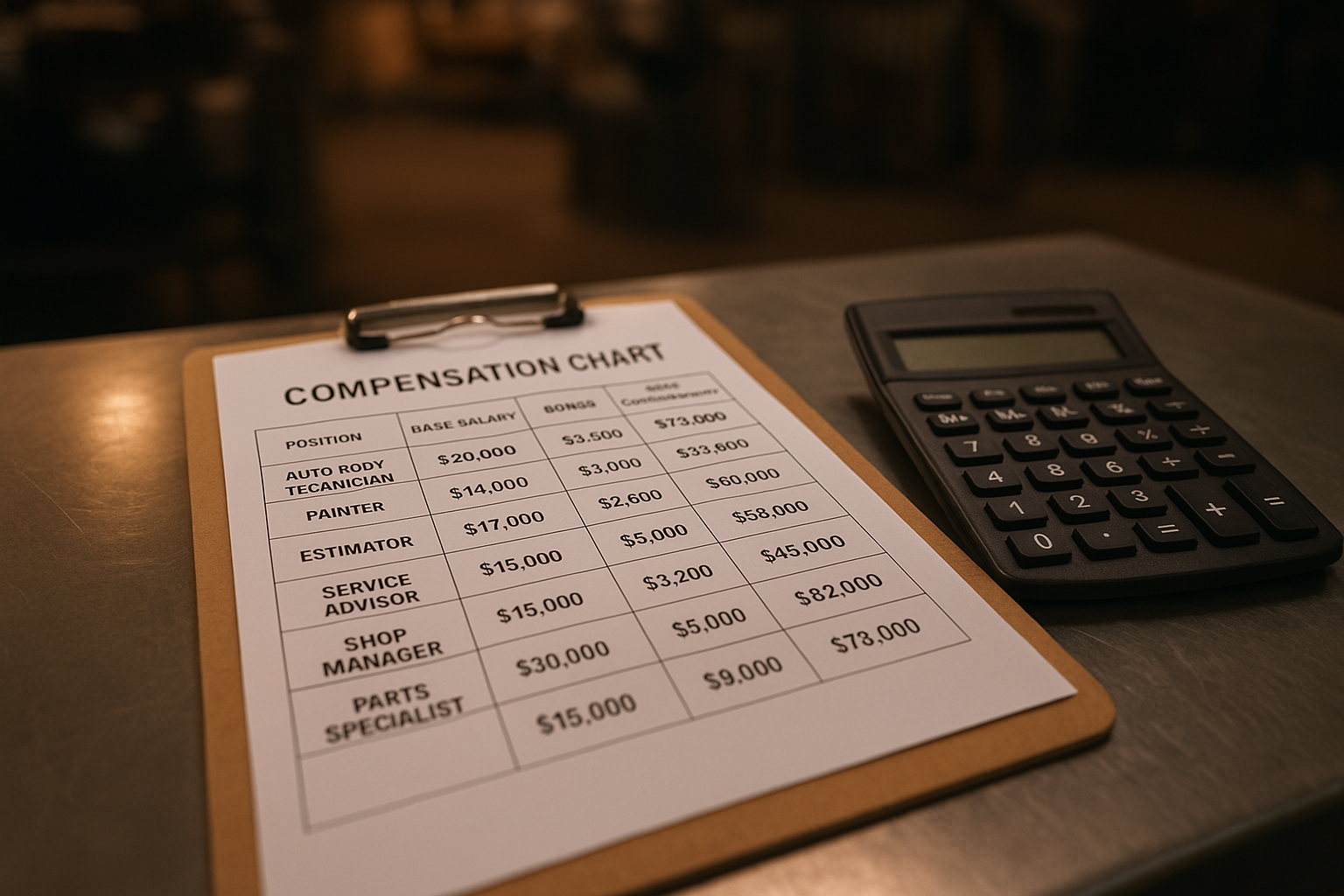
Comparing pay plan structures side by side helps shop owners make data-driven compensation decisions. See repair price comparison.
How Hybrid Pay Plans Balance Income and Performance
A hybrid pay plan combines the best features of both flat rate and hourly compensation. Specifically, technicians receive a guaranteed base hourly wage — ensuring income stability — plus additional bonus pay when their flat rate flag hour production exceeds a defined threshold. This structure is increasingly popular among high-performing shops seeking to retain top talent while maintaining accountability.
For instance, a technician might earn $20 per hour as a base, but receive an additional $8 per flag hour for every hour produced above 40 per week. Therefore, a highly productive technician can significantly boost their weekly take-home pay, while a technician going through a slower period still has a safety net.
Why Hybrid Plans Attract Experienced Technicians
Experienced technicians often prefer hybrid plans because they offer both security and upside. Similarly, shop owners benefit because the plan naturally filters for productive workers — those who consistently exceed thresholds earn more, while those who underperform are flagged early. According to I-CAR, technician training and compensation are two of the most significant factors in long-term shop performance and customer satisfaction.
For shops handling insurance claims, understanding compensation structures is closely tied to workflow efficiency. You can explore how insurance work affects shop operations in this detailed resource on choosing the best body shop for insurance claims.
Commission and Gross-Profit Pay Plans
Beyond flat rate, hourly, and hybrid structures, some shops — particularly high-volume or multi-location operations — use commission-based body shop pay plans, tying earnings to a percentage of the gross profit generated on each repair order. This model is less common for technicians but frequently used for estimators and service advisors who directly influence how a job is sold and priced.
Under a typical gross-profit plan, an estimator might earn a small base salary plus 3-5% of the gross profit on every repair order they write. As a result, this structure rewards accurate estimating, upselling appropriate services, and minimizing supplement requests — all of which improve cycle time and customer experience simultaneously.
However, commission plans require careful guardrails. Specifically, shops must ensure commission incentives never encourage unnecessary repairs or inflated estimates, since this can damage both customer trust and insurer relationships over time.
Salary-Based Pay Plans for Managers and Support Staff
Not every role in a collision repair shop fits neatly into flag hours or gross profit percentages. Shop managers, office administrators, and parts coordinators typically work under straight salary or salary-plus-bonus body shop pay plans instead. This provides predictable income for roles where output cannot be measured in book hours.
In particular, a well-designed manager pay plan often includes a base salary plus quarterly bonuses tied to shop-wide KPIs such as overall gross profit, average cycle time, and customer satisfaction index (CSI) scores. Consequently, managers stay focused on the metrics that matter most to long-term shop health rather than just short-term production numbers.
Pay Plans for Your Whole Team: Painters, Estimators, and Detailers
A common mistake shop owners make is designing one pay plan and applying it to everyone. In reality, each role in the shop contributes differently to revenue, so body shop pay plans should reflect those differences.
- Painters are usually paid flat rate per flag hour as well, though many shops add quality bonuses tied to zero comebacks and consistent color-match accuracy.
- Estimators often work under salary-plus-commission or gross-profit plans, since their primary value lies in accurate, fair pricing rather than physical repair speed.
- Detailers and support staff are typically hourly, since their tasks are steady and less variable in scope from job to job.
Paint and structural repair work also plays a role in how jobs are flagged and compensated. For a deeper understanding of how paint services factor into the overall repair process and cost, see this guide on auto body paint job processes, color matching, and quality.
Pay Plan Comparison At a Glance
| Pay Plan | Best For | Income Stability | Upside Potential |
|---|---|---|---|
| Flat Rate | Experienced, fast technicians | Low | High |
| Hourly | Apprentices, low-volume shops | High | Low |
| Hybrid | Retaining skilled technicians | Medium-High | Medium-High |
| Commission / Gross-Profit | Estimators, service advisors | Medium | Medium-High |
| Salary | Managers, admin staff | High | Low-Medium |
How to Choose the Right Pay Plan for Your Shop
Selecting the right body shop pay plan requires a structured approach. Follow these steps to build a compensation system that works for both your team and your bottom line:
- Assess Your Shop’s Volume and Workflow. Review your monthly car count, average repair order value, and technician throughput. High-volume shops generally benefit most from flat rate or hybrid plans because the steady flow of jobs keeps technicians productive and earning. Consider commercial customers and fleet work — see our fleet repair guide.
- Benchmark Local Market Rates. Research what competing body shops in your area pay per flag hour or per hour. In markets like Orange County, California, where cost of living is high, competitive pay is critical for attracting certified technicians. See local free estimates to compare market pricing.
- Define Quality and Performance Metrics. Establish measurable benchmarks — such as cycle time, comeback rate, and customer satisfaction scores — and tie bonus pay to these indicators. This approach balances speed with quality and should align with your shop's payment plans and compensation strategy.
- Draft and Review the Pay Plan Document. Write out the full compensation structure clearly, including base rates, bonus thresholds, and minimum wage guarantees. Then have it reviewed for compliance with state and federal labor laws.
- Communicate the Plan Transparently to Technicians. Present the plan to all technicians with clear examples of how earnings are calculated. Provide a written copy and answer questions openly to build trust from day one. Also review how your shop's pricing compares with others via a repair price comparison to justify compensation choices.
Productivity Metrics That Should Tie to Pay
The most effective body shop pay plans do not reward speed alone. Instead, they blend production data with quality indicators so technicians are never incentivized to cut corners. Consider tracking these metrics alongside flag hours or gross profit:
- Cycle time — the total days from intake to delivery, reflecting overall shop efficiency.
- Comeback rate — the percentage of repairs requiring rework, a direct signal of quality.
- Customer satisfaction index (CSI) — survey-based scores that reflect the customer experience.
- Efficiency percentage — flag hours produced divided by hours clocked, showing true productivity.
Ultimately, tying even a small bonus percentage to comeback rate or CSI transforms a purely speed-based pay plan into a balanced system that protects your shop’s reputation.
Legal Considerations for Body Shop Pay Plans
Every body shop pay plan, regardless of state, must comply with the federal Fair Labor Standards Act (FLSA), which sets baseline minimum wage and overtime rules for hourly and flat rate employees alike. However, some states go much further than federal law.
California has some of the strictest wage and hour laws in the country. As a result, body shops operating in the state — including those in Orange County — must ensure their pay plans comply with specific requirements. Under California law, flat rate technicians must be paid at least the state minimum wage for all hours worked, even during slow periods when flag hours are low.
Additionally, rest breaks and meal periods must be provided and compensated correctly, regardless of the pay structure in place. Shops that fail to meet these requirements face significant legal liability. Therefore, consulting with an employment attorney before rolling out any new pay plan is strongly advisable.
Shops in California must design body shop pay plans that comply with state wage and hour regulations.
Common Pay Plan Mistakes Shops Make
Even well-intentioned shop owners fall into predictable traps when building body shop pay plans. Watch for these common mistakes:
- Setting flat rate amounts too low to attract or retain certified technicians
- Ignoring non-productive time — such as parts delays — in hourly and hybrid plans
- Failing to tie any portion of pay to comeback rate or customer satisfaction
- Rolling out a new plan without clearly explaining it, leading to confusion and distrust
- Overlooking state-specific wage law, particularly in high-regulation states like California
How Pay Plans Affect Technician Retention and Shop Culture
Beyond the numbers, pay plans shape the culture of a shop. Specifically, a well-designed plan signals to technicians that the shop values their skills and rewards hard work fairly. In contrast, a poorly structured plan — one that feels arbitrary or difficult to understand — can breed resentment and drive turnover.
High technician turnover is one of the most costly problems a body shop can face. Recruiting, onboarding, and training a new technician can cost thousands of dollars in lost productivity. Therefore, investing time in designing a fair, transparent, and competitive pay plan is one of the highest-return decisions a shop owner can make.
At breaautobody.com, the certified technicians serving the Brea and Orange County area work within a structure that prioritizes both craftsmanship and accountability — values that are directly supported by thoughtful compensation design. You can also learn more about how insurance repair workflows connect to technician pay in this insurance claims body shop guide.
Frequently Asked Questions About Body Shop Pay Plans
What are body shop pay plans?
Body shop pay plans are compensation structures that determine how everyone on a collision repair team earns their wages. The most common types are flat rate, hourly, hybrid, commission, and salary systems, each with distinct advantages depending on the role, shop workflow, and technician experience level.
How does flat rate pay work in a body shop?
Flat rate pay compensates technicians based on the number of book hours assigned to each repair job, regardless of actual time spent. If a technician completes a job faster than the book time, they effectively earn more per hour, which rewards speed and efficiency.
Is flat rate or hourly pay better for auto body technicians?
It depends on the technician’s skill level and the shop’s volume. Experienced technicians who work efficiently often earn more under flat rate, while newer technicians may prefer the income stability of hourly pay.
What is a hybrid pay plan in a body shop?
A hybrid pay plan combines elements of both flat rate and hourly compensation. Technicians receive a guaranteed base hourly wage plus bonus pay when their flat rate production exceeds a set threshold, balancing income security with performance incentives.
What is the average auto body technician salary?
According to the U.S. Bureau of Labor Statistics, the median annual wage for automotive body and related repairers was approximately $49,610 as of 2023. Experienced technicians in high-volume shops or premium markets can earn significantly more.
How do body shops calculate flat rate book hours?
Flat rate book hours are calculated using industry-standard labor time guides such as Mitchell, CCC, or Audatex. These guides assign a predetermined number of hours to each specific repair operation based on the vehicle make, model, and damage type.
Can body shop pay plans affect repair quality?
Yes, pay plans can influence repair quality. Flat rate systems may pressure technicians to rush, while hourly systems can reduce urgency. A well-designed hybrid plan with quality bonuses can incentivize both speed and craftsmanship simultaneously.
Do body shop managers have different pay structures than technicians?
Yes, shop managers typically earn a base salary plus performance bonuses tied to overall shop revenue, customer satisfaction scores, or cycle time metrics rather than individual flat rate hours.
What is a flag hour in auto body pay plans?
A flag hour is a unit of measure in flat rate pay systems representing one book hour of labor assigned to a repair task. Technicians are paid a set dollar amount per flag hour, and their total earnings depend on how many flag hours they accumulate in a pay period.
How do body shops handle slow periods under flat rate pay?
During slow periods, flat rate technicians may earn less because fewer jobs are available to generate flag hours. Some shops address this with guaranteed minimum pay provisions or shift technicians to hourly pay during low-volume seasons.
What mistakes should body shops avoid when setting up pay plans?
Common mistakes include setting flat rate amounts too low to attract skilled technicians, failing to account for non-productive time in hourly plans, and not tying any portion of pay to quality or customer satisfaction metrics.
Are body shop pay plans regulated by law?
Yes, pay plans must comply with federal and state wage laws, including minimum wage requirements. In California, flat rate technicians must be compensated at least at the minimum wage for all hours worked, even during slow periods when flag hour production is low.
What is a commission-based pay plan in a body shop?
A commission-based pay plan ties earnings to a percentage of gross profit generated on a repair order. It is most common for estimators and service advisors, rewarding accurate pricing and efficient claims handling rather than physical repair speed.
How are painters and estimators paid differently than technicians?
Painters are usually paid flat rate like body technicians, often with quality bonuses for zero comebacks. Estimators, in contrast, are more commonly paid through salary-plus-commission or gross-profit plans since their value lies in pricing accuracy rather than production hours.
What productivity metrics should shops track when designing pay plans?
Shops should track cycle time, comeback rate, customer satisfaction index, and efficiency percentage alongside raw production numbers. Tying a portion of pay to these metrics keeps quality and speed balanced within any body shop pay plan.
Conclusion: Building a Pay Plan That Works for Everyone
Ultimately, body shop pay plans are not just numbers on a paycheck — they reflect a shop’s values, priorities, and commitment to its team. Whether you choose flat rate, hourly, hybrid, commission, or salary, the key is designing a system that is transparent, legally compliant, tied to real productivity metrics, and genuinely competitive in your local market. For shops in the Brea and Orange County area, where skilled technicians are in demand and standards are high, a well-crafted pay plan is one of the most powerful tools available for building a thriving, high-quality collision repair business. To learn more about how professional auto body services come together, visit this guide on finding the right body shop or explore the full range of services at breaautobody.com.

