

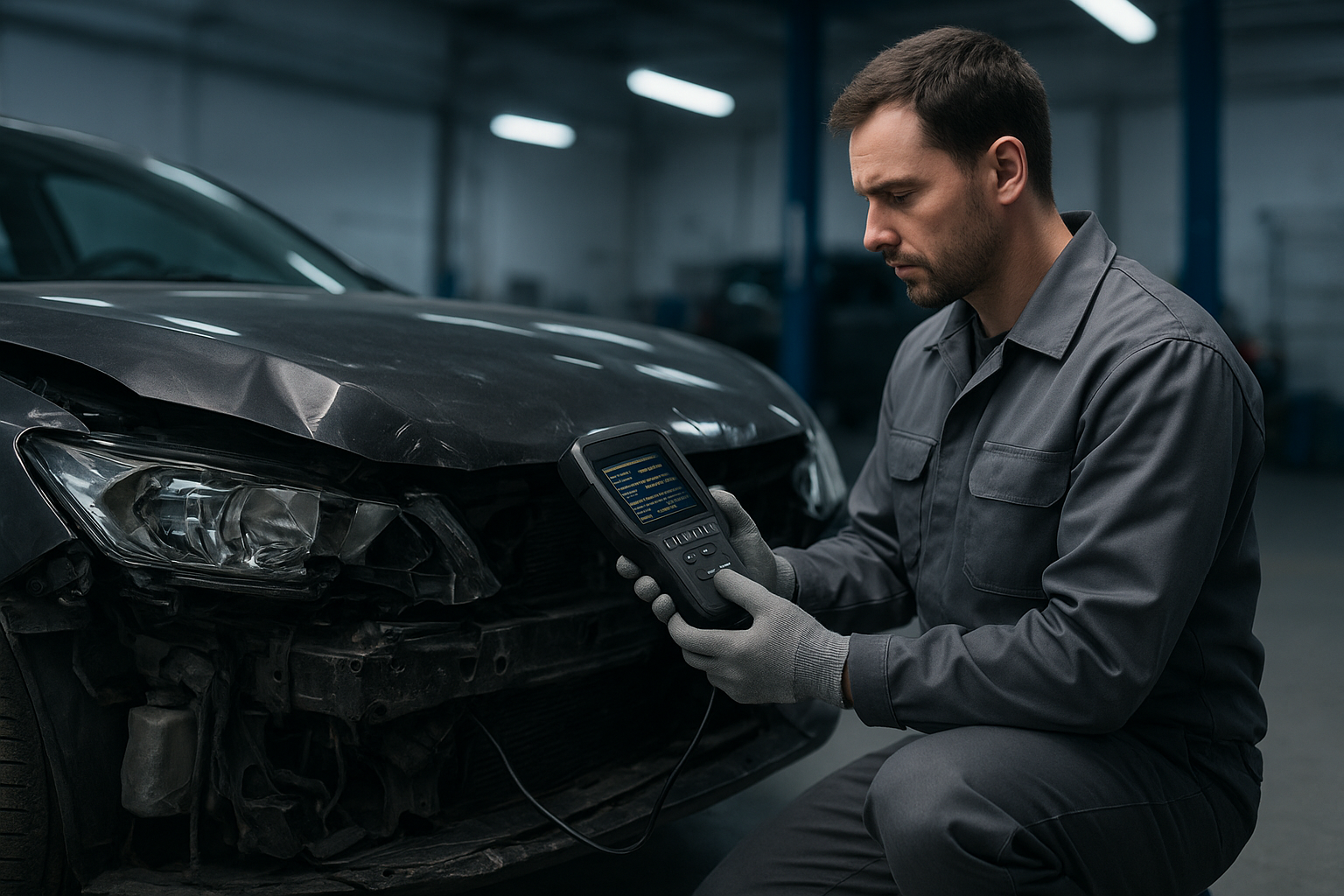
Electrical diagnostics is the process of testing a vehicle’s wiring, sensors, modules, and control systems to confirm they still work the way the manufacturer designed them to — and after a collision, this process becomes one of the most important steps in getting a car safely back on the road. Even a low-speed impact can knock a sensor out of alignment, pinch a wiring harness, or trigger a fault code that never shows up as a warning light. As a result, skipping proper electrical diagnostics after a crash can leave hidden damage behind long after the dents are fixed and the paint is buffed to a shine.

What Is Electrical Diagnostics? A Plain-English Overview
At its core, electrical diagnostics means connecting specialized equipment to a vehicle’s onboard computer network to read data straight from the source. Modern cars run on dozens of interconnected modules — the engine control unit, the airbag control module, the body control module, and often a dozen more — and each one constantly reports its status through a system called on-board diagnostics, or OBD-II. You can read more about how this standardized system works on Wikipedia’s OBD-II overview, but the short version is this: every fault, glitch, or miscommunication between components gets logged as a code, and a trained technician uses that code as a starting point, not the final answer.
Unlike a simple code scan at a parts store, professional electrical diagnostics goes several layers deeper. Specifically, it involves tracing voltage drops, testing continuity across wiring harnesses, and verifying that sensors report accurate data — not just that they turn on. Therefore, two vehicles with the exact same warning light can have completely different underlying problems, and only a full diagnostic session reveals which one you’re dealing with.
Why Electrical Diagnostics Matter After a Collision
Collisions don’t just crumple sheet metal. In addition to visible body damage, an impact can shift cameras behind the windshield, jolt radar sensors mounted in the bumper, or stretch a wiring harness hidden beneath a fender. Consequently, a car can look perfectly repaired on the outside while its safety systems remain silently compromised underneath.
This matters above all because so many of today’s safety features depend entirely on electrical accuracy. Anti-lock brakes, traction control, blind-spot monitoring, and automatic emergency braking all rely on sensors feeding clean data to a control module in real time. If a sensor is even a few degrees out of alignment after a crash, the system it supports may not function correctly — and in some cases, it may not warn the driver at all.
Common Warning Signs You Need Electrical Diagnostics
Some symptoms are obvious, while others are subtle enough to go unnoticed for weeks. Watch for the following:
- Dashboard warning lights that appear, disappear, or flicker intermittently
- Airbag or SRS light staying on after a collision repair
- Power windows, mirrors, or locks responding slowly or not at all
- Headlights or taillights dimming, flickering, or failing intermittently
- Lane-keep assist, blind-spot warning, or adaptive cruise control disengaging unexpectedly
- A battery that drains overnight even when the car isn’t driven
- Steering or traction warnings appearing after impact — see our wheel alignment and drivetrain repair work for related fixes
Our 6-Step Electrical Diagnostics Process
Every vehicle that comes through our shop after a collision follows a consistent, repeatable diagnostic workflow. This way, nothing gets overlooked, and you get documented proof of what was tested and repaired.
- Initial visual and battery inspection: Technicians check the battery terminals, ground straps, and visible wiring for corrosion, looseness, or physical damage before any equipment is connected.
- Full OBD-II system scan: A professional-grade scan tool pulls every stored and pending fault code from all onboard modules, not just the engine, to build a complete picture of the vehicle’s health.
- Live data and sensor verification: Technicians monitor real-time sensor readings while manually operating systems like brakes, steering, and lights to confirm data matches expected values.
- Wiring harness and continuity testing: Using a multimeter and wiring diagrams specific to the vehicle, technicians trace circuits for voltage drops, shorts, or breaks caused by the impact.
- Module and sensor recalibration: Cameras, radar units, and control modules are recalibrated to manufacturer specifications so ADAS features perform exactly as designed.
- Final road test and report: A test drive confirms real-world performance, and you receive a written diagnostic report detailing every finding and repair performed.
For a closer look at how this plays out in real repairs, you can browse our vehicle diagnostic case studies, which walk through actual before-and-after diagnostic findings on customer vehicles.
Advanced Tools Used in Modern Electrical Diagnostics
Professional-grade equipment separates a genuine diagnostic session from a quick code check at a parts counter. In particular, our technicians rely on manufacturer-specific scan tools, digital multimeters, oscilloscopes for reading electrical waveforms, and factory wiring schematics. These standards are shaped by organizations like SAE International, which sets the engineering protocols that govern how vehicle electrical systems communicate.
An oscilloscope, for example, displays the actual electrical signal a sensor produces as a wave rather than a simple on/off reading. This matters because a sensor can technically “pass” a basic test while still sending a distorted, unreliable signal — something only a waveform tool can catch. Similarly, a multimeter measuring voltage drop across a connector can reveal corrosion or damage invisible to the naked eye.
ADAS Calibration and Electrical Diagnostics: Why They Go Together
Advanced driver assistance systems (ADAS) — the cameras, radar, and sensors behind features like automatic emergency braking and lane departure warning — depend entirely on precise physical alignment and clean electrical signals. After a collision, even a bumper replaced with factory-correct parts can throw a radar sensor’s aim off by a fraction of a degree. That small shift is enough to make a safety feature misjudge distance or fail to activate at all.
According to guidance published by the National Highway Traffic Safety Administration, restraint systems like airbags must be inspected and, when necessary, replaced after deployment to remain effective in a future collision. The same logic applies to ADAS components: electrical diagnostics confirms the system is reporting correctly, while calibration confirms it’s physically aimed and mechanically sound. Skipping either step leaves a gap in your car’s safety net.
Common Post-Collision Electrical Problems We Diagnose
Certain issues show up again and again once a vehicle is on the lift. Below are the ones our team encounters most often during electrical diagnostics after a collision.
Battery and Charging System Faults
Impact can loosen battery terminals or damage the alternator’s mounting, leading to inconsistent charging. In contrast to a simple dead battery, this type of fault often mimics other electrical gremlins, which is why proper testing matters.
Airbag and SRS Sensor Errors
Impact sensors positioned throughout the body can be damaged even in a moderate crash. As a result, the supplemental restraint system may fail to deploy correctly — or deploy when it shouldn’t — unless it’s tested and reset.
Wiring Harness Damage
Wiring harnesses often run directly behind bumpers, fenders, and door panels — exactly where collisions strike. Pinched, stretched, or severed wires can cause intermittent failures that are notoriously hard to trace without proper equipment.
Module Communication Failures
Modern vehicles rely on internal networks like CAN bus to let modules “talk” to each other. Physical damage can interrupt this communication, causing unrelated systems — like power steering and cruise control — to malfunction together.
You can see documented examples of these exact issues by visiting our diagnostics repair portfolio, where real fault patterns and fixes are detailed case by case.
Electrical Diagnostics vs. DIY Code Readers
A $30 code reader can tell you that a fault exists. However, it can’t tell you why, and it certainly can’t test live sensor data, wiring continuity, or module calibration. Therefore, relying solely on a store-bought scanner after a collision is a bit like reading a single symptom and skipping the rest of the physical exam.
Professional electrical diagnostics goes further by combining that code with live testing, wiring inspection, and manufacturer-specific calibration procedures. This is also where our multi-point inspection process comes in — it ensures nothing related to the collision gets missed simply because it didn’t trigger a code.
What Affects the Cost of Electrical Diagnostics
Pricing varies based on several factors, so it’s worth understanding what drives the final number before you book an appointment.
- Vehicle complexity: Luxury vehicles and those loaded with ADAS features generally require more modules to test and calibrate.
- Severity of the collision: A minor fender tap requires far less testing than a high-impact crash affecting multiple systems.
- Number of affected modules: Each additional module that needs testing or recalibration adds time to the diagnostic session.
- Insurance coverage: In many collision claims, electrical diagnostics and calibration are covered costs — our team can help you document this for your claim.
Electrical Diagnostics for Hybrid and Electric Vehicles
Hybrid and electric vehicles add another layer of complexity because of their high-voltage battery packs and additional control modules. In particular, technicians must follow strict safety protocols before ever touching high-voltage components, and diagnostic tools must be compatible with the vehicle’s specific battery management system. Consequently, choosing a shop experienced with hybrid and EV electrical diagnostics isn’t optional — it’s a safety requirement.
Frequently Asked Questions About Electrical Diagnostics
How long does electrical diagnostics take after a collision?
Most sessions take between one and three hours, though vehicles with extensive ADAS features or multiple damaged modules may take longer to fully test and calibrate.
Will insurance cover electrical diagnostics?
In most collision claims, yes — electrical diagnostics and any related calibration are typically considered necessary repair steps and are commonly included in an approved estimate.
Can a car pass a visual inspection but still fail electrical diagnostics?
Absolutely. Sensors, wiring, and modules are hidden inside panels and bumpers, so a vehicle can look flawless while still carrying unresolved electrical faults underneath.
Do I need electrical diagnostics even if no warning lights are on?
Yes. Some faults, especially those involving ADAS calibration, don’t always trigger a dashboard light. A full scan checks for pending and hidden codes that a driver would never notice on their own.
What’s the difference between electrical diagnostics and a smog check?
A smog check focuses narrowly on emissions-related codes. Electrical diagnostics is far broader, covering safety systems, comfort features, sensors, and every module connected to the vehicle’s electrical network.
The Bottom Line on Electrical Diagnostics After a Collision
Ultimately, electrical diagnostics is the step that confirms your vehicle is truly safe again — not just visibly repaired. From battery and wiring checks to full ADAS calibration, this process catches the hidden damage that body work alone can’t fix. If your car has been in a collision, don’t assume everything is fine just because the warning lights are off. Instead, schedule a full electrical diagnostics session with a shop that tests every system, documents every finding, and gets it right the first time. For more on our full repair capabilities, visit Brea Auto Body to book your inspection today.

