

Hail Damage Repair Orange County: Complete Guide to Costs, Methods, Timelines & Insurance
Last updated for Orange County drivers dealing with storm damage — from Brea and Fullerton to Yorba Linda and Anaheim Hills.

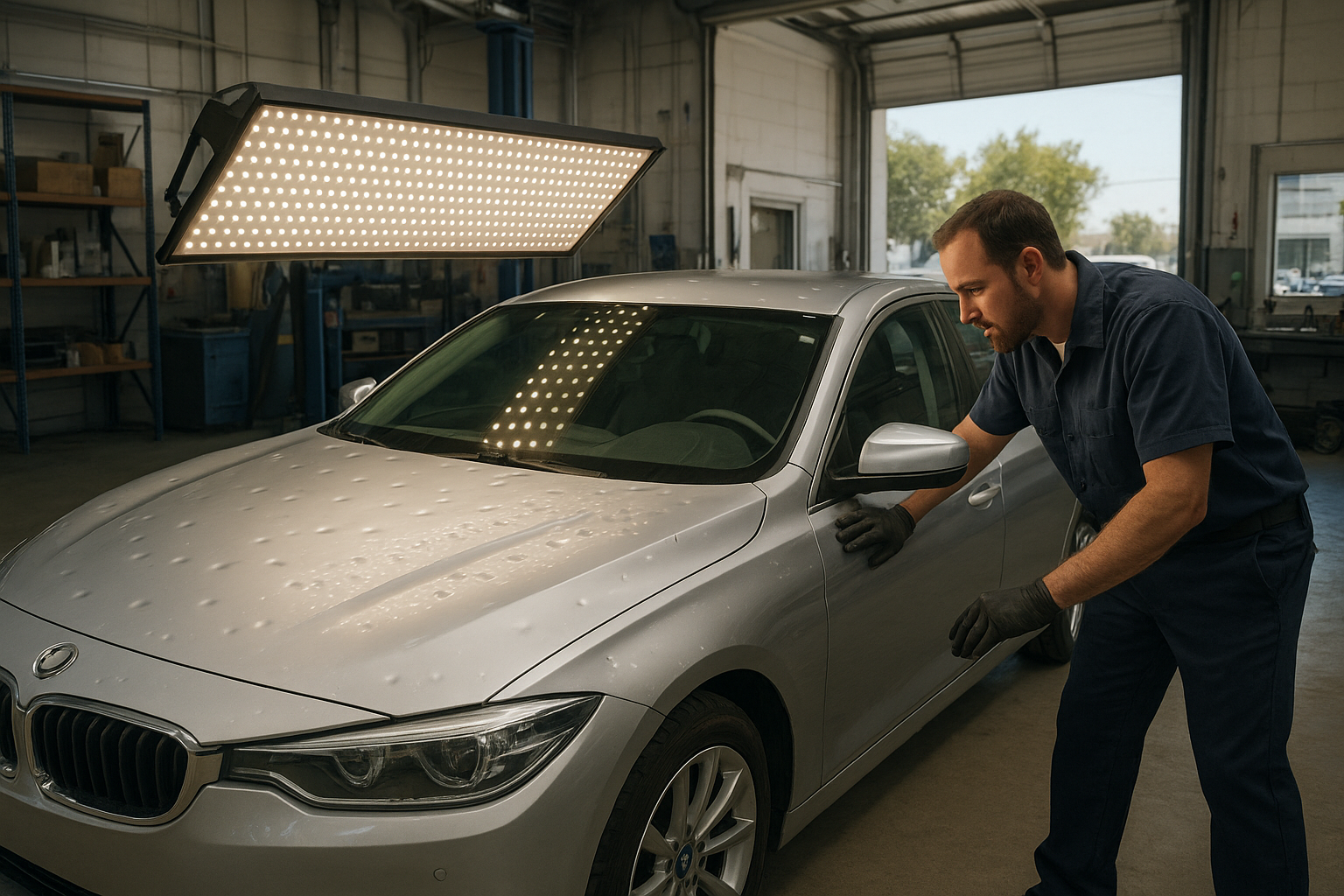
A certified technician maps hail dents under LED lighting — the essential first step in any Orange County hail repair.
A rare SoCal storm rolls through Orange County and suddenly your hood, roof, and trunk lid look like a golf ball. If you’re searching for hail damage repair in Orange County, you’ve landed in the right place. This is the most complete guide available for local drivers — covering every repair method, realistic cost ranges, how insurance works, how to choose a qualified shop, and exactly what will happen from the moment you drive in to the moment you drive away with a factory-smooth finish.
Ready to skip ahead? Book a same-day inspection at Brea Auto Body — a trusted Orange County shop with deep PDR and conventional bodywork expertise.
Why Hail Damage in Orange County Is Different From Other Regions
Orange County doesn’t see hail storms as often as the Midwest or Texas — but that infrequency makes each event more disruptive. Local body shops aren’t perpetually in “hail mode,” which means demand spikes fast after a storm and appointment windows fill quickly. There’s also a practical vehicle reality: Southern California has one of the highest concentrations of late-model luxury and performance vehicles in the country, many featuring aluminum-intensive body panels that require specialized PDR techniques.
Additionally, because hail events here are sporadic, many drivers have never filed a comprehensive claim before — which makes understanding the process from inspection to settlement all the more important. This guide addresses every step for OC drivers specifically.
Step 1: How Hail Damage Is Assessed — The LED Inspection Process
Before any repair begins, a qualified technician performs a controlled-light inspection. This is not a casual glance at your car in the parking lot — it’s a methodical, panel-by-panel evaluation that determines the entire repair plan, cost estimate, and timeline.
Here’s what a proper hail assessment in Orange County involves:
- LED hail-light boards or fluorescent angled lighting — These tools make even the shallowest dimples visible by highlighting distortion in the panel’s reflective surface. Natural daylight misses a significant percentage of dents, especially on darker vehicles.
- Panel-by-panel dent mapping — Each dent is counted and sized (in millimeters). A technician typically categorizes dents as small (under 10mm), medium (10–25mm), or large (over 25mm), and notes depth and shape.
- Paint integrity check — Any crack, chip, or breach in the clearcoat or color coat disqualifies that area for standard PDR and routes it to conventional refinishing instead.
- Body line and edge review — Dents that fall on sharp body character lines or panel edges are harder or impossible to PDR cleanly; a good estimator flags these upfront.
- ADAS and sensor zone identification — Modern vehicles have cameras, radar modules, and ultrasonic sensors embedded in body panels. If any hail-affected panel houses a sensor, calibration will be required post-repair and is flagged in advance.
The result is a detailed hail map — a written and often photographic record of every dent by panel. This document is essential for your insurance carrier and forms the basis of the estimate. Shops that skip this step and offer quick verbal quotes often miss dents, which leads to supplements, delays, and disputes later.

LED reflection boards reveal shallow hail dents invisible to the naked eye — critical for producing an accurate estimate.
Hail Repair Methods Explained: PDR vs. Conventional vs. Hybrid
Not all hail damage is treated the same way. The right method depends on dent size, location, paint condition, and panel material. Here’s a full breakdown of every approach used for hail damage repair in Orange County:
Paintless Dent Repair (PDR)
PDR is the gold standard for hail-damaged vehicles with intact paint. Certified technicians use two primary techniques:
- Metal rod manipulation (push-from-behind) — Rods of varying size and profile are inserted through access points (door jambs, trim openings, behind headliners) and used to massage the backside of the dented metal upward, gradually restoring the original contour.
- Glue-pull technique (exterior access) — For panels without rear access, specialized adhesive tabs are applied to the dent face and used with a slide hammer or pulling bridge to gently draw the metal outward. Residue cleans away without marking the paint.
PDR advantages:
- Preserves your factory OEM paint — no respray, no color-match risk
- Fastest turnaround of any method (1–5 days for most vehicles)
- No filler, primer, or baking cycles
- Typically preferred by insurance carriers because it’s thorough and cost-effective
- Preserves vehicle resale value better than repainted panels
PDR limitations:
- Cannot be used if paint is cracked, chipped, or peeled
- Not suitable for dents on sharp body lines or panel edges
- Severely stretched metal may not respond cleanly
- Extremely large dents (typically over 40–50mm) may need supplemental work
Conventional Body Repair and Refinishing
When PDR isn’t sufficient, conventional repair brings in body filler, primer, and a full spray refinish matched to your vehicle’s OEM color code. This is appropriate for:
- Any panel with cracked, chipped, or delaminated paint
- Large dents with significant metal stretching
- Panel replacement when damage exceeds the cost of a new part
- Damage near edges, character lines, or adjacent body features
Conventional refinishing takes longer and must be done under controlled conditions. Quality matters enormously — a poor color match or low-grade clear coat will show within a year. Always verify the shop uses OEM-approved paint systems and a spray booth with temperature control.
The Hybrid Approach (Most Common for Moderate-to-Heavy Hail)
The majority of hail-damaged vehicles seen at Orange County body shops require a hybrid repair: PDR handles the bulk of the dent count across most panels, while conventional refinishing addresses the few areas where paint was broken. This approach minimizes repainted surface area (protecting resale value) while ensuring a complete, OEM-consistent result.
A skilled estimator will identify which panels qualify for PDR-only, which need hybrid work, and which (if any) should be replaced — and explain the reasoning behind each decision before work begins.
PDR on Aluminum Panels
Many late-model vehicles — including popular models from BMW, Audi, Ford (F-150), and Jaguar Land Rover — use aluminum-intensive body construction. Aluminum behaves differently from steel: it has less “memory,” tears more easily under aggressive pushing, and requires technicians with specific aluminum PDR certification and specialized tooling. Not every PDR tech is qualified for aluminum work. If you drive an aluminum-intensive vehicle, confirm your Orange County shop has verified aluminum PDR experience before approving repairs.
Hail Damage Repair Costs in Orange County: Real Numbers
Cost is one of the most searched topics after a hail storm, and it varies significantly based on dent count, panel involvement, and whether paint refinishing is needed. Here are realistic ranges for hail damage repair in Orange County:
| Damage Level | Typical Dent Count | Method | Estimated Cost Range |
|---|---|---|---|
| Light | Under 50 dents | PDR only | $300 – $1,200 |
| Moderate | 50–200 dents, multiple panels | PDR + minor R&I | $1,200 – $3,500 |
| Heavy | 200–500+ dents, 4–8 panels | Hybrid PDR + refinish | $3,500 – $7,000+ |
| Severe / Total Loss Risk | Extensive paint damage or panel replacement | Conventional + possible totaling | $7,000+ |
Ranges are estimates for Orange County market conditions. Final costs depend on vehicle make, model, panel material, and insurance involvement. Get an inspection for an accurate figure.
What Drives Cost Up (or Down)
- Dent size matters more than dent count — A hood with 20 large dents can cost more than one with 80 small dents.
- Roof damage is labor-intensive — Headliner removal is typically required, adding time and cost.
- Panel R&I (remove & install) — Trim pieces, headliners, and inner panels must sometimes be removed for rear access. This adds cost but is necessary for quality PDR results.
- ADAS calibration — If a camera or radar module in a hail-damaged panel must be recalibrated, expect $150–$400+ per calibration depending on the system.
- Aluminum vs. steel — Aluminum PDR typically commands a premium due to slower, more careful technique requirements.
- High-end or exotic vehicles — OEM parts and paint systems for luxury brands carry higher parts and materials costs.
Repair Timelines: How Long Will You Be Without Your Car?
Timeline is often as important as cost — especially if you depend on your vehicle daily. Here’s what to realistically expect for hail damage repair in Orange County:
- Light hail damage (PDR only): 1–3 business days. These jobs are often handled in one continuous session by an experienced PDR tech.
- Moderate hail damage (PDR + R&I): 3–6 business days. Headliner removal, panel R&I, and multiple-panel PDR sessions extend the timeline. Insurance approvals during this phase can add 1–2 days if supplements are needed.
- Heavy/hybrid damage (PDR + conventional refinishing): 7–14 business days. Paint work requires prep time, spray booth scheduling, baking cycles, and final buffing and polish.
- Severe damage with panel replacement: 2–4+ weeks. Parts availability — especially for imported vehicles — can extend this considerably. OEM parts from Germany, Japan, or Korea can have 2–3 week lead times.
How to Speed Up Your Repair
- Book your inspection immediately after the storm — appointment slots fill quickly in Orange County after a widespread hail event.
- Open your insurance claim the same day you notice damage — don’t wait for an estimate first.
- Provide storm date and location details to your insurer at claim opening — carriers can cross-reference weather data to expedite verification.
- Photograph all damage before bringing the car in — wide shots from all four corners plus close-ups of each affected panel.
- Choose a shop with insurer direct-billing relationships — eliminates you as the financial intermediary and speeds authorization.
Navigating Insurance for Hail Damage in Orange County
Hail damage falls under comprehensive coverage — not collision. If you have comprehensive on your policy, here’s how the claim process typically unfolds:
Step-by-Step Insurance Claim Process
- Report the storm and open your claim — Call your insurer or use their app. Provide the date, time, and location of the hail event. Have your policy number and VIN ready.
- Insurer sends an adjuster or requests shop estimate — Some carriers send their own adjuster; others ask you to take the vehicle to a shop. Increasingly, many accept virtual photo estimates through their apps.
- Initial estimate is issued — Understand that adjuster estimates frequently undercount dents. Hail supplements are very common — when your shop does the full LED inspection and finds more damage than the adjuster documented, a supplement is submitted. This is normal and expected, not adversarial.
- Shop authorizes and supplements as needed — A reputable Orange County shop will document every dent photographically, submit a detailed hail map to your carrier, and advocate on your behalf for a complete, fair approval.
- Repair begins after authorization — Your deductible is paid at pickup; the insurer handles the balance directly with the shop (if the shop offers direct billing).
- Rental car coverage — If your policy includes rental reimbursement under comprehensive claims, activate it as soon as your car is dropped off. Limits vary (typically $30–$50/day up to 30 days), so clarify with your insurer upfront.
Will a Hail Claim Raise My Insurance Rates?
In most cases, no — or minimally. Comprehensive claims like hail are classified as “not at fault” events in California because you had no ability to prevent the damage. Most major carriers do not surcharge for the first comprehensive claim, and some do not surcharge at all for weather events. However, policies differ. Call your agent before filing if you’re uncertain, and ask specifically about surcharges for comprehensive weather claims in California. For most Orange County drivers with multiple dented panels, the cost of filing far outweighs paying out of pocket.
What If You Don’t Have Comprehensive Coverage?
If you carry only liability or collision coverage, hail damage is not covered. You’ll be paying out of pocket. In this case, getting a thorough inspection is still worthwhile — understanding the full scope of damage lets you prioritize repairs and avoid cosmetic damage worsening over time (surface paint damage can eventually lead to rust on steel panels, though less of a concern in dry Southern California). A good shop can also help you stage repairs to manage cost if you’re self-paying.
Full Step-by-Step: What Happens During Your Hail Repair Visit
Here’s exactly what to expect from drop-off to delivery at a qualified Orange County hail damage repair shop:
- Check-in and documentation — You’ll provide your claim number (if opened), storm date and location, vehicle history notes, and existing pre-storm damage disclosure. The shop logs all of this before touching the car.
- LED inspection and hail mapping — A certified estimator uses LED light boards to map every dent by panel. Dent counts and sizes are entered into estimating software (Mitchell, Audatex, or CCC) to produce an insurance-ready estimate.
- Method selection and repair plan presentation — You’re shown the plan: which panels get PDR, which (if any) need conventional work, what R&I is required, and the estimated timeline. You approve before anything proceeds.
- R&I for panel access — Headliners, trim pieces, inner door panels, and other components may be carefully removed to allow rear access for PDR rods. This is skilled work that must be done carefully to avoid scratching interior surfaces.
- PDR work — Technicians work panel by panel, using rods and/or glue-pull tools to restore the metal. Roof work is usually done last due to headliner reinstall sequencing.
- Conventional refinishing (where required) — Panels needing paint go through prep (sanding, masking), primer, color application, clear coat, baking, and final buff. This runs concurrently with PDR where possible to save time.
- Quality control inspection under LED lighting — Every repaired panel is re-examined under the same LED tools used during the initial inspection. Any residual ripple, high spot, or inconsistency is corrected before sign-off.
- ADAS calibration (if applicable) — If windshield work was involved, or if radar/camera sensor positions were disturbed, calibration is performed on-site or through a certified partner. You receive a calibration report.
- Final detail and delivery — The vehicle is cleaned inside and out, and you receive a written delivery inspection checklist and any insurance documentation required for your records.

A clear, documented repair process protects you, accelerates insurance approvals, and ensures nothing is missed.
How to Choose the Right Hail Damage Repair Shop in Orange County
After a storm, you’ll see increased advertising from traveling “hail chasers” — mobile PDR crews that follow storm systems across the country. Some are highly skilled. But many leave your area before any warranty issues surface, and few have OEM certifications or the equipment for hybrid repairs. Here’s a checklist for evaluating any Orange County shop:
- Verifiable local presence — A physical address in Orange County that has been operating before the storm. Check Google Maps timeline and business registration.
- OEM or I-CAR certifications — Industry training credentials (I-CAR Gold Class, OEM certification from Toyota, Honda, GM, BMW, etc.) indicate investment in proper repair procedures.
- Written warranty on repairs — PDR work should carry a lifetime warranty on the repaired dents; refinished panels should have a minimum 3-year paint warranty. Get it in writing.
- Insurance direct billing capability — Shops set up with direct insurer billing remove you from the payment chain and expedite approvals.
- Reviews with storm/hail-specific mentions — Look for Google or Yelp reviews that specifically reference hail repair — not just general bodywork. Hail PDR is a distinct skill set.
- Transparent, itemized estimate — You should receive a panel-by-panel breakdown, not just a total price. Each dent category should be visible in the estimate.
- ADAS awareness — If your vehicle has driver-assist systems, the shop should proactively mention calibration requirements. Any shop that ignores ADAS is not following OEM procedures.
Why a Local Orange County Shop Has Real Advantages
- Proximity for supplements and re-inspections: If your insurer sends an adjuster to review a supplement in person, a local shop can accommodate quickly. A traveling crew may be three states away.
- Accountability over time: You know exactly where to go if a dent reappears, paint fails, or a trim piece rattles after reassembly. Local accountability is irreplaceable.
- OEM familiarity: Southern California’s vehicle mix includes a high proportion of late-model imports and luxury vehicles requiring specific repair procedures. Local shops in this market develop deep familiarity with these procedures.
- ADAS calibration partnerships: Established local shops have standing relationships with calibration partners or in-house equipment, rather than improvising after the repair is complete.
For a trusted local option with comprehensive hail repair capabilities, Brea Auto Body serves drivers throughout Orange County — from Brea and Fullerton to Yorba Linda, Anaheim Hills, Placentia, and beyond.
Before and After: What Quality Hail Repair Actually Looks Like
The goal of any hail repair — whether PDR or conventional — is a finish indistinguishable from the factory. Here’s what that means in practical terms:
- PDR results: Zero visible dimples, ripples, or waviness in panel reflections. The repaired surface should be indistinguishable from an unaffected panel when viewed under the same LED inspection light used during assessment. No filler, no paint — just restored metal.
- Conventional refinish results: A color match within OEM tolerance — meaning the repainted panel should match adjacent panels without visible color shift, pearl orientation difference, or gloss mismatch. A quality shop will blend into adjacent panels when necessary to achieve a seamless appearance.
- Hybrid results: The combination should be seamless — you should not be able to identify which panels were PDR’d versus repainted through visual inspection.

Properly executed PDR: the before-and-after difference is complete — no dimples, no filler, no repaint on paint-intact panels.
What Happens If You Don’t Repair Hail Damage?
Skipping hail repair has compounding consequences beyond aesthetics:
- Resale and trade-in value drop significantly — Dealers and buyers discount heavily for visible hail damage. Independent appraisers flag it in Carfax history if prior insurance claims exist.
- Paint damage worsens over time — Even tiny clearcoat fractures allow moisture infiltration. While Orange County’s climate is dry, any compromise in the paint barrier can lead to delamination or rust on steel panels over years.
- Insurance claim window may close — Most comprehensive policies have a claims window. Delaying documentation can complicate or invalidate your coverage for this storm event.
- Lease return penalties — If you’re leasing your vehicle, the lessor’s end-of-lease inspection will flag and charge for unrepaired hail damage — often at above-market rates.
Hail Damage Repair Orange County: Frequently Asked Questions
How do I know if my car has hail damage if I can’t see obvious dents?
Hail dents are often nearly invisible in daylight, especially on light-colored vehicles. Have your car evaluated under LED lighting at a qualified shop. Many Orange County shops offer free hail inspections — it costs you nothing to know for certain, and you may have damage you’re unaware of.
Can I get hail damage repair in Orange County covered under insurance without a deductible?
Your deductible will apply to any comprehensive claim. No legitimate shop can legally waive your deductible — that practice constitutes insurance fraud. If someone offers to “waive your deductible,” treat it as a red flag for the quality and integrity of their work. Your out-of-pocket cost is your deductible; the insurer covers everything above it.
Will hail damage repair in Orange County affect my car’s resale value?
Quality PDR repair — which preserves your original factory paint — has minimal negative impact on resale value. In fact, leaving damage unrepaired reduces value far more than a properly documented PDR repair. Conventional refinishing can reduce value slightly (some buyers discount repainted panels), which is another reason to maximize PDR where possible and minimize painted surface area.
Is PDR always the best choice for hail damage repair?
PDR is the best choice when paint is intact and dents are in accessible, workable locations. It’s faster, less expensive, and preserves your factory finish. When paint is broken, metal is severely stretched, or dents fall on edges or body lines, conventional refinishing or a hybrid approach is necessary for a proper result. An honest shop will tell you which your vehicle actually needs — not default to the higher-revenue option.
What’s the difference between a hail supplement and a new claim?
A supplement is an addition to your existing approved claim — submitted when the shop discovers damage beyond what the initial estimate covered. It is not a new claim, does not create a new claim number, and does not trigger a separate deductible. Supplements are routine in hail repair because initial adjuster estimates regularly miss dents without the benefit of a full LED inspection.
Can hail damage total my car?
Yes. If the repair cost exceeds a threshold percentage of your vehicle’s actual cash value (ACV) — typically 70–80% depending on your insurer and California regulations — the vehicle may be declared a total loss. This most often occurs with older vehicles with lower ACV, or vehicles that suffered severe hail combined with other existing damage. If your car is totaled, you receive the ACV minus your deductible.
Do I have to use my insurance company’s preferred shop?
No. In California, you have the legal right to choose any licensed repair shop. Insurance companies may recommend their DRP (Direct Repair Program) network shops, but you are not obligated to use them. Choosing an independent qualified shop does not jeopardize your claim, though it may add slightly more administrative steps in some cases.
How soon after a hail storm should I get my car inspected?
As soon as possible — ideally within 24–72 hours. Beyond the urgency of documenting fresh storm damage, Orange County shops fill up quickly after a regional hail event. Early appointment booking means shorter wait times, faster claim processing, and less time without your vehicle. Delay also risks timeline conflicts with your insurance claim window.
Cities We Serve Across Orange County
Brea Auto Body provides hail damage repair services to drivers across the entire Orange County region, including:
- Brea
- Fullerton
- Yorba Linda
- Anaheim Hills
- Placentia
- La Habra
- Anaheim
- Orange
- Villa Park
- Diamond Bar
- Chino Hills
- Whittier
Not sure if we’re the right fit for your vehicle or damage type? Call us or use our online booking — we’ll tell you honestly whether your vehicle is a PDR candidate and what to expect from start to finish.
Ready to Restore Your Car After Hail Damage in Orange County?
Get a thorough LED inspection, a complete repair plan, and expert insurance navigation — all from a trusted local shop with a proven track record.
Book Your Hail Inspection at Brea Auto Body ?
Serving Brea, Fullerton, Yorba Linda, Anaheim Hills, Placentia, and all of Orange County.

