

How to Find the Highest Rated Auto Body Shop: The Complete Guide to Ratings, Repairs, and Real Quality
Everything you need to evaluate, compare, and confidently highest rated auto body shop in your area — so your vehicle is restored correctly the first time.
A seamless delivery experience is what drivers expect from the highest rated auto body shop.
Why Searching for the “Highest Rated” Auto Body Shop Is the Right Starting Point
When your vehicle is damaged in a collision, the stakes are high — structural integrity, safety system function, resale value, and your family’s safety all depend on the quality of the repair. Searching for the highest rated auto body shop is the right instinct, but a raw star rating alone doesn’t tell the whole story.
The shops that consistently earn top ratings do so because of a verifiable system: certified technicians, manufacturer-approved repair methods, calibrated diagnostics, documented quality control, and warranties that actually mean something. This guide decodes what “highest rated” really means, what separates exceptional shops from average ones, how to evaluate your options in an afternoon, and what questions to ask before you hand over your keys.
Whether you’re dealing with a minor fender dent or a major collision, the criteria below apply equally — and using them will help you make a decision you won’t regret.
What “Highest Rated” Actually Means — Beyond the Star Score
A five-star rating is a signal, not a guarantee. The most meaningful question is: what behavior produced those stars? Over time, the highest rated auto body shops earn their reputation through a combination of technical excellence and consistent process discipline. Here’s what the ratings are actually measuring:
1. Verified Technician Training and Certifications
The most reliable quality signal in collision repair is ongoing, verifiable training. Look for these credentials:
- I-CAR Gold Class: The industry’s highest team training achievement. Requires all roles — estimators, technicians, refinishers — to complete annual training. Only about 20% of collision shops nationwide hold Gold Class status.
- ASE Certification: Individual technician credentials that verify knowledge in specific repair categories — structural, non-structural, refinishing, and more.
- OEM Certifications: Manufacturer-specific programs (e.g., Tesla Approved, Honda ProFirst, Ford Certified) that require specialized training, tooling, and audits. Certified shops have demonstrated they can repair your specific vehicle to factory standards.
Shops that invest in training typically diagnose structural damage correctly, follow OEM repair procedures, and document each step — all of which show up in their reviews.
2. OEM-Aligned Repair Procedures
Modern vehicles — especially those with aluminum structures, advanced high-strength steel, mixed materials, ADAS, and EV platforms — are engineered to extremely tight tolerances. Using the wrong weld setting, the wrong adhesive, or the wrong sectioning location can compromise the vehicle’s ability to protect occupants in a future collision.
The highest rated auto body shops subscribe to OEM repair information databases like ALLDATA, use approved tooling, and document their adherence to procedure. This is what keeps vehicles safe — and keeps customers coming back and leaving five-star reviews.
3. Transparent, Process-Driven Operations
Behind every top-rated shop is an operational framework that minimizes errors and maximizes communication. Key process indicators include:
- Cycle time tracking — average days from intake to delivery, a direct measure of workflow efficiency
- On-time delivery rate — percentage of vehicles delivered on the promised date
- Supplement transparency — proactive communication when hidden damage requires additional repair authorization
- Final QC checklists — documented pre-delivery inspection covering panel gaps, sensor status, warning lights, paint finish, and road test results
- Customer update cadence — scheduled texts or emails so you always know where your vehicle stands
4. Genuine, Detailed Community Feedback — Across Multiple Platforms
Don’t evaluate a shop on a single platform. Cross-reference Google Reviews, Yelp, Facebook, and industry-specific sites like CarWise or the shop’s own testimonials page. When reading reviews, look for specifics: paint match quality, communication responsiveness, structural accuracy, ADAS calibration results, delivery timing, and post-repair follow-up. Generic praise (“great job!”) is less useful than detailed accounts of the repair experience.
Patterns in negative reviews matter too. One or two complaints about parking logistics are different from recurring mentions of late delivery, poor communication, or rework.
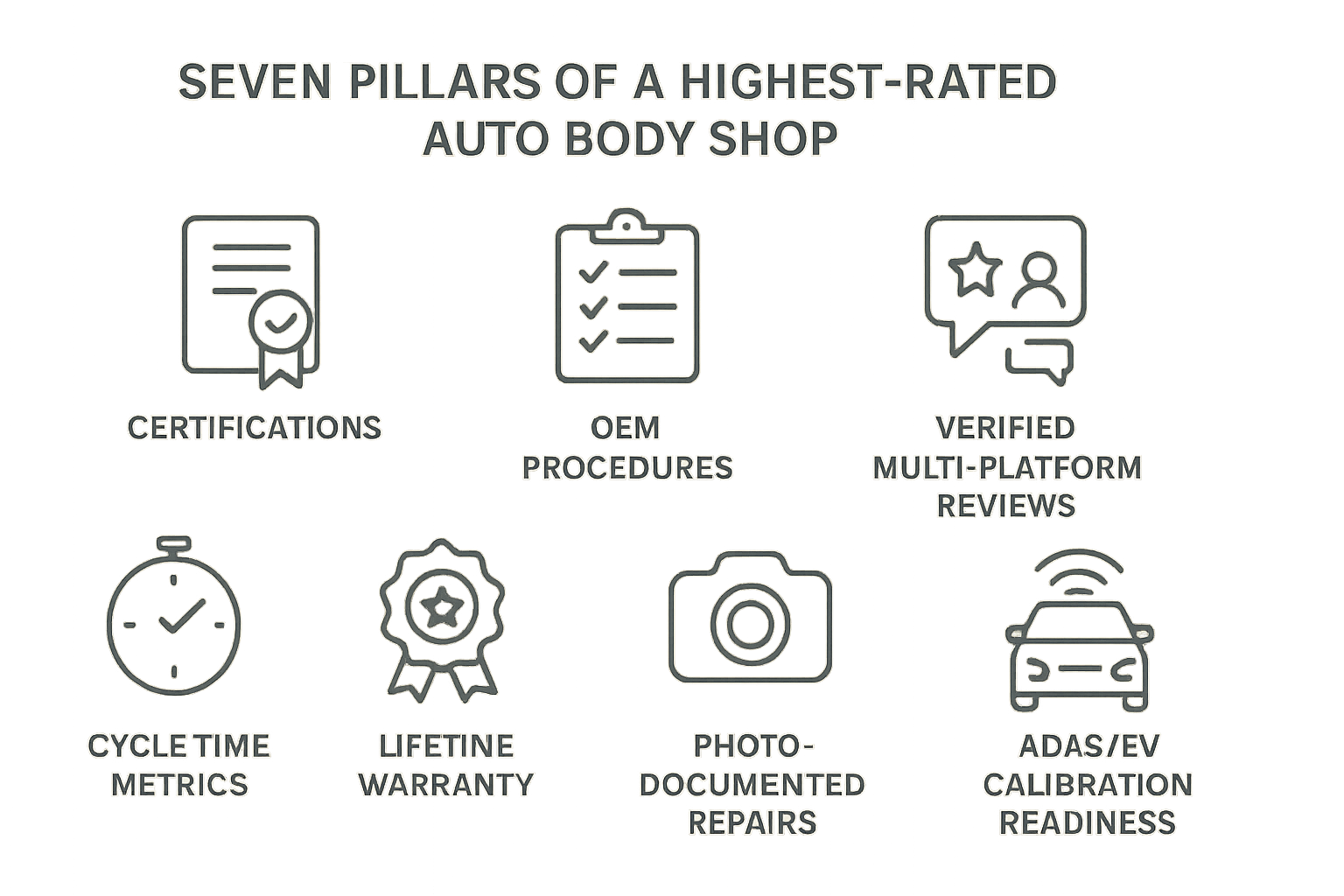
Key factors that consistently appear in reviews of the highest rated auto body shop.
How to Find the Highest Rated Auto Body Shop Near You: A Step-by-Step Evaluation Process
Finding the best collision repair shop in your area doesn’t have to be overwhelming. Follow this structured process and consult our Brea Auto Body Shop Guide to compare your options confidently in a single afternoon.
Step 1 — Search Strategically, Then Shortlist
Start with Google Maps or your insurer’s locator tool and choose a collision repair shop. Search “highest rated auto body shop near me” or your city name. Filter results to shops with at least 50 reviews and a 4.5-star average or higher. Quantity and recency of reviews matter — a shop with 200 reviews over three years is more credible than one with 10 reviews in one month.
Shortlist two to three candidates and visit each shop’s website. Look for certification logos (I-CAR, ASE, OEM), before/after photo galleries, and warranty information. If those three elements aren’t visible, proceed with caution.
Step 2 — Request Written Estimates with Full Documentation
Ask for written estimates from your top two or three candidates, and review examples of auto body repair. A professional estimate from a top-rated shop will:
- Itemize labor and parts separately
- Specify OEM, OEM-equivalent, or aftermarket parts and explain why each was chosen
- Flag safety-critical components that require OEM parts
- Include anticipated ADAS calibrations or scanning fees
- Note the procedure for handling hidden damage discovered during teardown (supplements)
Step 3 — Verify Credentials and Physical Capabilities
When you visit in person, ask directly about: and consider resources explaining how to find a family-owned auto body shop.
- I-CAR Gold Class status — ask to see the certificate or look them up on the I-CAR website
- OEM certifications relevant to your vehicle make
- Frame and uni-body measurement equipment — computerized systems like Car-O-Liner, Chief, or Celette
- In-house ADAS calibration capability — dedicated calibration bay with manufacturer-approved targets and scan tools
- Paint booth and refinish system — look for a downdraft booth with baked finish capabilities
- Corrosion protection process — cavity wax, seam sealer application, and anti-corrosion primer use
Step 4 — Inspect Past Work and Ask the Right Questions
Ask the shop for before/after photos of repairs similar to yours. Look for consistent panel gaps, clean paint edges, and color-matched adjacent panels. On-site, observe:
- Is the shop organized, with parts clearly labeled and staged?
- Is the paint booth area free from dust contamination?
- Are vehicles covered and protected while in production?
- Do technicians appear busy and working systematically, or is the shop chaotic?
Step 5 — Confirm the Warranty and Communication Process
Before committing, get clarity on:
- Warranty scope: Does it cover workmanship, paint, and parts? Is it a lifetime warranty tied to vehicle ownership?
- Update frequency: How often will you receive status updates — daily, every few days, or only when asked?
- Delivery timeline: What is the estimated completion date and what factors could extend it?
- Delivery walkthrough: Will a technician or estimator walk through the completed repairs with you?
The highest rated auto body shops are proactive communicators. If a shop can’t answer these questions clearly, that’s the preview of your repair experience.
What the Best Collision Shops Do Differently: A Technical Deep Dive
Transparent Estimating and Parts Strategy
A top-rated shop doesn’t hand you a one-page printout and ask you to trust them. Estimators walk through the damage line by line, explaining what will be repaired versus replaced, why certain parts must be OEM (safety systems, structural components), and where quality aftermarket or certified recycled parts are appropriate.
They also explain the supplement process — what happens when the tech tears down the vehicle and discovers damage that wasn’t visible during the initial inspection. Shops that handle supplements transparently (rather than surprising you with extra charges at pickup) consistently earn higher customer satisfaction scores.
Structural Measurement and Verification
Computerized frame and uni-body measurement systems use precision laser or mechanical arms to compare your vehicle’s actual dimensions against the factory specification. Verified datum points and post-repair measurement printouts give you — and your insurer — objective, documented proof that the vehicle has been restored to factory geometry.
This matters enormously for future collision performance. A vehicle pulled to within 2mm of spec but not verified with documentation may still have alignment issues, uneven tire wear, and compromised crash performance. Customers who receive measurement printouts at delivery routinely mention this in five-star reviews — it’s a tangible proof point that the repair was done correctly.
Paint Match and Finish Longevity
A visible paint mismatch is one of the most common reasons customers leave negative reviews — and it’s entirely preventable. Top shops invest in:
- Spectrophotometer color matching — electronic tools that read the actual pigment values of your vehicle’s existing paint and mix a formula to match
- Panel blending strategy — refinishing portions of adjacent undamaged panels to create a seamless color transition, especially important for metallic and pearl finishes
- Downdraft paint booths with baked finish — filtered airflow and heat curing eliminate dust nibs and produce factory-level hardness and gloss
- Multi-stage clear coat application — proper build and cut ensures the finish maintains its appearance over years, not just at pickup
Reviews that rave about a “perfect paint match” or “looks better than new” are the signature of shops that don’t cut corners on refinishing.
Pre-Delivery Quality Control — The Invisible Standard-Setter
The highest rated auto body shop doesn’t treat delivery as the first moment anyone looks closely at the finished repair. A rigorous QC checklist — completed before you arrive — covers:
- Panel gap uniformity — consistent spacing between doors, hoods, fenders, and trunk lids
- ADAS sensor status and calibration confirmation
- Post-repair scan showing no active or stored fault codes
- Road test — straight-line tracking, no pulls or vibrations
- Water leak check on repaired seams and glass
- Interior cleanliness — no compound residue, dust, or handprints
- Paint surface inspection under raking light for any texture or gloss issues
When a shop delivers a vehicle that drives and looks flawless, and then hands you a document confirming all of the above was checked — that’s what earns a five-star review and a returning customer.
ADAS, EVs, and Why Calibration Quality Now Defines the Best Auto Body Shops
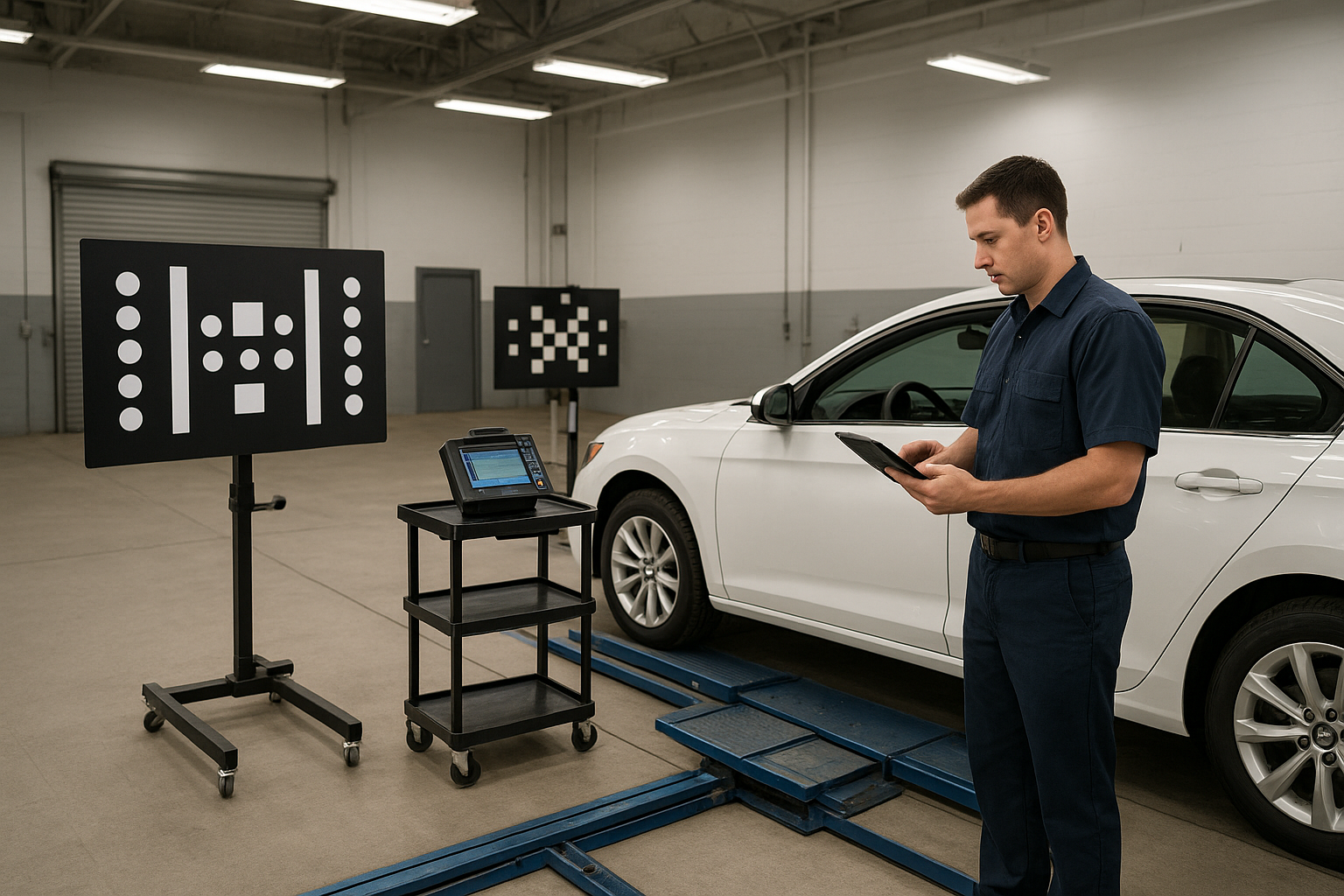
Accurate ADAS calibration is now a hallmark of the highest rated auto body shop.
Advanced Driver Assistance Systems (ADAS) and electrified powertrains have fundamentally changed what collision repair means. A vehicle that appears visually repaired but has uncalibrated sensors is not safe — it’s a liability. The highest rated auto body shops have responded by investing in the equipment, training, and processes required to handle ADAS and EV repairs correctly.
Why ADAS Calibration Is Now Standard, Not Optional
Replacing a bumper cover, windshield, front fender, or even performing a wheel alignment can disturb the precise aiming of cameras, radar units, lidar sensors, and ultrasonic parking sensors. Improper calibration can cause:
- Automatic emergency braking that activates too late or not at all
- Lane-keep assist that drifts or doesn’t respond correctly
- Adaptive cruise control that maintains incorrect following distances
- Blind spot monitoring that misses vehicles in adjacent lanes
Top-rated shops perform pre-repair and post-repair scans, complete static or dynamic calibrations per OEM specifications, and provide printed calibration reports at delivery. Customers increasingly mention “no warning lights,” “lane-keep working perfectly,” and “fast turnaround on sensors” in their five-star reviews — strong evidence that calibrations were performed correctly.
EV and Hybrid-Specific Repair Requirements
Electric and hybrid vehicles introduce additional repair complexity that the highest rated auto body shops are prepared for:
- High-voltage system isolation — before any structural repair, the HV system must be properly disabled by a trained technician
- Non-conductive tooling — standard steel tools can be dangerous near HV components; certified EV repair shops use insulated equipment
- Battery pack inspection and thermal management — OEM procedures define when a battery must be inspected, tested, or replaced after collision impact
- Dedicated EV welding protocols — aluminum-intensive EV structures require separate, dedicated MIG welding equipment to prevent cross-contamination
- Post-repair charging and range verification — confirming the vehicle charges correctly and range estimates are accurate after repair
If you drive a Tesla, Rivian, GM EV, or any hybrid model, ask explicitly whether the shop holds the manufacturer’s EV certification and what their HV isolation procedure looks like. This is a non-negotiable safety matter, not just a quality preference.
Understanding Insurance, DRP Networks, and Your Right to Choose Any Shop
After a collision, your insurer will often recommend a Direct Repair Program (DRP) shop — a facility that has a preferred relationship with the insurance company. Many DRP shops are excellent. But you need to understand the full picture before defaulting to a recommendation. See our insurance claims guide.
What DRP Means — and What It Doesn’t Guarantee
DRP relationships benefit insurers through faster cycle times and negotiated labor rates. They can benefit you through streamlined claims handling and on-site rental coordination. However, DRP agreements do not automatically guarantee the highest quality repair — they guarantee a relationship between the shop and the insurer.
The law in most U.S. states gives you the right to choose your repair facility regardless of what your insurer recommends. Your insurer may not pay beyond their approved labor rates or parts pricing, but they cannot legally require you to use a specific shop.
What to Ask When Navigating the Insurance Process
- Does the shop handle insurer communication and supplements directly, or will I need to manage that myself?
- Will the shop document all OEM procedures in writing for my insurer?
- If my insurer disputes a necessary repair, will the shop advocate on my behalf?
- What documentation will I receive at the end of the repair — scan reports, calibration records, measurement printouts?
- Is there a written lifetime warranty on workmanship?
The highest rated auto body shops thrive both inside and outside DRP networks because they build their reputation on quality, communication, and documentation — not on insurer relationships alone.
Common Types of Collision Damage — and What Quality Repair Looks Like for Each
Understanding what your repair actually involves helps you evaluate whether a shop is giving you the right answer — or the easy answer.
Minor Dents and Dings
Correct approach: Paintless Dent Repair (PDR) for dents without paint damage; conventional filler and refinish for dents with paint cracking or creasing. PDR preserves the factory finish and is typically faster and more economical.
What distinguishes top shops: Technicians who accurately assess whether PDR is appropriate rather than defaulting to body filler, which adds unnecessary material and can crack over time.
Bumper Damage
Correct approach: Replacement versus repair depends on impact severity. Modern bumper assemblies often include radar sensors, parking cameras, and active grille shutters that must be transferred, reprogrammed, or replaced. Post-repair ADAS calibration is frequently required.
What distinguishes top shops: They identify all embedded electronics, order required OEM or approved components, and include calibration in the estimate rather than adding it as a surprise at billing.
Side Impact and Door Damage
Correct approach: Depending on severity, door shells may be repaired or replaced. Side curtain airbag sensors, impact bars, and window regulator mechanisms must all be verified. Blind spot monitoring and side camera systems need calibration after door or mirror replacement.
What distinguishes top shops: Comprehensive teardown before finalizing the repair plan, with the full scope documented and explained before work begins.
Front-End and Structural Collision Damage
Correct approach: Full computerized measurement against OEM datum specifications. Structural components (rails, subframes, strut towers) must be repaired or replaced according to OEM position statements — not just pulled back to visual approximation. Post-repair measurement printouts are mandatory documentation.
What distinguishes top shops: They refuse to cut corners on structural work even when an insurer pushes back. A repair done to “save money” on structural damage can cost lives in a subsequent collision.
Hail Damage
Correct approach: PDR is often preferred for hail damage because it preserves factory paint. Severity mapping determines which panels require conventional repair. Glass, cameras, and external sensors mounted in affected areas must be inspected.
What distinguishes top shops: Accurate damage mapping tools, honest PDR versus conventional repair recommendations, and realistic timelines — hail season volumes can create significant backlogs at reputable shops.
Red Flags That Reveal a Shop Is Not Actually Highest Rated
Knowing what good looks like is only half the equation. Here are warning signs that a shop — regardless of its rating — may not deliver the quality you expect:
- Refuses to provide written estimates — legitimate shops document everything
- Can’t identify their certifications on the spot — I-CAR, ASE, and OEM credentials should be visible and verifiable
- Doesn’t mention ADAS calibration for a repair that clearly affects sensors or cameras — this is a knowledge or honesty gap
- Promises an unusually fast turnaround that doesn’t account for parts lead times, calibrations, or structural work
- No lifetime warranty offered — or warranty language that is vague about what’s covered
- Pressure to decide immediately — confidence in quality doesn’t require pressure tactics
- Reviews that mention repeat visits for uncorrected issues — look for this pattern across platforms, not just one outlier
- Unable to provide scan reports or measurement printouts from previous comparable repairs
- Consistently vague answers to technical questions — a great shop can explain their process clearly; evasiveness signals a lack of expertise or transparency
What to Expect at Pickup from the Highest Rated Auto Body Shop
The delivery experience at a truly top-rated shop is a structured event, not just a key handoff. Here’s what a world-class vehicle pickup should look like:
- Formal vehicle walkthrough with the estimator or production manager — they walk you through every repaired panel, explain what was done and why, and invite your questions
- Scan report and calibration confirmation — a printed or digital document showing all ADAS systems calibrated, no active fault codes
- Structural measurement printout (for structural repairs) — confirms the vehicle is back within OEM specifications
- Paint care guidance — how long to wait before washing, waxing, or polishing newly refinished panels
- Written warranty document — clearly states what is covered, for how long, and the process for addressing any concerns
- Test drive opportunity — you should be encouraged to drive the vehicle and confirm it tracks straight, all systems function, and there are no unusual sounds
If any of these elements are missing at delivery, that gap tells you something important about the shop’s commitment to quality.
A Local Example That Sets the Standard
In North Orange County, Brea Auto Body is a collision repair center that reflects the best practices outlined throughout this guide. From transparent, line-item estimating and OEM-aligned repair procedures to careful refinish work, in-house ADAS calibration, and documented post-repair quality control, their approach embodies what consistent five-star reviews are built on. Learn more about how to choose the best auto body shop.
If you’re comparing collision repair options in the North Orange County area — whether for a minor dent, hail damage, or a significant collision — review their service capabilities, browse recent customer feedback, and request a personalized estimate directly through their site. You’ll find the credentials, the process documentation, and the transparency that define a truly top-rated shop.
When evaluating any shop, use the criteria in this guide as your checklist: verified training, OEM-aligned methods, in-house or verified ADAS calibration, structural documentation, and a written lifetime warranty — then validate those claims through detailed reviews and direct conversation with the estimating team.
Frequently Asked Questions About Finding the Highest Rated Auto Body Shop
Are the highest rated auto body shops always the most expensive?
Not necessarily. Top-rated shops aim for safe, durable repairs that stand the test of time. Their estimates will be competitive, but they won’t artificially lower prices by skipping calibrations, using non-approved parts on structural components, or cutting steps in the refinish process. The true cost comparison includes the cost of rework, future mechanical problems, and compromised safety that result from low-quality repairs.
Can I choose the highest rated auto body shop even if my insurer recommends a different one?
Yes, in most U.S. states you have the legal right to choose any qualified repair facility. Inform your adjuster of your choice, provide the shop’s contact information, and the shop will handle the rest. Your insurer may have specific labor rate agreements that differ from the shop’s posted rates, which may require some negotiation — but a top-rated shop is experienced at navigating this process.
How long should collision repair take at the highest rated auto body shop?
Repair timelines vary significantly based on damage severity, parts availability, and current shop volume. Minor cosmetic repairs may take 2–5 days. Moderate collision damage typically runs 7–14 days. Complex structural repairs, extensive ADAS systems, or EV-specific work can take 3–6 weeks or longer. A reputable shop will give you a realistic timeline at estimate, keep you updated if it changes, and never rush a repair to hit an arbitrary deadline.
What does a lifetime warranty from a collision repair shop actually cover?
A legitimate lifetime warranty from the highest rated auto body shop covers defects in workmanship — including paint adhesion, paint match, panel fit, and structural repairs — for as long as you own the vehicle. It typically does not cover damage from subsequent accidents, road debris, or normal wear. Ask for the warranty in writing and read the exclusions before you authorize the repair.
What questions should I ask when calling a collision shop for the first time?
Ask: Are you I-CAR Gold Class certified? Do you hold any OEM certifications for my vehicle make? Do you perform ADAS calibrations in-house or through a certified partner? How do you handle supplements if hidden damage is found? What documentation will I receive at delivery? Do you offer a lifetime warranty on workmanship? How will you keep me updated on repair progress? The quality of these answers tells you almost everything you need to know.
Does a higher star rating mean the repair will be done faster?
Not always. High ratings reflect quality and communication, not necessarily speed. In fact, shops that take the time to do every step correctly — complete teardowns, accurate supplements, proper calibrations, rigorous QC — may take longer than shops that rush. The best shops manage expectations honestly: they give realistic timelines and communicate proactively when things change.
Should I be concerned if the highest rated auto body shop near me isn’t on my insurer’s DRP list?
Not necessarily. DRP status reflects a business relationship with an insurer, not an independent quality assessment. Many of the highest rated auto body shops deliberately operate outside DRP agreements to maintain independence in repair decisions — particularly around parts selection and OEM procedure compliance. Evaluate the shop on its own merits: certifications, reviews, capabilities, and warranty.
The Bottom Line: Define “Highest Rated” Before You Decide
A five-star average is where your search starts — not where it ends. The highest rated auto body shop earns its reputation through verified technician training, documented OEM repair procedures, precise ADAS calibrations, structural measurement printouts, proactive communication, and a written warranty that holds up over time. These aren’t marketing claims — they’re measurable, verifiable standards you can confirm before you commit.
Use this guide as your framework. Shortlist shops with strong multi-platform reviews and visible credentials. Ask the questions outlined in Step 3. Visit in person and trust your instincts about how a shop presents itself and communicates.
If you’re in North Orange County and want to see these qualities demonstrated in practice, explore Brea Auto Body’s collision repair services and request a personalized estimate today. Every repair they complete is built on the standards this guide describes — and their review record reflects it. Reviewed by Brea Auto Body experts. Last updated 2026-06-22.
Quick Reference: What the Highest Rated Auto Body Shop Should Have
- ? I-CAR Gold Class certification (verifiable online)
- ? ASE-certified technicians
- ? OEM certifications for your vehicle make (if applicable)
- ? Computerized structural measurement equipment
- ? In-house ADAS calibration capability with printed reports
- ? Written, line-item estimates with OEM procedure documentation
- ? Pre-delivery QC checklist and road test
- ? Post-repair scan report with no active fault codes
- ? Written lifetime workmanship warranty
- ? 4.5+ star rating across multiple review platforms with 50+ reviews

