

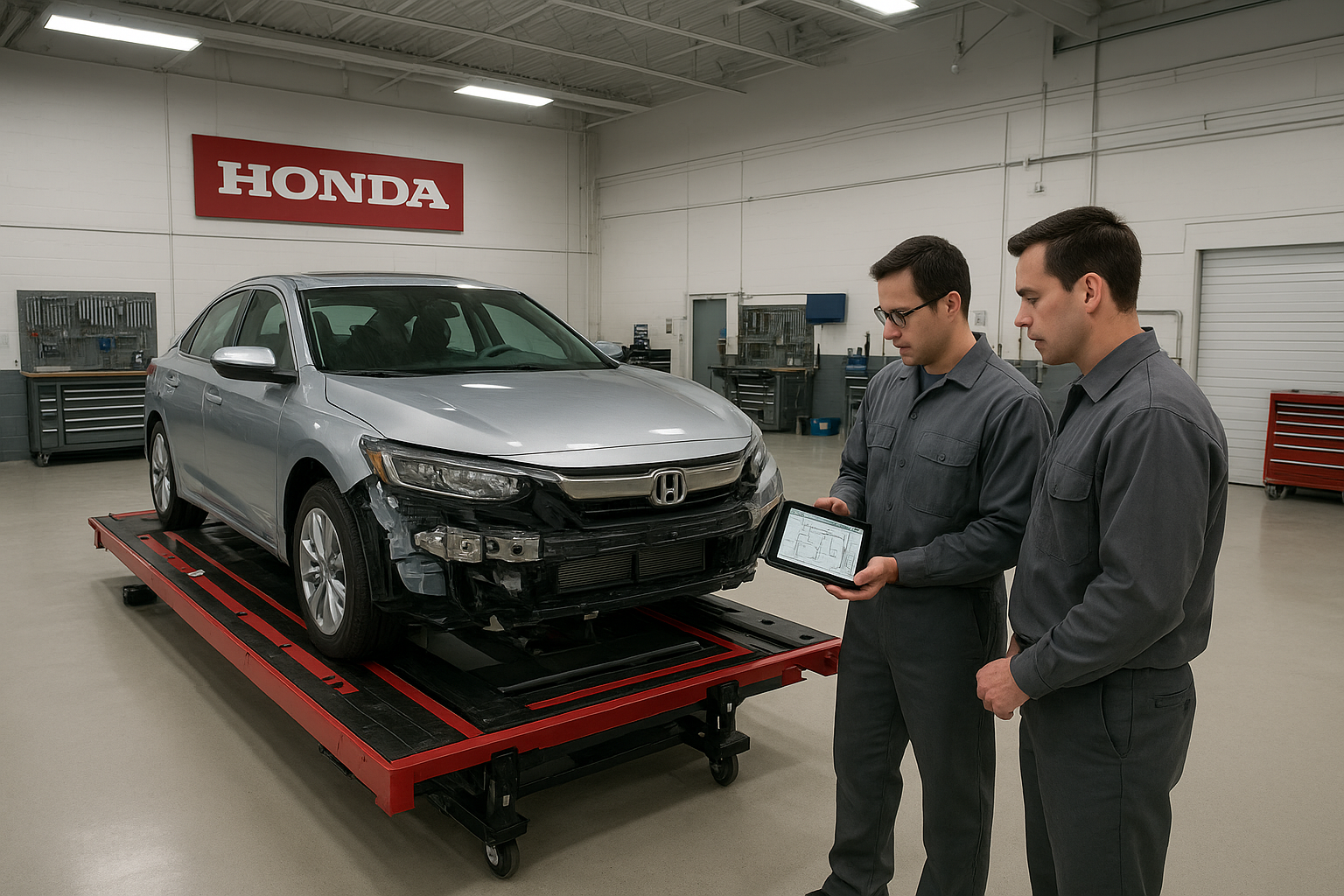
Honda certified collision center: your complete 2026 guide

A Honda certified collision center focuses on OEM repair methods, specialized equipment, and trained technicians.
If you drive a Civic, Accord, CR?V, Pilot, or any Honda equipped with advanced driver-assistance features, choosing a Honda certified collision center is the most reliable way to bring your vehicle back to pre-loss safety and value. This guide explains what certification really means, how to verify it, the repair steps you should expect, and how local drivers can get started with a trusted resource in North Orange County.
What “Honda certified collision center” really means
Certification signals that a body shop meets Honda’s standards for training, equipment, facility, and access to OEM repair information. In practice, it means:
- Technicians complete brand-specific training that covers Honda materials (including ultra-high-strength steel and structural adhesives) and model-year changes.
- The facility maintains factory-approved tools such as spot welders for boron steel, structural measuring systems, and resistance weld testing devices.
- The shop follows Honda repair procedures and position statements rather than guesswork or “what worked last time.”
- Preferred use of Honda Genuine Parts for structural and safety-related areas to preserve crash performance, corrosion resistance, and fit.
- Post-repair diagnostics and calibrations for cameras, radar, and ultrasonic sensors that support Honda Sensing features.
The payoff: your vehicle’s complex safety systems and crash energy management are restored as designed—critical for both everyday driving and future resale value.
How to verify a Honda certified collision center
Reliability begins with verification. Here’s a straightforward approach:
- Ask the shop to show current proof of Honda certification and any related training records.
- Confirm they have access to Honda’s service information and follow model-specific repair procedures for your exact VIN.
- Request a walkthrough of their calibration process for Honda Sensing (more on that below).
- Review parts usage on your estimate—Honda Genuine vs. aftermarket or recycled—and where each is appropriate.
- Look for a documented quality-control checklist and warranty policy on refinish and workmanship.
When you compare shops, you’ll often find that the lowest initial estimate leaves out required procedures. A truly qualified Honda certified body shop will itemize those steps up front so there are fewer surprises later.
From estimate to delivery: the repair process at a Honda certified collision center
While every claim is unique, the most professional shops follow a predictable, transparent workflow:
1) Intake, documentation, and blueprinting
Expect a thorough intake with photos, pre-scan diagnostics, and “blueprinting”—a full disassembly to uncover hidden damage before parts orders are finalized. This prevents delays mid-repair.
2) Structural measurement and repairs
Your Honda’s body structure is engineered to manage crash forces in precise ways. Certified facilities use computerized measuring systems and manufacturer-approved anchoring to correct structural and suspension alignment within tight tolerances.
3) OEM procedures, welds, and corrosion protection
Honda specifies where to section panels, what welds to use, and when to apply adhesive bonding. After repairs, technicians restore corrosion protection with seam sealers, cavity wax, and primer systems so your vehicle resists rust long term.

The Honda collision repair workflow, from blueprinting to final quality control and ADAS calibration.
4) Paint, color matching, and curing
Modern Hondas use multi-stage finishes (including pearls) that require precise color formulation, controlled bake cycles, and blending adjacent panels for an invisible repair. Booth cleanliness and air movement are key to a factory-grade finish.
5) Reassembly, diagnostics, and calibration
After paint, technicians reassemble components with correct torque specs and fasteners, then run a post-scan. If your Honda uses cameras, radar, or ultrasonic sensors, a proper calibration follows so features like Lane Keeping Assist or Adaptive Cruise Control function as designed.
Why OEM parts and procedures matter on Hondas
Honda engineering balances light weight, crash performance, and repairability using a mix of steels and strategic adhesives. Substituting untested parts or skipping a specified weld pattern can upset that balance. Here are examples where OEM fidelity is essential:
- High-strength structures: Some rails and reinforcements are not sectionable and must be replaced entirely to preserve crash energy paths.
- Sensor mounts and brackets: Even small deviations in mounting position or material thickness can misalign Honda Sensing hardware, leading to false alerts or reduced system performance.
- Corrosion strategy: The sequence—bare metal prep, primers, seam sealing, cavity wax—protects internal seams that are otherwise invisible after assembly.
ADAS calibration for Honda Sensing: what to expect
Many late-model Hondas rely on camera- and radar-based systems. After certain repairs—front or rear bumper replacement, radiator support work, windshield replacement, or suspension alignment changes—calibration is not optional. A Honda certified collision center will determine whether static, dynamic, or combined calibration is required and perform it with targets, precise distances, and level floors per OEM specs.

Proper ADAS calibration ensures Honda Sensing features like ACC and LKAS work correctly after repairs.
Insist on documentation showing which calibrations were performed, target measurements, and post-repair scan results. This paperwork is valuable for your records and future resale.
Insurance, timing, and cost: aligning expectations with quality
Insurers may recommend preferred shops, but you have the right to choose the repairer. Quality-focused facilities will coordinate with adjusters while defending OEM-required procedures. Timeframes vary based on parts availability, structural complexity, and calibration scheduling. A transparent shop will give you a realistic timeline, update you proactively, and avoid rushing steps that affect safety.
Considering options in North Orange County?
If you’re comparing estimates near Brea, Fullerton, La Habra, or Yorba Linda, explore Brea Auto Body as a convenient resource for collision repair services and to request an estimate. Review their process, ask about Honda-specific training, and confirm calibration capabilities to ensure your Honda is restored correctly.

Accurate color matching and controlled refinishing help your Honda look factory-fresh.
Quick answers: Honda certified collision center FAQs
Do I need a Honda certified collision center after a minor crash?
Even minor damage can affect sensors, bumper absorbers, or mounting points. Certification increases the likelihood the correct OEM steps are followed, minimizing safety and drivability risks.
Will aftermarket parts void my warranty?
Using non-OEM parts doesn’t automatically void a warranty, but structural and safety areas often require Honda Genuine Parts to maintain crash performance. Ask your shop to explain part choices line by line.
Is calibration always required after windshield or bumper work?
Often yes. If your model’s camera or radar is disturbed, a calibration per OEM specs is needed to restore Honda Sensing performance.
How can I learn more straight from the manufacturer?
Review official resources from Honda for ownership and maintenance guidance at owners.honda.com, and learn about technician training standards at I?CAR.
The bottom line
Your Honda was engineered with precise materials, welds, and safety systems. A Honda certified collision center follows the OEM roadmap to rebuild that precision—using the right parts, procedures, and calibrations. If you’re local to North Orange County and ready for a transparent estimate process, start with a trusted nearby option: Brea Auto Body. Ask the right questions, verify certification, and drive away confident that your Honda is repaired the way its engineers intended.

