

Insurance Approved Body Shop: How It Works, What to Expect, and How to Choose the Right Collision Center

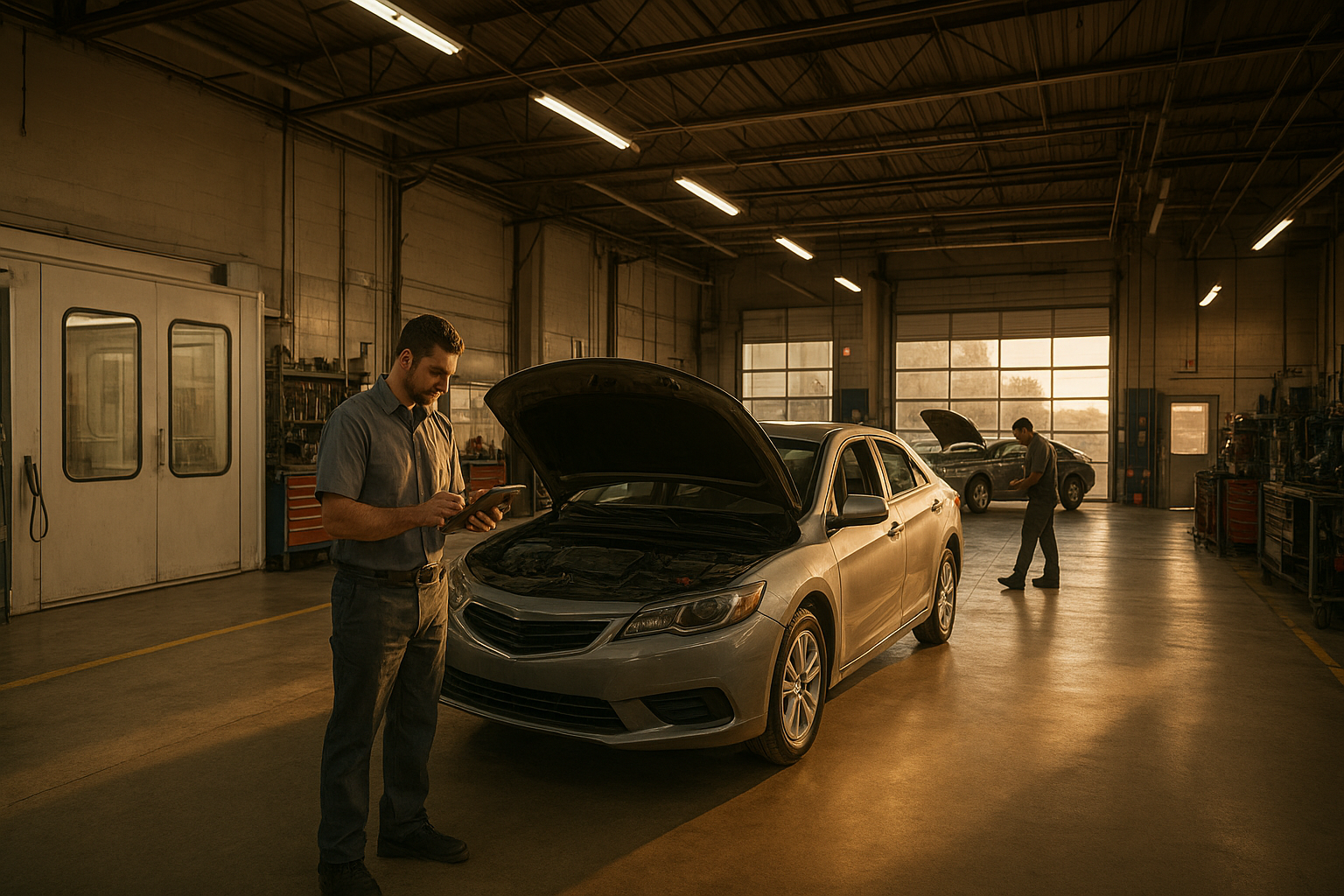
A modern insurance approved body shop ready to diagnose and restore your vehicle.
An insurance approved body shop is a collision repair facility that has been vetted and pre-authorized by your insurer to handle claims repairs — meaning faster processing, guaranteed communication, and often a backed warranty on the work.
If you’ve just filed a claim after a fender-bender or a serious collision, you’ll quickly encounter the phrase “insurance approved body shop.” However, what it actually means — and how it affects repair quality, timing, cost, and your warranty — is rarely explained clearly. This comprehensive guide demystifies the term completely. Furthermore, it shows you how insurer Direct Repair Programs (DRPs) work, what credentials to look for, and how to confidently choose the best collision center for your situation.
What Does “Insurance Approved Body Shop” Actually Mean?
An insurance approved body shop is a collision repair facility that meets a specific insurer’s participation criteria. In most cases, these shops operate within a Direct Repair Program (DRP) — a formal agreement where the insurer pre-authorizes the shop to write and process estimates on the carrier’s behalf. Insurers vet DRP shops for equipment standards, technician training, cycle time performance, customer satisfaction scores, documentation practices, and warranty policies.
For you as a vehicle owner, the primary benefits include a streamlined claims process, faster communication between shop and insurer, reduced paperwork burden, and typically a lifetime repair warranty backed by the facility. In addition, many DRP shops have dedicated insurance liaisons who handle supplement submissions and rental coordination directly — so you don’t have to make those calls yourself.
However, insurer approval is not the only indicator of repair quality. Many outstanding independent collision facilities deliberately choose to remain outside DRP agreements. They do this specifically to retain full autonomy over pricing, parts selection, and repair methodology. Consequently, a shop’s absence from an approved list does not automatically mean it is inferior.
Furthermore, in most U.S. states you have a legal right — sometimes called “right to choose” — to select any licensed collision repair facility you prefer, regardless of insurer recommendation. Approval status affects how the claim is administered, not your freedom to select the shop.
Bottom line: Use “insurance approved” as one quality signal among several. Always verify OEM procedure compliance, equipment investment, technician credentials, and the shop’s reputation before making your final decision.
How to Report a Claim and Engage an Insurance Approved Body Shop
Before your vehicle ever reaches a repair bay, you need to navigate the claims reporting process. Understanding each step up front helps you avoid delays and ensures your rights are protected from the very beginning.
Step 1: Report the Claim to Your Insurer
Report your claim as soon as possible — ideally within 24 hours of the incident. Most insurers offer multiple channels: a mobile app, online portal, or direct phone line to their claims department. When you report, have your policy number, the date and location of the loss, a description of the damage, and the other party’s information if applicable. Specifically, note whether anyone was injured, as that affects how the claim is routed.
Step 2: Receive Your Claim Number and Assignment
Your insurer will assign a claim number and, in most cases, a dedicated claims representative or adjuster. Therefore, write this number down immediately — you’ll reference it throughout the entire repair process. At this stage, your insurer may suggest a list of insurance approved body shops in their DRP network. However, remember: that list is a suggestion, not a requirement.
Step 3: Choose Your Repair Facility
This is your decision to make. You may choose a shop from the insurer’s approved list, or you may select an independent facility that is not on any approved list. In either case, the insurer is obligated to pay for covered repairs up to your policy limits. As a result, your primary criteria should be quality, credentials, and trust — not simply whether a shop appears on a carrier’s roster.
Step 4: Authorize the Estimate and Teardown
Once you deliver your vehicle, sign authorizations for the estimate and for teardown if applicable. Specifically, a written authorization protects both you and the shop. At an insurance approved body shop operating within a DRP, the shop communicates the estimate directly with your insurer — often through a shared estimating platform — which significantly reduces your administrative burden.
The Full Repair Workflow at an Insurance Approved Body Shop
While every insurer and shop has its own nuances, the repair workflow at an insurance approved body shop consistently follows a structured, documentation-driven process. Understanding each phase helps you set realistic expectations and ask the right questions.

The insurance claim and collision repair workflow from intake to delivery.
Phase 1: Check-In, Photography, and Pre-Scan
At drop-off, the shop verifies your claim number, captures comprehensive photographs of all damage angles, and performs an electronic pre-scan of the vehicle’s onboard diagnostic systems. Pre-scans reveal fault codes triggered by the collision impact — even when no warning lights are illuminated on the dashboard. Consequently, this step is critical because it guides a more accurate and complete estimate from the outset.
Phase 2: Initial Estimate vs. Blueprint Estimate
You’ll receive a preliminary estimate first. However, the definitive estimate — often called the blueprint estimate — is produced during teardown, when panels are removed and hidden structural or mechanical damage becomes visible. Insurance approved body shops document newly discovered damage through a formal supplement request submitted to your insurer with supporting photographs and measurements. This process is completely routine and expected in collision repair.
Phase 3: Parts Selection Grounded in Safety and OEM Guidance
Parts are sourced according to your policy language, safety considerations, and manufacturer guidance. The main categories are:
- OEM new parts — manufactured by the original automaker to factory specification.
- OEM remanufactured parts — factory-rebuilt originals that meet OEM tolerances.
- Quality aftermarket parts — third-party alternatives certified to meet or exceed OEM fit and finish standards.
- Reconditioned/used parts — salvage-grade components, appropriate for certain non-structural applications.
For safety-critical components and anything involving Advanced Driver Assistance Systems (ADAS), most automakers and reputable shops strongly recommend OEM parts. The reason is straightforward: sensor housings, mounting brackets, and structural members must meet exact tolerances for proper calibration and crash performance. A reputable insurance approved body shop will explain the rationale for every parts decision on your estimate line-by-line.
Phase 4: Structural Repair, Welding, and Mixed Materials
Modern vehicles are built from mixed materials — high-strength steel, boron steel, aluminum alloys, and composite panels. Each material requires specific repair procedures, welding equipment, and bonding agents. For example, aluminum cannot share tools with steel without causing galvanic corrosion. Therefore, a properly equipped shop maintains dedicated, isolated aluminum repair workstations entirely separate from their steel repair areas. The shop’s blueprint references OEM repair documentation to ensure structural integrity and crash performance are fully restored.
Phase 5: Refinishing, Color Matching, and Bake-Cure
Paint refinishing at a quality insurance approved body shop involves computerized color-matching technology and physical spray-out test cards — both used together to achieve a seamless, invisible blend with your vehicle’s existing finish. Furthermore, a bake-cure paint booth controls temperature and airflow with precision, producing a consistent, durable result that resists chipping, fading, and peeling over time.
Phase 6: ADAS Calibration and Post-Repair Scanning
This phase is among the most consequential in modern collision repair. Advanced Driver Assistance Systems — including lane departure warning, automatic emergency braking, adaptive cruise control, and blind-spot monitoring — all depend on sensors and cameras aimed to precise manufacturer specifications. After any repair that affects the front fascia, windshield, hood, suspension geometry, or wheel alignment, these systems must be formally recalibrated.
Specifically, there are two types of calibration: static calibration, performed in a controlled shop environment using target boards and manufacturer software, and dynamic calibration, performed during a road drive at specified speeds and conditions. A post-repair electronic scan then confirms all fault codes are cleared and all systems are reading within specification. Skipping either step can leave critical safety features silently impaired — a risk no reputable shop should take.
Phase 7: Quality Control, Test Drive, and Delivery
Before your vehicle is returned, a structured quality control inspection verifies panel gaps, paint uniformity, trim alignment, sensor status, and overall drivability. A test drive confirms ride and handling feel normal and that no warning indicators appear under real driving conditions. At delivery, your service advisor reviews the complete itemized invoice, warranty documentation, and any maintenance guidance for new paint surfaces.
Credentials That Define a Quality Insurance Approved Body Shop
Because vehicle technology evolves rapidly, ongoing investment in training and equipment is what separates trustworthy insurance approved body shops from those that simply have a carrier’s name on their door. Specifically, look for these verifiable credentials:
OEM Repair Procedure Compliance
Automakers publish detailed, model-specific repair procedures covering sectioning locations, weld patterns, rivet spacing, adhesive types, torque specifications, and calibration sequences. A shop that subscribes to these manufacturer repair portals — and can demonstrate they follow them — is performing repairs to the same standard the factory intended. In contrast, a shop that repairs “by feel” or relies solely on estimating software rather than OEM documentation may unknowingly compromise your vehicle’s crash performance.
I-CAR Gold Class and Role-Specific Certifications
I-CAR (Inter-Industry Conference on Auto Collision Repair) is the collision industry’s primary training and credentialing organization. I-CAR Gold Class — the industry’s highest team-based recognition — requires every role in the shop (estimators, structural technicians, non-structural technicians, and refinishers) to complete ongoing annual training. Consequently, a Gold Class designation signals a culture of continuous improvement, not a one-time achievement.
In addition to I-CAR, many automakers offer brand-specific certification programs — for example, Tesla Approved, Rivian Certified, or OEM programs from Ford, GM, BMW, and others. These programs require specific tooling, training, and procedural compliance verified through audits. If you drive a late-model or EV vehicle, specifically seeking a shop with your brand’s certification is strongly advisable.

Precise ADAS calibration ensures advanced safety systems function correctly after collision repair.
Essential Equipment Investments
Ask about the shop’s tooling before committing. Specifically, a properly equipped insurance approved body shop should have:
- Frame bench with 3D measuring system — verifies structural alignment to within millimeters of factory specification.
- Dedicated aluminum repair workstations — isolated from steel work areas to prevent contamination.
- OEM-capable scan tools — reads and clears manufacturer-specific fault codes, not just generic OBD-II codes.
- ADAS calibration targets and software — for both static and dynamic calibration procedures.
- Modern paint booth with bake-cure capability — temperature-controlled with dust extraction for consistent finish quality.
- Squeeze-type resistance spot welder (STRSW) — required for OEM-compliant welding on high-strength steel panels.
These investments reduce repair comebacks, help the shop meet insurer cycle-time targets, and — most importantly — ensure your vehicle is returned to pre-loss condition safely.
Timing, Cost, and Your Deductible — Realistic Expectations
One of the most common sources of frustration after a collision is a mismatch between expected and actual repair timelines. Therefore, understanding the variables that drive repair duration and cost helps you plan more effectively.
What Drives Repair Time
Three primary variables determine how long you’ll be without your vehicle: parts availability, the need for sublet services (such as calibration, glass replacement, or wheel alignment), and supplement approval turnaround from your insurer. Mild cosmetic repairs — a bumper scuff, a single dented door panel — can often be completed in two to four business days. Structural repairs, frame straightening, and ADAS-heavy jobs may require two to four weeks, particularly when specialty parts are backordered from the manufacturer.
Additionally, during high-demand periods — such as after regional weather events or during supply chain disruptions — even straightforward repairs may take longer than usual. Consequently, ask your shop to give you a realistic milestone schedule at the time of drop-off, including estimated parts arrival and paint timing.
What You’ll Pay Out of Pocket
Your direct out-of-pocket cost typically equals your policy deductible, plus any non-covered items you specifically authorize — for example, choosing OEM parts when your policy specifies aftermarket equivalents. A transparent insurance approved body shop will explain every choice up front, identify any insurer caps or restrictions, and obtain your written consent before proceeding with upgrades or changes that affect cost.
Similarly, if your policy includes a diminished value clause — meaning your vehicle’s market value may be lower after a collision even after proper repair — this is worth discussing with your insurer at the time you file. Some states allow you to make a separate diminished value claim against the at-fault party’s insurer.
Rental Vehicle Coordination
Review your policy’s rental reimbursement limits carefully — specifically the daily maximum and the total cap for the claim. Insurance approved body shops operating within a DRP typically coordinate rental pickup to match your vehicle’s drop-off date and return to match the delivery date, minimizing out-of-pocket rental overage charges. In contrast, managing rental timing independently when using a non-DRP shop requires more vigilance on your part.
How to Choose the Right Insurance Approved Body Shop: A Complete Checklist
Use the following criteria to evaluate any collision center thoroughly — whether it’s on an insurer’s approved list or not. The goal is to find a shop that consistently produces safe, accurate, and durable repairs, not simply one that processes claims quickly.
? Documentation Discipline
Ask to see sample repair files that cite specific OEM procedures, include pre- and post-repair photographs, and attach pre- and post-scan reports. A shop that documents comprehensively is one that repairs comprehensively.
? On-Site ADAS Calibration Capability
Specifically confirm whether calibration is performed in-house or through a documented sublet partner. In addition, ask whether wheel alignment is checked whenever suspension components or structural geometry is affected — it should be.
? Mixed-Materials Expertise
Ask how the shop handles aluminum panels and high-strength steel. Specifically, verify that aluminum work is performed in a dedicated, isolated area. Shops that use shared tooling across materials risk cross-contamination that can cause long-term corrosion.
? Paint Quality and Color Match Process
Ask whether the shop uses computerized spectrophotometer color matching, produces physical spray-out test cards, and uses a recognized waterborne or solvent refinish system. Furthermore, ask for a written paint warranty — not just a verbal commitment.
? Lifetime Workmanship Warranty
A reputable insurance approved body shop should offer a lifetime warranty on workmanship — meaning as long as you own the vehicle. Additionally, ask whether the warranty transfers to a new owner if you sell, which can protect your vehicle’s resale value.
? Proactive Communication Standards
Confirm how updates are delivered — text, email, or both — and at what repair milestones. Specifically, you should expect check-ins at teardown completion, parts arrival confirmation, paint start, and pre-delivery QC. Shops that communicate proactively rarely produce unpleasant surprises at pickup.
? Verified Online Reputation
Look for consistent reviews that specifically mention estimate accuracy, paint match quality, and how the shop handled unexpected problems — not just how fast they finished. A shop with 4.8 stars and 300+ reviews that discuss process detail is far more trustworthy than one with 5 stars and 12 reviews.
Finally, when comparing shops, ask each one to walk you through a recent similar repair — what made it complex, how they validated the structure, and what the post-scan showed. The best facilities are proud to demonstrate their process and paperwork. A shop that hesitates to show you documentation is one worth reconsidering.
Understanding Your Rights When Filing a Claim
Many vehicle owners don’t realize how many rights they have in the claims and repair process. Consequently, they accept situations that are fully within their power to change. Understanding these rights ensures you get the repair your vehicle deserves.
Right to Choose Your Repair Facility
In virtually every U.S. state, you have the right to choose any licensed collision repair facility — regardless of whether it is on your insurer’s approved list. Your insurer cannot legally require you to use a specific shop as a condition of coverage. However, if you choose a non-DRP shop, you may need to manage more of the communication and documentation process yourself.
Right to a Thorough and Accurate Repair
Your insurer is obligated to return your vehicle to its pre-loss condition — meaning the state it was in before the accident. Furthermore, this obligation extends to structural integrity, mechanical function, safety systems, and cosmetic appearance. If a repair estimate is insufficient to achieve pre-loss condition, your shop has the right to submit supplements, and you have the right to advocate for them.
Right to Request OEM Parts
Depending on your policy language and your state’s regulations, you may have the right to request OEM parts — particularly for vehicles still under manufacturer warranty or for safety-critical components. Specifically, some states have enacted legislation requiring insurers to disclose when non-OEM parts are being used and to obtain your consent. Ask your claims representative about your policy’s parts specification language before the repair begins.
Right to Dispute the Estimate
If you believe the insurer’s estimate is insufficient to cover a proper repair, you may dispute it. Most policies include an appraisal clause — a formal dispute resolution process where independent appraisers review the damage and agree on a fair repair value. As a result, you are never obligated to accept the first number offered if it doesn’t reflect the true cost of restoring your vehicle.
Frequently Asked Questions About Insurance Approved Body Shops
Do I have to use the shop my insurer recommends?
No — you can choose any licensed collision repair facility in virtually every state. Using an insurer-recommended insurance approved body shop may streamline paperwork and rental coordination. However, the final choice is entirely yours, and your insurer cannot penalize you for choosing a different qualified shop.
Will an insurer-approved shop always use OEM parts?
Not necessarily. Parts decisions are guided by policy language, safety requirements, parts availability, and OEM position statements. For safety-critical components and ADAS-related items, OEM parts are strongly advisable. Ask your shop to explain their parts rationale for each significant line item on your estimate.
What happens if more damage is found during the repair?
The shop submits a supplement request to your insurer — supported by photographs and documentation of the newly discovered damage. This is a completely standard and expected part of the collision repair process. Consequently, it does not mean the shop missed something initially; hidden structural damage simply cannot always be seen until panels are removed.
Is the paint finish covered by a warranty?
Reputable shops offer a lifetime workmanship warranty covering paint and refinish for as long as you own the vehicle. Always ask for this warranty in writing at delivery, and confirm whether it transfers to a new owner if you sell the car.
What is a Direct Repair Program (DRP), and should I use a DRP shop?
A DRP is a formal partnership agreement between an insurer and a collision repair facility. DRP shops process claims more efficiently because they communicate directly with the insurer’s systems, often without requiring you to act as an intermediary. However, DRP participation does not guarantee superior repair quality on its own. Therefore, evaluate DRP shops and non-DRP shops using the same credential and equipment criteria.
How long will my collision repair take?
Timeline depends on damage severity, parts availability, and whether sublet services (calibration, glass, alignment) are required. Minor cosmetic repairs often complete in two to four business days. Structural repairs or those involving significant ADAS recalibration may take two to four weeks. Ask for a milestone-based timeline at drop-off so you can plan accordingly.
Can I dispute my insurer’s repair estimate?
Yes. If the insurer’s estimate is insufficient to cover a proper repair, your shop can submit supplements with supporting documentation. Furthermore, if a disagreement persists, most policies include a formal appraisal clause — an independent review process that can resolve valuation disputes without litigation.
Looking for a Trusted Insurance Approved Body Shop?
If you’re looking for an experienced team that combines seamless insurer coordination with OEM-compliant craftsmanship, explore the repair capabilities and customer support process at Brea Auto Body — insurance approved body shop services. Their site outlines repair capabilities, claims management, and how they guide your vehicle from initial estimate to final delivery.
Prefer to talk it through first? Reach out via the contact options on breaautobody.com to start your estimate and get expert guidance on claim documentation, rental coordination, and repair planning.

