

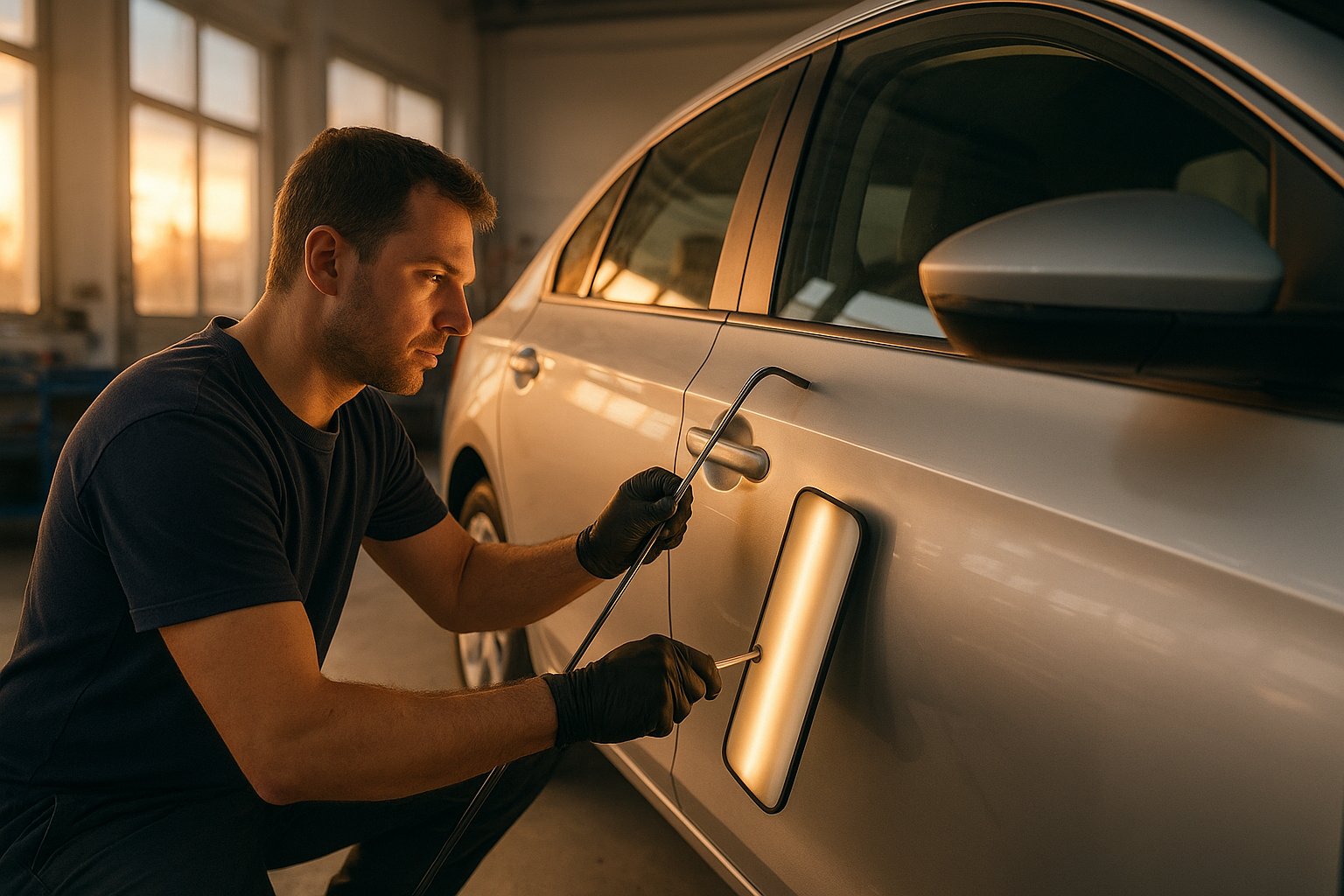
Paintless Dent Repair vs Traditional Dent Repair: Which Is Best for Your Car?

A side-by-side look at paintless dent repair vs traditional dent repair starts with understanding the tools and the finish they deliver.
If you’re weighing paintless dent repair vs traditional dent repair, you likely want the best balance of cost, turnaround time, and a factory-quality finish. This guide breaks down how each method works, when each is the smarter choice, and what to consider before you book an estimate. By the end, you’ll know exactly which repair path fits your dent, your budget, and your timeline.
What is Paintless Dent Repair (PDR)?
Paintless dent repair is a precision technique that reshapes metal from behind the panel to remove dents without sanding, body filler, or repainting. Using slender rods, glue tabs, and reflection lights, a skilled technician massages the metal back to its original geometry. Because the factory paint is preserved, you retain the OEM finish and avoid the risks of color mismatch or texture differences.
PDR excels on:
- Small to moderate dents where the paint is not cracked or chipped.
- Door dings, parking-lot impressions, and hail damage clusters.
- Broad, shallow dents with accessible panel backs (doors, hoods, roofs, fenders).
Limitations include sharp creases at body lines, edge damage where metal is overstretched, and any area where paint is fractured or missing—cases better suited to conventional methods.
What is Traditional Dent Repair?
Traditional dent repair (sometimes called conventional body repair) restores panels by pulling or filling the damaged area, then refinishing the surface. The steps typically include panel prep, dent pulling or filling, sanding, primer, color coat, and clearcoat, followed by blending adjacent panels where necessary to achieve a seamless visual match.
Traditional methods are ideal when:
- The paint is cracked, chipped, or missing.
- The dent has a sharp crease, stretched metal, or sits at a panel edge.
- Corrosion is present or the substrate needs structural correction before refinishing.
The tradeoff is more labor, materials, and drying/curing time, but it enables complete restoration in scenarios that PDR cannot address.
Paintless Dent Repair vs Traditional Dent Repair: Head?to?Head Comparison

At-a-glance comparison of cost, time, finish, and other decision factors.
Finish and Resale Value
PDR preserves your original factory paint, which helps maintain texture, color depth, and long-term resale value. Traditional repairs can also look excellent when performed by a qualified shop, but they replace the OEM finish with a refinish system. Blending is often required for an invisible match, particularly on metallic or pearl paints.
Turnaround Time
PDR jobs often finish same day or within 24–48 hours for larger hail sets. Traditional repairs take longer due to bodywork, curing, and potential parts ordering—think several days to a couple of weeks depending on scope and scheduling.
Cost Drivers
PDR tends to cost less for eligible dents because it avoids costly paint materials and blend labor. Traditional repair costs scale with bodywork complexity, paint/clear usage, and the number of panels requiring blending. Severe damage, multiple panels, or color-matching challenges increase conventional repair totals.
Environmental Impact
With no primer, color, or clearcoat involved, PDR produces minimal waste and avoids solvent emissions. Conventional refinishing is more material-intensive, though reputable shops use advanced filtration and compliant coatings to minimize environmental impact.
Insurance, Deductibles, and Diminished Value
Insurance carriers commonly approve both methods. For hail events, PDR is often the default when feasible. If you’re managing a deductible, PDR’s lower cost can reduce out-of-pocket expense. Preserving the factory finish can also help minimize the risk of diminished value assessments at resale.
How to Decide Which Method Fits Your Damage
Use this quick framework to match your dent to the right approach:
- Paint intact and dent shallow? PDR is likely the best mix of speed and savings.
- Paint cracked, metal stretched, or dent on an edge? Traditional repair is the reliable choice.
- Multiple small dings or hail? PDR scales efficiently across many dents.
- Lease return or resale soon? PDR helps you keep the OEM finish and avoid repaint flags on inspections.

Simple decision flow to help choose paintless dent repair or a traditional repair path.
Access and Panel Construction Matter
PDR requires physical access behind the panel. Interior trim, hood liners, or headliners may need removal to reach the dent. Aluminum and high-strength steel panels are repairable with PDR in many cases, but they may demand additional time and advanced technique. Traditional repair is less constrained by back-side access.
Color, Pearls, and Blending
Some paint colors—especially pearls and tri-coats—are harder to match perfectly. If your paint is intact, PDR helps you avoid the need to blend. If repainting is necessary, choose a shop that demonstrates strong color-matching capability and explains when blending will be used for a seamless result.
Common Myths and Mistakes
Myth: “PDR is only for tiny dings.” Skilled technicians can remove surprisingly large dents without paintwork if the metal isn’t overstretched and the paint remains sound.
Myth: “Traditional repair always looks obvious.” Quality shops deliver excellent results with proper prep, materials, and blending. The key is craftsmanship and process control.
Mistake: Waiting too long. Heat cycles and time can ‘set’ a dent, making both PDR and conventional work more complex. Early assessment often yields better outcomes.
Mistake: Chasing the lowest bid. Underpriced work often skips necessary steps. Ask how the repair will be performed, what warranty is offered, and what finish standard you can expect.
Choosing a Qualified Shop
Whether you pursue PDR or a traditional repair, look for a shop that documents the damage, explains the repair plan in plain language, and provides a written estimate. Certifications, clean workspace, and consistent before/after photos are good signs. For a convenient starting point—estimates, timelines, and repair options—visit Brea Auto Body to explore services and request guidance tailored to your vehicle.
Frequently Asked Questions
Will my dent disappear completely with PDR?
On ideal PDR candidates, results can be virtually undetectable. On borderline cases, technicians can significantly improve appearance, but a small trace may remain. An in-person evaluation sets realistic expectations.
Can traditional repair fix anything?
It covers the broadest range of damage, from sharp creases to paint failure. However, it involves more steps and may require blending adjacent panels for an invisible finish.
Is PDR safe for aluminum panels?
Yes—when performed by a trained tech with appropriate tools and lighting. Aluminum can “spring” differently than steel, so experience matters.
Bottom Line: Choose the Method That Fits the Damage
When your paint is intact and the dent is accessible, paintless dent repair is usually faster, less expensive, and better for preserving resale value. When paint is compromised, metal is stretched, or body lines are sharply creased, traditional dent repair is the right path to a factory-grade appearance. If you’re still uncertain, get a professional opinion—clear photos and a quick inspection go a long way.

Before-and-after comparison: when eligible, PDR restores the panel without repainting.
Ready to see what your vehicle needs? Start with a quick estimate and a transparent plan from a trusted local shop. Visit breaautobody.com and get guidance on paintless dent repair vs traditional dent repair for your specific dent.

