

Hit and Run Repair: The Complete Step-by-Step Guide to Fixing Your Vehicle and Protecting Your Rights
Last updated: 2025-07-14 | Estimated read time: 12 minutes
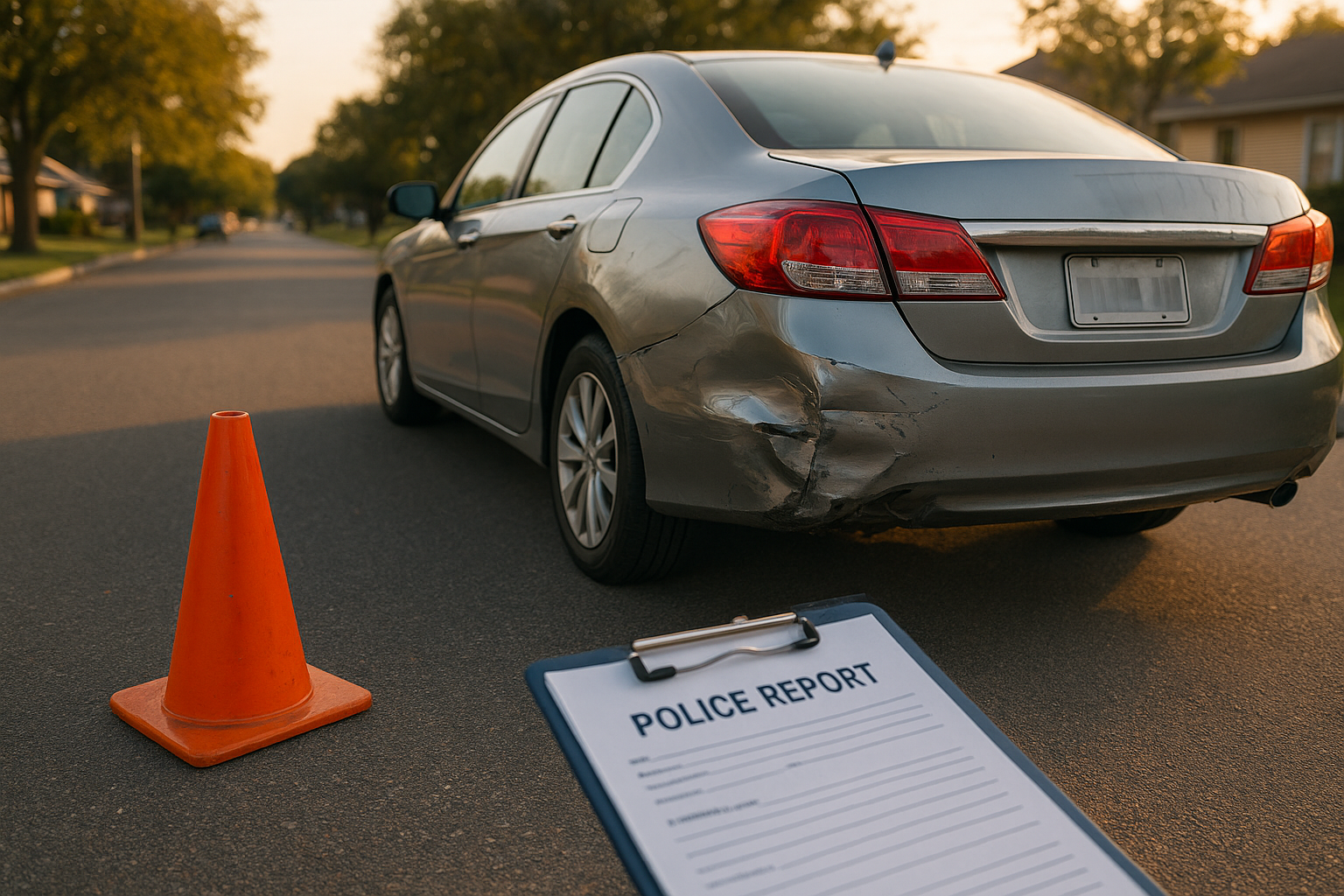
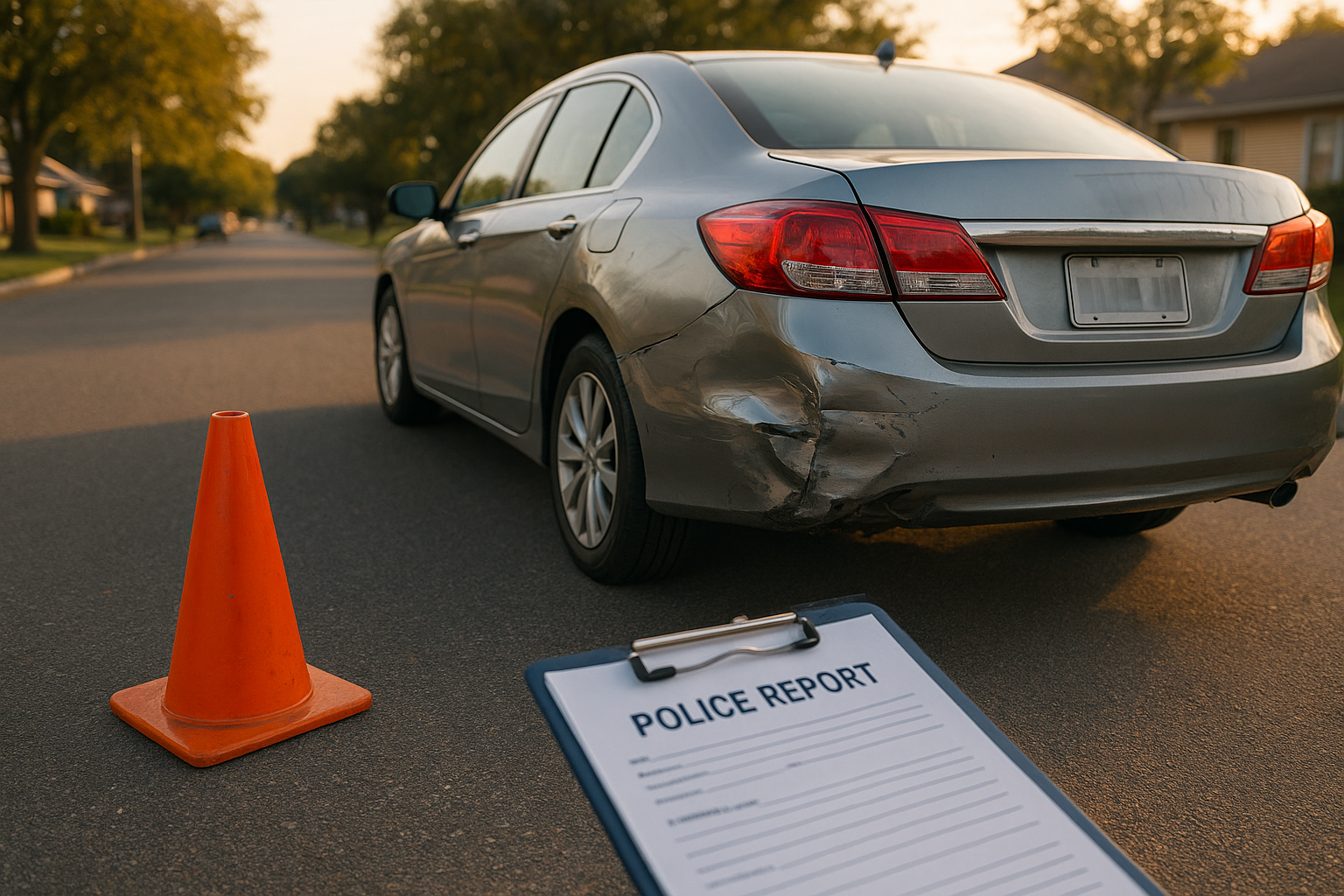
Hit and run repair begins with documenting damage and staying safe at the scene.
Quick Answer
If your vehicle was struck and the other driver fled, start by documenting the damage with photos, filing a police report immediately, and contacting your insurer. Hit and run repair is the process of professionally restoring a vehicle damaged by an unknown or fleeing driver — covering everything from bodywork and paint to structural repair and ADAS (advanced driver-assistance system) recalibration.
Discovering fresh damage on your parked car with no other driver in sight is frustrating and stressful. Hit and run repair is one of the most requested collision services in the country precisely because it combines bodywork, paint matching, structural correction, and critical electronic calibrations — all while navigating an insurance claim for a driver who didn’t stick around. This guide covers everything: what to do in the first minutes after a hit-and-run, how professional shops diagnose hidden damage, how insurance works, what the full repair process looks like, and how to protect your vehicle’s safety systems long-term.
Furthermore, this guide answers the legal questions many drivers overlook — including what hit-and-run actually means under the law, what your obligations are as the victim, and when you may have additional recourse beyond your own insurance policy.
What Is a Hit and Run? Legal Definition and Your Rights
A hit and run occurs when a driver involved in a collision — whether with another vehicle, a pedestrian, a cyclist, or stationary property — leaves the scene without stopping to identify themselves, exchange insurance information, or render aid where required. Specifically, all 50 U.S. states treat leaving the scene of an accident as a criminal offense, with penalties ranging from misdemeanor fines to felony charges depending on the severity of injuries involved.
As the victim, you have clear rights. In particular, you are entitled to file an insurance claim under your own collision or uninsured motorist coverage, and in some states you may pursue a civil claim if the driver is later identified. Above all, understanding these rights early prevents you from making costly mistakes — such as declining to file a police report — that can complicate your hit and run repair claim later.
Hit and Run as a Property Damage Event vs. an Injury Event
Most parked-car hit-and-run incidents involve property damage only. However, if you were inside the vehicle at the time of the collision, you may also have a personal injury component to your claim. In that case, uninsured motorist bodily injury (UMBI) coverage becomes relevant in addition to the property damage path covered throughout this guide. Consult a personal injury attorney if you experienced any physical symptoms after the incident — even seemingly minor ones like neck stiffness or headaches.
What to Do Immediately After a Hit and Run
The actions you take in the first 30 minutes after discovering hit-and-run damage directly affect both your safety and the quality of your repair claim. Therefore, follow these steps in order — don’t skip any of them.
Step 1 — Prioritize Safety First
If your vehicle is still in a traffic lane or an unsafe location, move it to the nearest safe area before doing anything else. Turn on your hazard lights. Do not place yourself in danger to examine the damage while traffic is moving nearby.
Step 2 — Look for Witnesses and Camera Footage
Scan the immediate area for potential witnesses — passersby, nearby business employees, or other parked drivers. Additionally, look for surveillance cameras on storefronts, ATMs, parking structures, traffic signals, and residential doorbells. Note the exact address or cross streets, because you or law enforcement can later request footage before it is overwritten. Many cameras recycle footage within 24–72 hours, so speed matters here.
Step 3 — Document the Damage Thoroughly
Photograph your vehicle from every angle before touching or moving anything near the damage. Specifically, capture:
- Close-up shots of every point of contact, including paint transfer, scratches, and dents
- Wide-angle shots showing your vehicle’s position in the lot or lane
- Any debris left at the scene — broken plastic, glass fragments, or paint chips from the other vehicle
- Surrounding context — street signs, store signs, or landmarks that confirm location
- A timestamp-enabled photo or a screenshot of your phone’s map app confirming location and time
Do not wash your vehicle before the adjuster or shop documents the damage. Paint transfer and micro-debris are valuable forensic indicators of impact angle and vehicle type, which can assist police in identifying the fleeing driver.
Step 4 — File a Police Report Immediately
Filing a police report is not optional — it is essential. Most insurers require a police report number to process a hit-and-run claim under collision or uninsured motorist property damage (UMPD) coverage. Call your local non-emergency police line or, in some jurisdictions, file an online report if you did not witness the collision happen. Provide all your photos, any witness contact information, and any debris or paint transfer details you documented.
Consequently, delaying the report — even by a day — can give your insurer grounds to question the timeliness of the claim, which may complicate the approval process for your hit and run repair.
Step 5 — Contact Your Insurance Company
Notify your insurer as soon as possible — ideally from the scene or immediately after filing the police report. Provide the report number, your photos, and the approximate damage description. Your insurer will explain which coverage applies, confirm your deductible, and walk you through next steps including whether they want to send an adjuster or direct you to an approved facility.
Step 6 — Assess Driveability
Before driving home, assess whether the vehicle is safe to operate. Specifically, check for:
- Warning lights on the dashboard — these may indicate sensor damage even if the exterior looks minor
- Fluid leaks under the vehicle
- Loose bumper covers or trim that could detach and become road debris
- Damaged headlights or taillights that create a legal or visibility issue
- Tire contact with wheel well, suggesting suspension or wheel damage
When in doubt, have the car towed to a trusted collision center for a professional assessment rather than risking further damage — or a traffic stop for an unsafe vehicle.
Insurance Coverage for Hit and Run Repair: A Full Breakdown
Understanding your coverage options before you file prevents frustrating surprises. In general, three types of coverage may apply to hit and run repair — and which ones you can use depends on your specific policy and your state’s laws.
Collision Coverage
Collision coverage is the most commonly used pathway for hit-and-run property damage. It covers the cost to repair your vehicle regardless of fault, subject to your deductible. For example, if repairs total $3,800 and your deductible is $500, your insurer pays $3,300. Collision coverage does not require identifying the other driver — which makes it particularly well-suited for hit-and-run incidents.
However, filing a collision claim does go on your insurance record, which may affect your premium at renewal. Ask your insurer whether your policy includes a “forgiveness” provision before filing.
Uninsured Motorist Property Damage (UMPD)
Uninsured motorist property damage (UMPD) coverage is available in most states and can cover hit-and-run damage with a lower deductible than collision in some cases. In contrast, some states explicitly exclude hit-and-run incidents from UMPD unless there is corroborating physical evidence or a witness. Check your policy language carefully or ask your agent. In states where it applies, UMPD can sometimes be used without affecting your collision history.
Rental Car Coverage
If your policy includes rental reimbursement, it will pay for a rental vehicle while your car is being repaired — typically up to a daily and total dollar limit. For instance, a common provision covers $35/day up to $1,050 total. Confirm your limits before renting, and note that hit and run repair timelines can extend to two or three weeks for complex structural or multi-panel jobs.
What If the Other Driver Is Later Identified?
If police later identify the fleeing driver, the case may shift from an uninsured motorist claim to a standard at-fault liability claim against the other driver’s insurance. In that scenario, your insurer may pursue subrogation — recouping what they paid from the at-fault driver — and your deductible may be refunded. Consequently, keeping your police report number and all documentation organized is critical even months after the repair is complete.
Can You Choose Your Own Repair Shop?
Yes — in virtually every state, you have the right to choose any licensed collision repair facility for your hit and run repair. Insurers may recommend their “preferred” or direct repair program (DRP) shops, which can streamline paperwork and approvals. However, those shops work within the insurer’s cost guidelines, which occasionally creates pressure to use non-OEM parts or skip certain calibration steps. Above all, choose a shop that will advocate for the correct repair on your behalf — not simply the cheapest one.
How Shops Assess Hit and Run Damage
A quality collision center goes far beyond a visual inspection. In fact, what you see on the surface is often a small fraction of what actually happened to the vehicle during impact. Expect a layered assessment process that includes disassembly, computerized measuring, and electronic scanning — all before a final repair plan is approved.
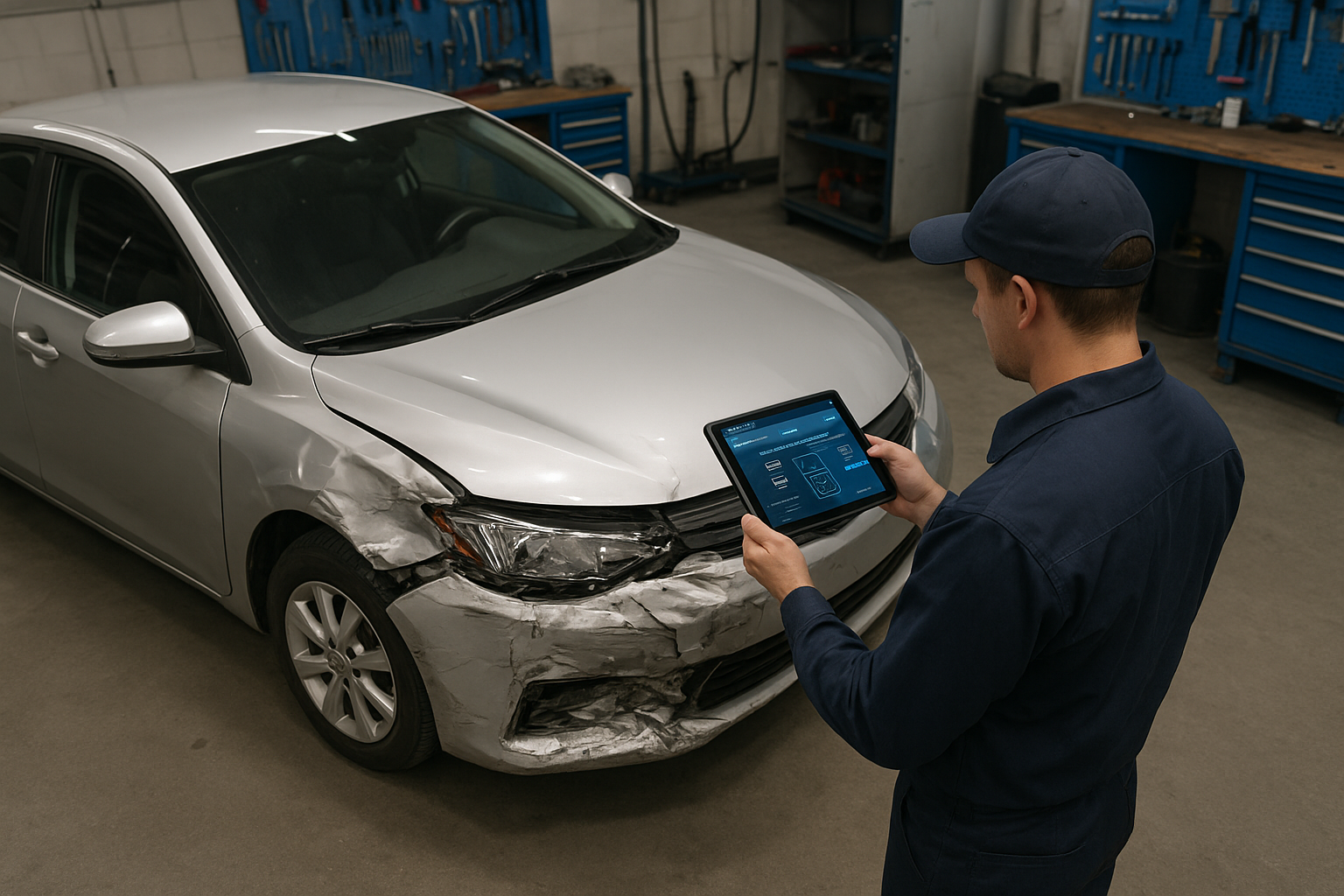
Thorough diagnostics catch hidden issues that affect hit and run repair quality and safety.
Hidden Damage You Can’t See From the Outside
Low-speed impacts — even ones that leave only a scuff or a small dent — can still transmit force deep into the vehicle’s structure. Specifically, areas commonly affected include:
- Bumper energy absorbers — the foam or plastic components behind the bumper cover that crush on impact and often need replacement even when the cover itself looks fine
- Bumper reinforcement bars — the structural steel or aluminum bar that backs the absorber; a bent bar compromises crash protection
- Crash sensors and brackets — impact sensors and PDC (parking distance control) sensors are often mounted on or near bumper assemblies and can be displaced or cracked
- Radiator supports and cooling components — front-end impacts frequently involve the radiator, condenser, or fan shroud
- Suspension and alignment geometry — under-body or corner impacts can bend control arms, knuckles, or subframe components, causing immediate or progressive alignment issues
- Active grille shutters and active air dams — aerodynamic components increasingly found on modern vehicles that affect fuel economy and cooling when damaged
Therefore, an initial visual estimate should always be treated as preliminary. Only after disassembly does the true scope of a hit and run repair become clear.
Computerized Frame and Unibody Measuring
Modern collision centers use computerized measuring systems — such as Car-O-Liner or Chief — that compare the vehicle’s actual dimensions against the manufacturer’s published specifications to the millimeter. As a result, structural misalignment that would be invisible to the naked eye gets identified and corrected before panels are reinstalled. This is especially important for unibody vehicles (which make up the vast majority of modern passenger cars), where the body structure itself is the frame.
Pre-Repair Electronic Scanning
Before any wrenches turn, a qualified shop will connect a diagnostic scan tool to the vehicle’s OBD-II port to retrieve any stored fault codes (DTCs — diagnostic trouble codes). These codes reveal which modules, sensors, or systems were affected by the impact. For example, a rear collision may store codes in the parking sensor module, the backup camera system, the rear cross-traffic alert radar, or even the stability control system. Knowing this upfront ensures that nothing is overlooked when writing the repair plan.
ADAS and Electronics: The Most Overlooked Part of Hit and Run Repair
Advanced driver-assistance systems — the umbrella term for technologies like automatic emergency braking, lane-keeping assist, blind-spot monitoring, and adaptive cruise control — are now standard on most vehicles built after 2018. These systems rely on a network of cameras, radar modules, ultrasonic sensors, and lidar units mounted in very specific locations around the vehicle.
Consequently, any collision that displaces a sensor, changes the ride height, replaces a windshield, or modifies the mounting geometry of a bumper can throw these systems out of alignment — even if the electronic component itself appears undamaged.
What Happens If Calibration Is Skipped?
Skipping ADAS calibration after hit and run repair can lead to dangerous real-world outcomes, including:
- Lane-departure warnings that trigger incorrectly or not at all
- Automatic emergency braking that activates at the wrong moment — or fails to activate when needed
- Adaptive cruise control that misreads following distance
- Blind-spot monitoring that consistently fails to detect adjacent vehicles
- Backup cameras and parking sensors that display distorted or inaccurate information
Above all, if a miscalibrated system fails to prevent a future accident, the liability implications — and the safety consequences — are severe. Therefore, ADAS calibration is not an optional add-on; it is a required part of any complete hit and run repair involving affected sensor zones.
Static vs. Dynamic Calibration
ADAS calibration comes in two forms. Static calibration is performed in the shop using precisely positioned targets and specialized equipment — it does not require driving the vehicle. Dynamic calibration, in contrast, requires driving the vehicle at specific speeds on clearly marked roads so the system can “learn” its environment and confirm correct operation. Some vehicles require both. Your repair shop should be able to specify which type your vehicle needs and provide documentation confirming calibration was completed to manufacturer specifications.
The Hit and Run Repair Process: Step by Step
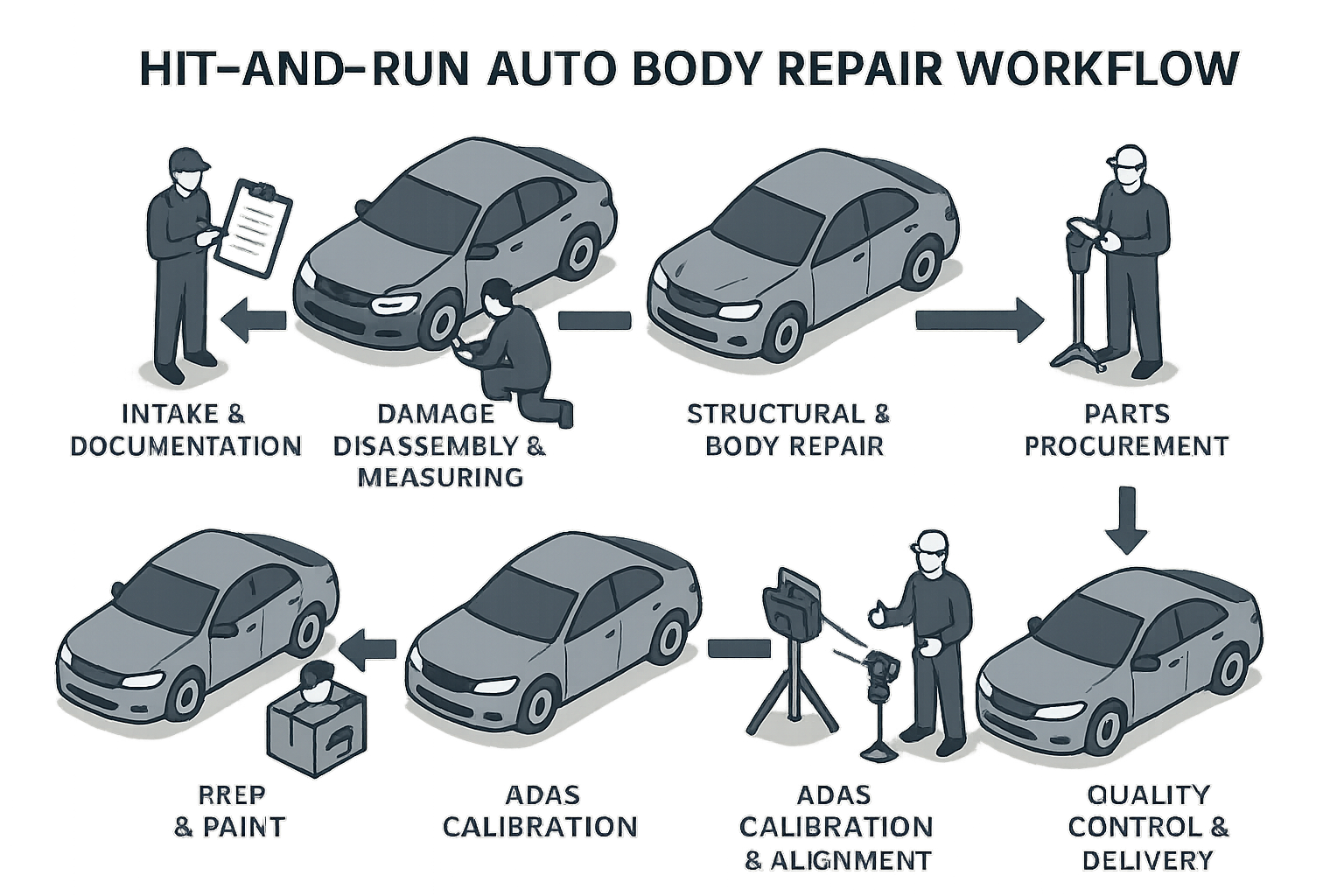
From intake to quality control, a structured workflow ensures a safe, OEM-grade hit and run repair.
A professional hit and run repair follows a structured, documented workflow. Each stage builds on the last — and each is critical to restoring your vehicle to pre-loss condition. Here is exactly what happens at a quality collision center:
Stage 1 — Intake and Documentation
On arrival, the shop photographs all damage in detail, records your concerns and any symptoms you noticed while driving, performs a pre-repair electronic scan, and writes a preliminary estimate. The insurer may authorize a formal teardown — where damaged panels are removed before a final repair plan is approved — to ensure the estimate accurately captures the full scope of work.
Stage 2 — Disassembly and Structural Measuring
Technicians remove trim, bumper covers, and damaged panels to expose the underlying structure. The vehicle is then placed on a computerized measuring system that checks dimensions against factory specifications. Any structural deviation — however small — is identified and documented before repairs begin. In addition, any previously hidden damage revealed during disassembly is photographed and added to a supplement for insurer approval.
Stage 3 — Structural and Body Repair
Using the vehicle manufacturer’s OEM (original equipment manufacturer) repair procedures — not generic practices — the team repairs or replaces structural components including bumper reinforcement bars, absorbers, crash sensors, sheet metal, and plastic assemblies. High-strength steel (HSS) and aluminum — materials used in virtually all modern vehicles — require specific tools, welding certifications, and repair techniques to preserve crash performance. Improvising on these materials compromises the vehicle’s engineered safety behavior in a future collision.
Stage 4 — Parts Procurement
Shops source OEM (direct from the manufacturer), OEM-equivalent aftermarket, or certified recycled parts depending on your preferences, the insurer’s guidelines, and parts availability. For safety-critical components — specifically those involved in crash energy management or sensor mounting — OEM or equivalent parts are strongly recommended. Ask your shop explicitly whether any non-OEM parts are being used and why, especially for bumper assemblies, sensor brackets, or structural components.
Stage 5 — Surface Preparation, Paint, and Color Blending
Achieving an invisible paint match requires far more than selecting the correct color code. Modern refinish systems use spectrophotometers — handheld devices that measure the light-reflection properties of the existing paint to generate a custom-adjusted formula — to account for paint fade and batch variation. Panels are carefully masked, primed, and refinished in a climate-controlled spray booth. Adjacent panels are typically blended to ensure the color transition is seamless and the finish matches in both artificial and natural light. Finally, clear coat is applied and properly cured before the vehicle moves to reassembly.
Stage 6 — ADAS Calibration and Four-Wheel Alignment
After reassembly, any system affected by the repair — radar modules, cameras, ultrasonic sensors, or steering geometry — must be calibrated according to manufacturer specifications. A four-wheel alignment (not just a front-end toe adjustment) is performed whenever suspension geometry, ride height, or steering components were affected. The post-repair electronic scan confirms that all fault codes are cleared and all systems are operating within specification before the vehicle leaves the shop.
Stage 7 — Quality Control and Final Delivery
Before delivery, the shop conducts a thorough quality control inspection covering panel gaps and flush, paint match and texture under multiple lighting conditions, warning light status, and a road test to confirm ride, handling, and system behavior. You should receive a complete repair summary including parts used (OEM or otherwise), scan reports, calibration documentation, alignment printout, and the shop’s written warranty on workmanship and refinishing.
Hit and Run Repair Costs and Timelines: What to Realistically Expect
One of the most common questions after a hit-and-run is: “How much will this cost, and how long will my car be in the shop?” Both answers depend on the type and severity of damage — but here is a realistic framework to set expectations.
Typical Cost Ranges by Damage Type
- Minor scuffs and paint-only damage: Generally $200–$800 depending on panel size and location. May not justify an insurance claim if it is below or near your deductible.
- Bumper cover replacement with paint: Typically $800–$1,800. Increases significantly if sensors, cameras, or adaptive cruise radar are integrated into the bumper assembly.
- Multi-panel body damage: Commonly $2,000–$5,000+ depending on whether structural work is involved. Color blending adjacent panels adds to material and labor costs.
- Structural repair with ADAS calibration: Can range from $4,000–$10,000+ for significant frame or unibody work combined with full system calibration, alignment, and sensor replacement.
Furthermore, supplement costs — additional charges identified during disassembly that weren’t visible in the initial estimate — are normal and expected in any thorough hit and run repair. A good shop will document and photograph all discovered damage and submit a supplement to the insurer on your behalf.
Repair Timeline Factors
- Parts availability: OEM parts for popular vehicles are generally stocked locally; for newer models or imported vehicles, parts may need to be ordered — adding 3–10 business days
- Insurer supplement approvals: Hidden damage found during disassembly must be documented and approved before work can proceed, which can add 1–3 days
- Shop workload: A busy season or high-demand shop may have a queue before your vehicle enters the production cycle
- Calibration scheduling: Some ADAS calibrations require specific conditions (dry roads, natural light) or dedicated equipment time that may not align immediately with repair completion
In general, expect minor hit and run repairs to take 2–5 business days and moderate-to-complex repairs to take 1–3 weeks. Ask your shop for a written schedule at intake and confirm whether rental coverage duration aligns with the expected timeline.
How to Choose the Right Shop for Hit and Run Repair
Selecting the right collision center is arguably the most consequential decision in the entire hit and run repair process. The shop you choose determines the quality of structural work, the accuracy of ADAS calibrations, the quality of the paint match, and ultimately whether your vehicle is truly safe to drive after the repair.
Key Qualifications to Look For
- I-CAR Gold Class certification: The highest industry-wide training standard, indicating that technicians complete ongoing role-specific training in structural repair, refinishing, and electrical/electronics. This is non-negotiable for quality hit and run repair.
- OEM certifications: Programs run by vehicle manufacturers — such as Ford Certified Collision Network, Toyota Certified Collision Center, or Tesla Approved Body Shop — indicate the shop has been vetted for tools, equipment, and repair process compliance for that specific brand.
- In-house scanning and calibration capability: Shops that perform pre- and post-repair scans in-house — and have the equipment for static ADAS calibration — avoid delays and third-party handoff errors.
- Experience with your vehicle’s materials: Shops that regularly work on aluminum-intensive vehicles (like many Audi, BMW, and Ford F-150 models) or carbon fiber components need dedicated tools and trained staff not found at every facility.
- Written warranty on workmanship and refinishing: A quality shop stands behind its work with a documented warranty — not just a verbal assurance.
- Transparent insurer communication: The best shops communicate directly and proactively with your adjuster, submit photographic documentation of supplements, and advocate for OEM-required procedures when insurers push back.
Questions to Ask Before Choosing a Shop
- Do you perform pre- and post-repair electronic scanning in-house?
- Are you certified for my vehicle’s make and model?
- How do you handle supplements — do you advocate for OEM parts with the insurer?
- What is your written warranty on body repairs and paint?
- Do you perform ADAS calibrations in-house, or do you use a vetted third party?
- Can I see documentation of previous calibration work you’ve completed?
If you’re in North Orange County and need a trusted, certified specialist, consider scheduling a free estimate with Brea Auto Body — a local expert in hit and run repair who knows your insurer’s processes, handles ADAS calibrations, and advocates for OEM-quality repairs on your behalf.
Protecting Your Vehicle’s Value and Safety After Repair
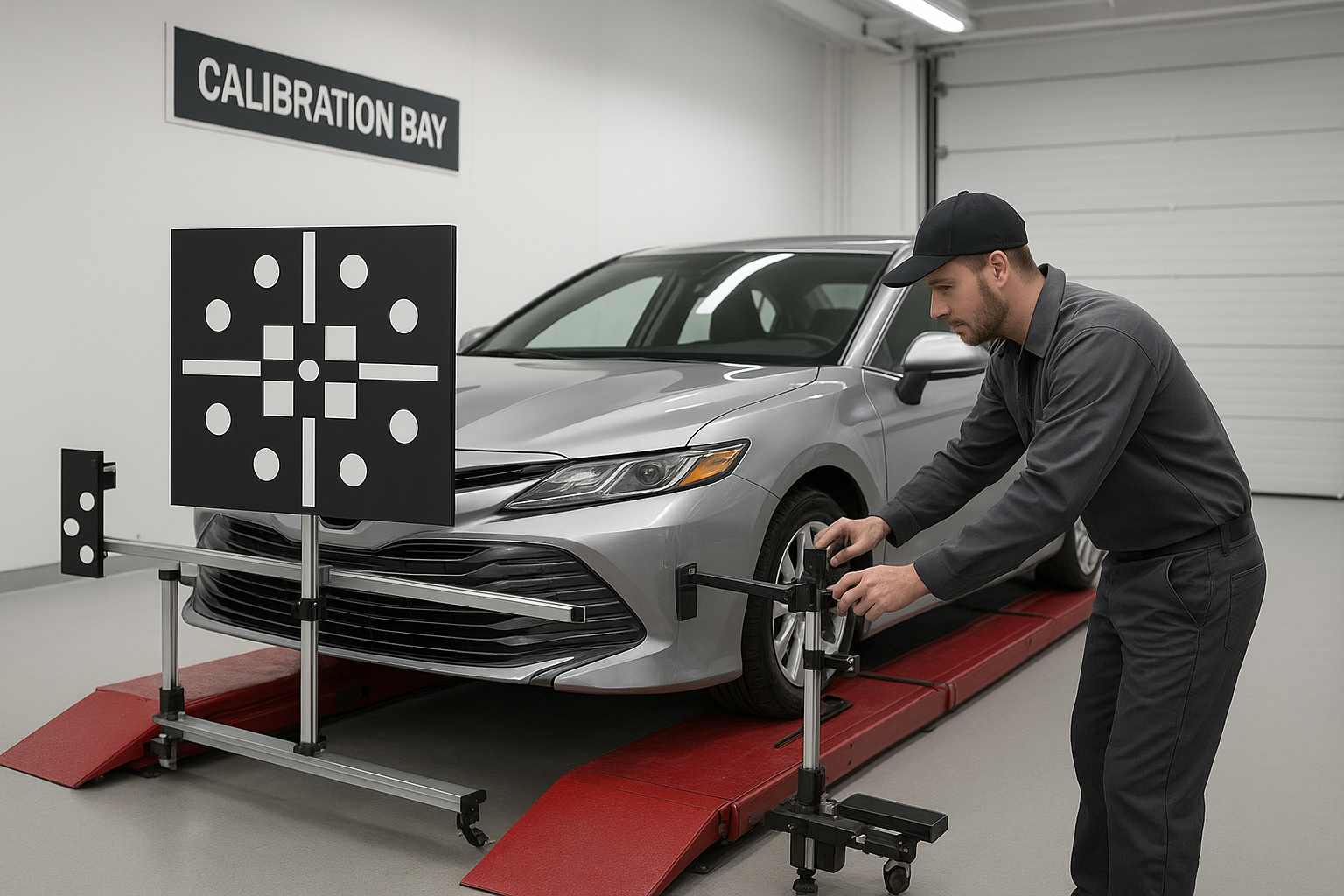
Proper ADAS calibration ensures lane, braking, and parking systems work correctly after hit and run repair.
Completing the repair is not the end of your responsibility as a vehicle owner. Similarly, protecting your investment and safety record requires a few additional steps after picking up your vehicle.
- Insist on pre- and post-repair scan documentation: Keep the printouts with your vehicle’s service records. These documents establish the electronic condition of the vehicle before and after the repair — invaluable if a fault emerges later and someone questions whether it was repair-related.
- Request your calibration certificates: ADAS calibration reports should include the make, model, VIN, calibration type, and technician confirmation of completion to specification. Store these alongside your alignment printout.
- Confirm your paint warranty in writing: A quality refinish warranty covers peeling, cracking, and excessive fade — typically for the life of vehicle ownership. Get it in writing, not verbally.
- Ask about OEM repair procedure documentation: Shops that reference manufacturer repair documentation (via OEM1Stop, I-CAR ProMatcher, or direct OEM portals) are more likely to have restored your vehicle’s engineered crash performance and sensor accuracy.
- Monitor for delayed symptoms: In the weeks after picking up your repaired vehicle, note any new dashboard warning lights, unusual handling characteristics, vibration, or ADAS alerts. Report any of these to the shop promptly — they may indicate a calibration issue or a missed supplement item.
- Diminished value consideration: In some states, you can file a diminished value claim against the at-fault driver’s insurer to recover the difference in market value between a repaired vehicle and an equivalent undamaged one. If the other driver is eventually identified, consult an attorney about this option.
FAQ: Hit and Run Repair
Do I have to use my insurer’s preferred shop for hit and run repair?
No. You have the right to choose any licensed collision repair facility. Insurers may recommend their preferred network shops because it simplifies their internal process — but the choice is always yours. However, if you use a non-preferred shop, be aware the insurer may ask for multiple estimates. Choose quality over convenience when it comes to safety-critical repairs.
Will filing a hit-and-run claim raise my insurance premium?
It depends on your insurer and policy. Filing a collision claim — even for a not-at-fault incident — can sometimes affect your rate at renewal. However, many insurers offer accident forgiveness provisions. Ask your agent specifically about the rate impact before filing. In some cases, if damage is minor and near your deductible, paying out-of-pocket may be the financially wiser choice.
Can I drive my car before getting hit and run repairs done?
Only if it is confirmed safe. If there are warning lights active, if the bumper is loose or dragging, if fluid is leaking, or if any structural component appears compromised, do not drive it. When in doubt, tow it to a shop for inspection. Driving a compromised vehicle can worsen damage, create a safety hazard, and in some states result in a traffic citation for an unsafe vehicle.
How do I know the paint will match after a hit and run repair?
Modern collision refinish shops use spectrophotometers to read your existing paint and generate a custom-adjusted formula that accounts for fade and batch variation. In addition, adjacent panels are blended to ensure seamless color transitions. Ask the shop about their color-matching process and whether they blend adjacent panels — a shop that says blending is unnecessary is a red flag.
What if I can’t afford the deductible right now?
Some collision centers offer deductible financing or payment plans. Ask the shop directly about available options. Additionally, if the at-fault driver is later identified by police, you may recover your deductible through subrogation — your insurer pursues the other driver on your behalf. Furthermore, some states allow you to file a small claims action against an identified hit-and-run driver independently.
Is hit and run the same as leaving the scene of an accident?
Yes — the terms are legally interchangeable. Leaving the scene of an accident without stopping, identifying yourself, and in some cases rendering aid is classified as a hit-and-run offense in all U.S. states. As the victim, this distinction matters because it confirms the other driver broke the law and strengthens your insurance and legal position.
How long does hit and run repair typically take?
Minor repairs — such as a bumper scuff or single panel — typically take 2–5 business days. Moderate damage involving structural work, multi-panel refinishing, and ADAS calibration can take 1–3 weeks. Parts availability and insurer supplement approvals are often the biggest scheduling variables, not the physical repair time itself.
Conclusion: Take Control of Your Hit and Run Repair
A hit-and-run is disorienting — but taking prompt, informed action puts you back in control. Document the scene thoroughly, file your police report immediately, contact your insurer right away, and choose a collision center that will do the job correctly — not just quickly. From hidden structural damage to ADAS recalibration, a truly complete hit and run repair restores not just your vehicle’s appearance but its full safety performance.
Above all, don’t settle for a surface-level fix when the integrity of your safety systems is at stake. The right shop, the right process, and the right documentation protect your vehicle, your safety, and your peace of mind long after you drive away.
For expert guidance and a thorough estimate in North Orange County, contact Brea Auto Body and start your hit and run repair the right way.

