

The Best Body Shop for Insurance Claims: A Complete 2026 Guide to Stress-Free Collision Repair
Everything you need to choose the right shop, protect your rights, and get your car back — safely and on time.
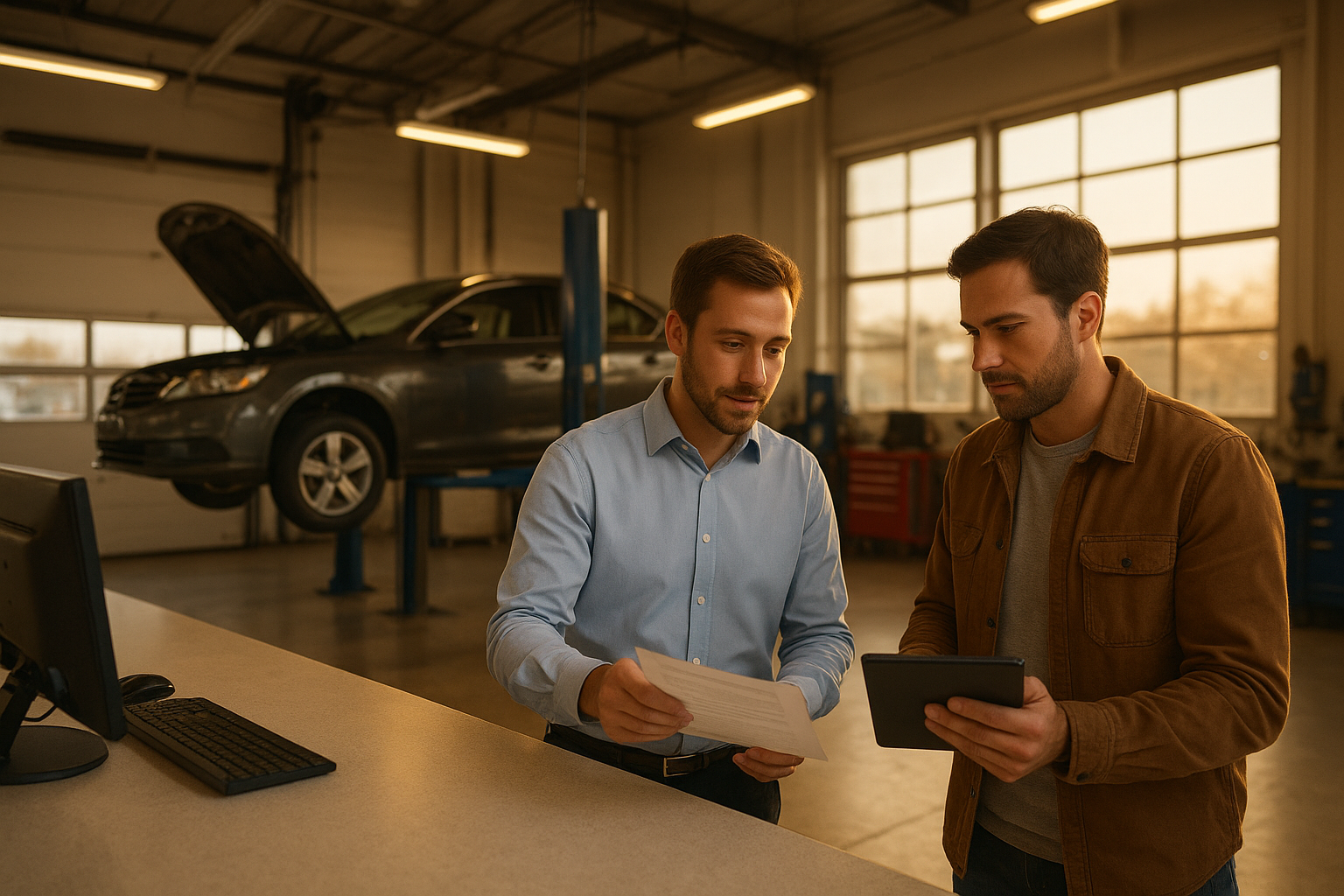
Finding the best body shop for insurance claims starts with clear communication and a transparent repair plan.
The best body shop for insurance claims is one that combines insurer expertise, rigorous repair standards, and honest communication — so your vehicle is restored safely and your claim moves without unnecessary delays. If you’ve recently been in a collision and your search history reads “best body shop for insurance claims,” you’re asking exactly the right question. The shop you choose directly affects how quickly you get back on the road, whether your car is truly safe afterward, and how painless the entire experience feels. This guide breaks down every factor that separates an excellent insurance-claim shop from a mediocre one — and gives you the questions to ask before you sign anything.
Specifically, we’ll cover what to look for in a shop, how the repair process should unfold step by step, the difference between DRP and independent shops, red flags to avoid, what your legal rights actually are, and how to compare real repair quality before committing.
What Makes the Best Body Shop for Insurance Claims?
Not every shop that accepts insurance is the right shop for your repair. In fact, the best body shop for insurance claims isn’t simply the cheapest estimate or the most convenient location. Furthermore, it isn’t necessarily the shop your insurer first recommends. The right facility blends insurance expertise with uncompromising repair quality — and it proves both through documentation, not just promises.
Below are the five defining characteristics to evaluate before authorizing any repairs.
1. Insurance Fluency — Without Sacrificing Your Rights
Top-tier shops speak the language of adjusters — supplements, labor operations, betterment deductions, and parts pricing — yet they always keep you at the center of every decision. They explain your options clearly, including the difference between OEM (original equipment manufacturer) parts and aftermarket alternatives. They also confirm your legal right to choose your own repairer, regardless of what your insurer suggests.
In most U.S. states, you have the right to select any licensed body shop for your repair. Consequently, insurer pressure to use a “preferred” shop is guidance, not a mandate. A shop that proactively explains this is working in your interest.
2. Accurate, Data-Driven Estimates
Quality estimates are built on OEM repair procedures and digital diagnostics — not guesswork or flat-rate shortcuts. Specifically, expect the following from any shop worth considering:
- Pre-scan diagnostic — a computerized scan performed before any work begins, to identify fault codes and hidden damage not visible to the eye.
- Teardown inspection — full disassembly of damaged areas before the estimate is finalized, because surface damage routinely conceals structural or mechanical issues underneath.
- Documented supplements — written updates submitted to your insurer when additional damage is discovered, with clear explanations of each line item.
- OEM procedure references — printouts or links to manufacturer repair guidelines that justify every operation on the estimate.
3. Advanced Technology and ADAS Calibrations
Modern vehicles rely on ADAS — Advanced Driver Assistance Systems — including lane-keep assist, automatic emergency braking, blind-spot monitoring, and adaptive cruise control. These systems depend on precisely positioned sensors and cameras. Therefore, any collision repair that involves the front end, windshield, bumpers, or structural components must include a post-repair calibration to verify these systems are functioning correctly.
The best body shop for insurance claims performs both pre-scans and post-scans, documents every calibration result, and provides you with printed proof. If a shop cannot confirm this capability, move on.
4. Clear Timelines and Proactive Communication
Cycle time — the number of days from drop-off to delivery — matters enormously when you’re paying for a rental car or relying on public transport. However, speed without transparency is just as frustrating as a long wait with no updates. The best facilities set realistic expectations up front and then communicate at every meaningful milestone: parts arrival, insurer approval, paint completion, and reassembly.
Furthermore, high-performing shops coordinate rental logistics on your behalf — so you’re never left guessing what happens next while your car sits waiting.
5. Documented Quality and a Meaningful Warranty
Look for a lifetime workmanship warranty, written repair documentation, and photographs of critical repair steps. A shop that won’t provide these isn’t confident in its own work. In contrast, a shop that proactively shares scan reports, calibration sheets, and OEM procedure printouts is demonstrating accountability — and giving you proof you can present to your insurer or in court if needed.
Your Legal Rights When Choosing a Body Shop for an Insurance Claim
This topic is critically important — and it’s one that many drivers don’t fully understand until after they’ve already handed over their keys. Here is what you need to know.
You Have the Right to Choose Your Own Shop
In the United States, policyholders generally have the right to select any licensed body shop for their vehicle repair — regardless of which insurer is paying. Your policy may reference a “preferred” network, but in most states, steering you exclusively to those shops is either prohibited or heavily restricted. As a result, you should never feel forced into a shop you haven’t independently evaluated.
What “Steering” Looks Like — and Why It Matters
Steering is the practice of directing or pressuring claimants toward insurer-preferred shops, sometimes with misleading statements such as “we can only guarantee repairs done at our network shops.” This is often inaccurate. Specifically, many states prohibit insurers from telling you that coverage depends on using their network. If you experience this, document it and contact your state’s Department of Insurance.
OEM Parts vs. Aftermarket Parts — Your Right to Know
Your insurer may approve aftermarket (non-OEM) parts to reduce claim costs. However, you have the right to know exactly what parts are being used in your repair. In some states, shops are legally required to disclose parts sourcing on the repair order. Furthermore, many policies allow you to request OEM parts — sometimes with an additional cost. A trustworthy shop will walk you through this decision rather than making it without your input.
How the Insurance Claim and Repair Process Works, Step by Step
When you partner with a high-performing collision repair shop, the claim moves in a predictable, transparent sequence. Understanding each phase helps you set expectations and catch problems early.
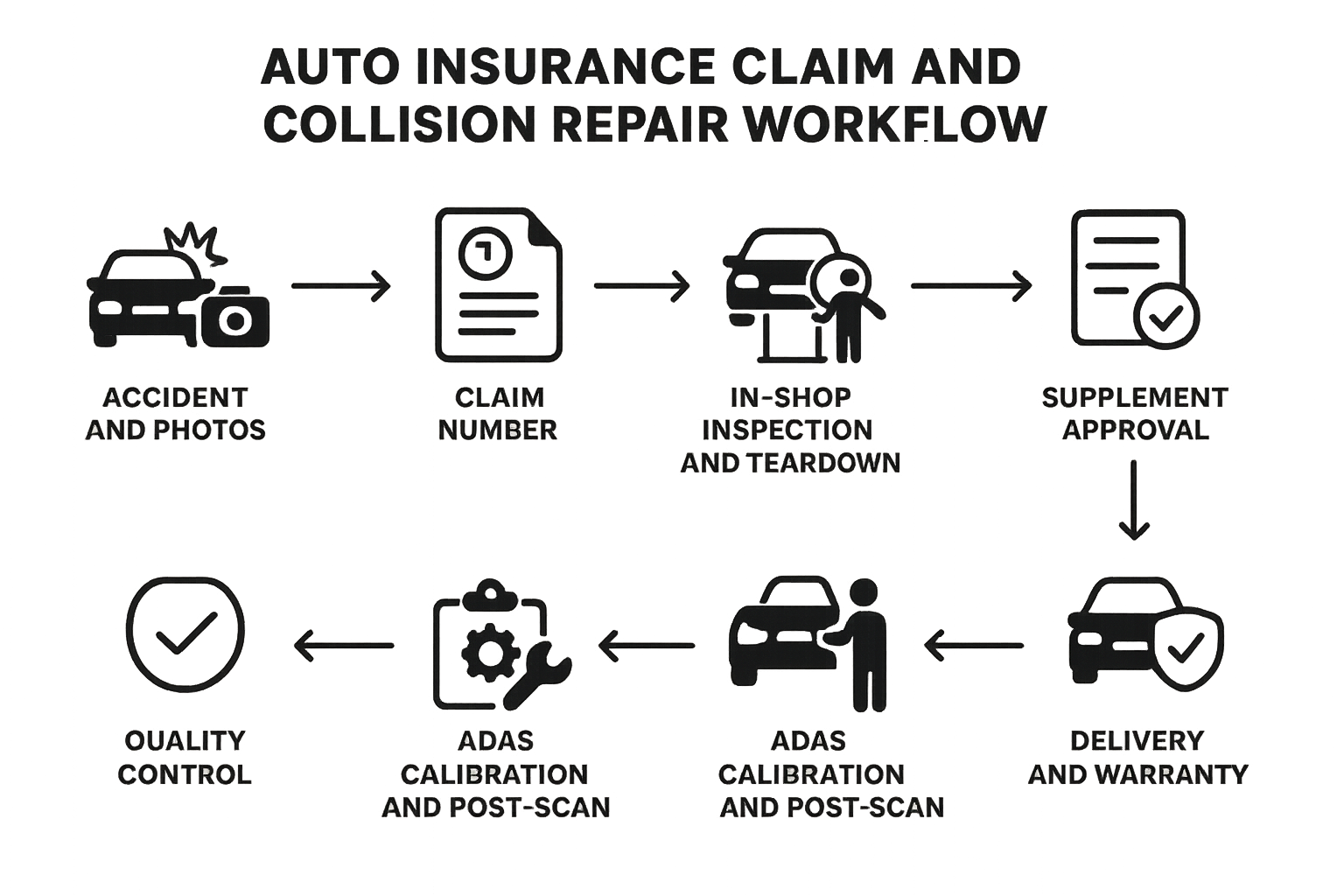
An organized claim and repair workflow keeps your schedule — and your vehicle — on track.
Step 1 — Intake and Claim Setup
You bring the vehicle in or it’s towed directly to the shop. The advisor references your claim number, reviews your coverage details, confirms liability status, and notes any special concerns. At this stage, a reputable shop also verifies whether you want OEM or aftermarket parts and whether rental coordination is needed.
Step 2 — Pre-Scan Diagnostic
Before any physical work begins, a computerized pre-scan checks all vehicle systems for fault codes. This baseline reading is essential — it captures any pre-existing electronic issues and confirms which new fault codes the collision itself caused. Furthermore, this report becomes part of your repair documentation.
Step 3 — Initial Estimate and Photo Documentation
The advisor captures detailed photographs and creates a preliminary estimate for your insurer’s review. Importantly, a responsible shop will explain that this estimate is preliminary — hidden damage is common and will only become visible once the vehicle is disassembled. Any shop that guarantees a “no supplement” total before teardown is either cutting corners or not planning to look closely.
Step 4 — Teardown and Disassembly Inspection
After receiving initial approval to proceed, the vehicle is disassembled to expose structural, mechanical, and electrical areas. This is where the true extent of damage is revealed. As a result, the shop submits a refined estimate — called a supplement — to your insurer for additional approvals before any metal is moved or welded.
Step 5 — Parts Ordering and Strategy
The shop recommends OEM, aftermarket, or recycled parts based on your policy terms, safety considerations, parts availability, and your preferences. The best body shop for insurance claims documents the reasoning behind each parts choice — particularly for safety-critical components like airbag systems, crumple zones, and structural reinforcements.
Step 6 — Structural Repair, Mechanical Work, and Paint
Technicians follow OEM repair procedures — including welding parameters, adhesive types, seam sealing, and corrosion protection treatments. Each of these details matters for long-term structural integrity. Following structural work, the vehicle moves to a controlled paint booth where color-matching, base coat application, clear coat, and gloss finishing meet factory standards.
Step 7 — ADAS Calibrations and Road Testing
After reassembly, cameras, radar sensors, and driver assistance systems are calibrated — either in-house or with a certified mobile specialist. A post-scan then confirms all fault codes are resolved. Additionally, a road test verifies drivability, brake response, steering feel, and safety system engagement before the vehicle is cleared for delivery.
Step 8 — Quality Control and Delivery
A final quality inspection verifies panel alignment, paint consistency, electronics function, and interior cleanliness. You review the invoice line by line, ask any final questions, and receive your warranty documentation in writing. A well-run shop walks you through every item — not just hands you a clipboard to sign.
DRP vs. Independent Body Shops: Which Is Better for Insurance Claims?
This is one of the most common questions drivers ask when searching for the best body shop for insurance claims. The answer requires understanding what each type of shop actually is.
What Is a DRP Shop?
A Direct Repair Program (DRP) shop is a collision facility that has a pre-negotiated agreement with one or more insurance companies. In exchange for a guaranteed volume of work, DRP shops agree to pricing schedules, parts sourcing guidelines, and cycle-time targets set by the insurer. In return, the insurer streamlines estimate approvals, billing, and communication — which can speed up certain administrative steps.
What Is an Independent Body Shop?
An independent shop operates outside insurer agreements. However, this does not mean it’s inferior. In contrast, many independent shops deliver significantly higher repair quality precisely because they’re not constrained by DRP pricing requirements. They can recommend OEM parts freely, take additional time for proper teardowns, and fight harder for supplements — because their revenue doesn’t depend on keeping an insurer happy.
How to Evaluate Both Types Fairly
Regardless of network status, the evaluation criteria are identical. Specifically, ask for:
- OEM procedure printouts for your repair
- Pre-scan and post-scan diagnostic reports
- Calibration documentation with pass/fail results
- Parts sourcing transparency — OEM vs. aftermarket, and why
- A written workmanship warranty with clear terms
- References or photo galleries of similar completed repairs
A shop — DRP or independent — that willingly provides all of these is demonstrating accountability. Consequently, one that deflects or says “we don’t do that” is showing you exactly what working with them will feel like.
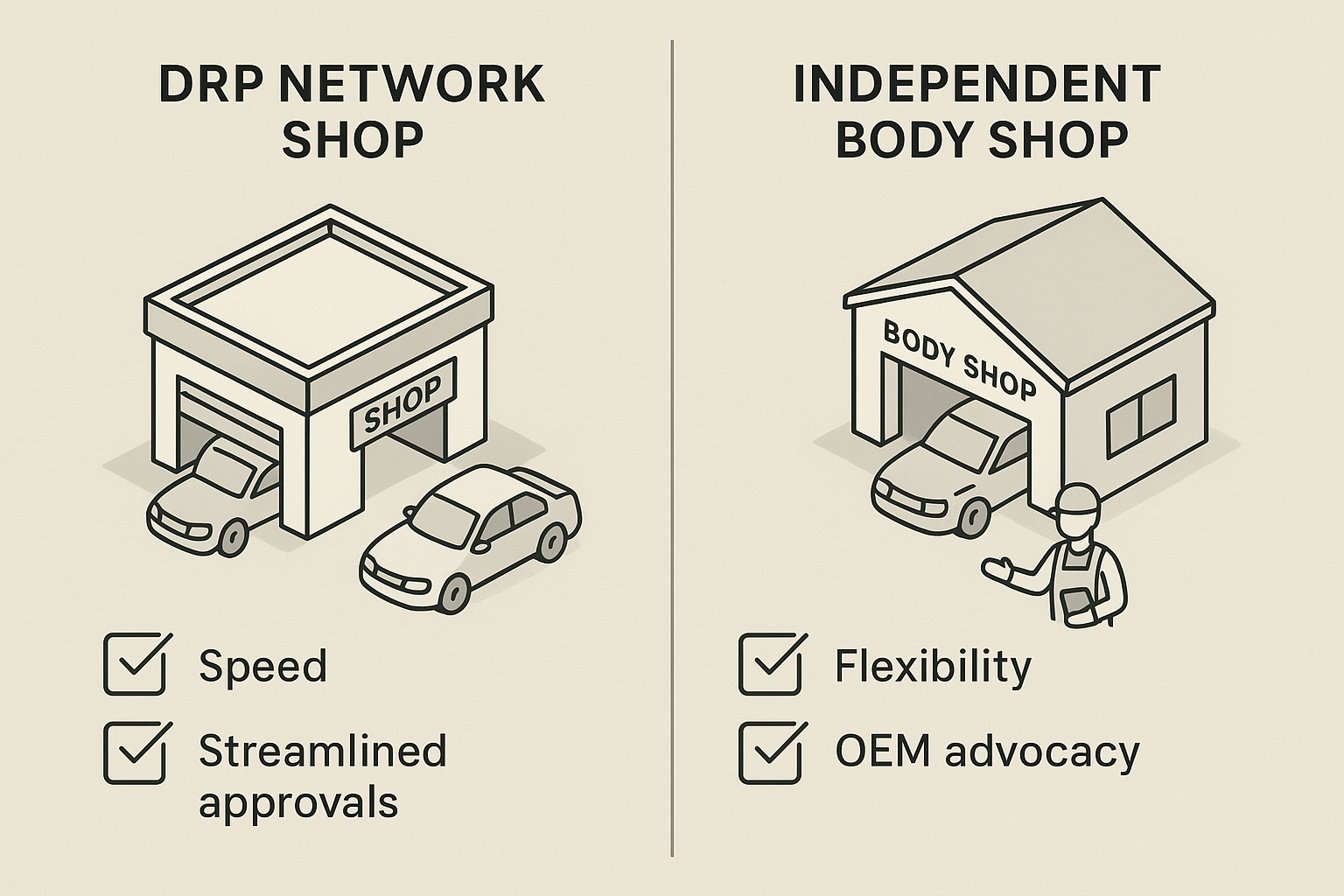
DRP and independent shops can both deliver great results — the winner is the one that proves its process, quality, and communication.
How to Compare Body Shops Before Making a Decision
Choosing a shop based solely on proximity or insurer recommendation is a mistake that many drivers regret. Instead, treat the selection process like hiring a contractor — with a checklist, direct questions, and verifiable proof of quality.
Check Certifications and Training
Look for I-CAR Gold Class certification — the industry’s highest recognition for ongoing collision repair training. Additionally, manufacturer certifications (such as Honda ProFirst, Toyota Collision Repair, or GM Certified) indicate that technicians have been trained on specific vehicle platforms and have access to proprietary repair data. These credentials matter for modern vehicles with complex structural designs and ADAS systems.
Read Reviews — But Read Them Critically
Google and Yelp reviews provide useful signals, but look beyond star ratings. Specifically, search for reviews that mention communication during the repair, accuracy of the timeline estimate, handling of supplements and delays, and whether the car felt right after pickup. These details reveal process quality — not just customer service polish.
Request a Shop Tour
A reputable shop will welcome a brief walkthrough. Look for a dedicated frame straightening area, a controlled paint booth, diagnostic scanning equipment, and an organized workflow. Furthermore, note whether vehicles in progress appear carefully masked and covered — this signals attention to detail throughout the job, not just at delivery.
Ask for a Sample Repair Order
Asking to see a sample completed repair order — with identifying information removed — is entirely reasonable. This shows you how the shop documents labor operations, parts sourcing, scan results, and OEM procedure references. As a result, you’ll know exactly what kind of paper trail your repair will produce.
Questions to Ask Before You Authorize Repairs
These targeted questions reveal whether a facility truly acts as your advocate during an insurance claim — or simply processes vehicles on behalf of an insurer.

Digitally documented scans and calibrations are non-negotiable for safe, modern collision repairs.
- “Do you perform a pre-scan and post-scan on every vehicle?” — If the answer is no, or conditional, that’s a red flag for any modern vehicle built after 2015.
- “How do you handle supplements and insurer approvals?” — You want a clear, timestamped process so nothing stalls in limbo for days.
- “Do you perform ADAS calibrations in-house or outsource them?” — Either can be acceptable, but the shop should own the documentation either way.
- “What is your parts philosophy — OEM, aftermarket, or recycled?” — Ask specifically how they document safety-critical parts choices on the repair order.
- “What is your average cycle time for a repair like mine?” — A specific answer by repair category demonstrates operational maturity. Vague answers do not.
- “What does your warranty cover, and for how long?” — A lifetime workmanship warranty with written terms is the standard to expect.
- “Can I see your I-CAR or manufacturer certifications?” — Legitimate credentials should be displayed or readily available.
- “Will you provide me with all scan reports and calibration results?” — Your answer here tells you everything about how transparent this shop is willing to be.
Red Flags That Slow Claims and Compromise Repair Quality
Not every shop that handles insurance work handles it well. Therefore, knowing what to avoid is just as important as knowing what to look for. The following warning signs suggest a shop that prioritizes insurer efficiency over your vehicle’s safety and your rights as a policyholder.
Promising “No Supplements” Before Teardown
This guarantee is almost always a lie — or a signal that the shop won’t look closely enough to find hidden damage. Supplements are a normal part of collision repair. Furthermore, a shop that avoids them is likely leaving damage unaddressed, which becomes your problem weeks or months after delivery.
Refusing to Provide Scan or Calibration Evidence
If a shop won’t give you printed or digital proof of pre- and post-repair scans, treat that as a serious red flag. You cannot verify that ADAS systems are functioning correctly without this documentation. Consequently, you could be driving a vehicle with a disabled emergency braking system or miscalibrated lane-keep assist — and have no evidence to support a warranty claim.
Pressuring You to Skip Safety-Critical Steps
Some shops — particularly those under DRP pressure — may suggest skipping calibrations, bypassing teardown inspections, or using uncertified recycled parts on structural components to “keep costs down.” Specifically, none of these shortcuts benefit you. They benefit the insurer’s bottom line or the shop’s cycle-time metrics. Decline any shop that frames cutting safety corners as a courtesy.
Poor Communication During the Repair
If a shop is hard to reach, slow to return calls, or consistently vague about timelines, those habits don’t improve once your car is in the bay. In contrast, the best body shops proactively contact you when parts are delayed, when insurer approvals stall, and when the delivery date needs to shift. Silence is not professional restraint — it’s a process failure.
Understanding Your Deductible, Total Loss Threshold, and Diminished Value
These three financial concepts have a direct impact on your insurance claim — and many drivers don’t fully understand them until they’re in the middle of the process.
Your Deductible
Your deductible is the amount you pay out of pocket before insurance covers the rest. For example, if repair costs are $4,200 and your deductible is $500, you pay $500 and your insurer covers $3,700. However, if the at-fault driver’s insurer is paying (a third-party claim), your deductible is typically not involved. A good body shop helps you understand this distinction at intake.
Total Loss Threshold
If repair costs exceed a certain percentage of your vehicle’s actual cash value (ACV) — typically 70%–80%, depending on state law — your insurer may declare it a total loss. In this case, they pay you the ACV rather than funding repairs. Therefore, if your shop’s estimate is close to this threshold, understanding the threshold helps you make an informed decision about whether to negotiate for repairs or accept the settlement.
Diminished Value
Diminished value is the reduction in your vehicle’s market worth after a collision — even after it’s been perfectly repaired. In many states, if another driver was at fault, you can file a separate diminished value claim against their insurer. Specifically, this is separate from your repair claim and can result in additional compensation. Ask your shop whether they’ve helped customers navigate diminished value claims before — a knowledgeable team can point you toward appraisers and documentation strategies.
Why Local Reputation Matters — and Where to Start
Online reviews, real repair photo galleries, and referrals from local dealerships, fleet managers, or automotive service departments are among the most reliable signals that a shop consistently delivers quality work. However, local reputation is built on more than positive reviews — it’s built on repeat business and the fact that other professionals in the automotive space trust the shop with their customers.
If you’re comparing options and want a team that emphasizes proactive claim coordination, OEM-informed repairs, and transparent documentation, explore Brea Auto Body — a resource for drivers seeking an insurance-claim-friendly collision repair experience. Review their documented approach, contact the shop with specific questions from this guide, and verify that their documentation standards align with your expectations.
Frequently Asked Questions About Choosing a Body Shop for Insurance Claims
Can my insurance company force me to use their preferred shop?
In most U.S. states, no. Your insurer can recommend a network shop, but they generally cannot require you to use one. You have the right to choose the best body shop for your insurance claim — and the insurer must provide the agreed-upon payment for a properly documented repair regardless of where it’s performed.
What happens if my insurer and the shop disagree on the repair cost?
This is common and is resolved through the supplement process. Your shop submits additional documentation — photos, OEM procedure references, parts invoices — to support the higher cost. Most legitimate disputes are resolved this way. However, if the insurer continues to underpay, you may have the option to invoke the appraisal clause in your policy, which brings in a third-party appraiser.
How long does a typical collision repair take?
Repair timelines vary significantly based on damage severity, parts availability, and insurer approval speed. A minor bumper repair may take 3–5 days. Moderate structural damage typically takes 10–20 business days. Severe collision repairs with ADAS calibrations can take 4–6 weeks or more. Therefore, any shop that gives you a definitive timeline before completing a teardown should be viewed with skepticism.
Does using a non-preferred shop affect my coverage?
Generally, no — as long as the repairs are properly documented and costs are reasonable. Some insurers claim they’ll only “guarantee” repairs at network shops, but this guarantee is typically about their administrative convenience, not a meaningful additional coverage benefit. A quality independent shop’s lifetime workmanship warranty provides equivalent or superior protection.
Should I get multiple estimates for an insurance repair?
Getting multiple estimates is your right, and it can be informative. However, the lowest estimate is rarely the best outcome — it often means a shop is planning to skip steps or use inferior parts. Instead, compare the detail and transparency of each estimate: which shop is explaining OEM procedures, documenting parts choices, and providing scan results? That level of detail is the more meaningful comparison point.
Your Next Steps: Turn a Stressful Claim into a Smooth Repair
Accidents are stressful — but your insurance claim doesn’t have to be. The right shop acts as your partner, not a processing station for your insurer. Choose a facility that proves its process with documentation, keeps you informed at every stage, and advocates for safe, complete repairs that restore your vehicle to pre-loss condition.
Specifically, here are the actions to take right now:
- Use the questions in this guide to interview at least two shops before authorizing repairs.
- Ask each shop for a sample repair order and proof of I-CAR or manufacturer certifications.
- Verify that your chosen shop performs both pre-scans and post-scans on every vehicle.
- Confirm their warranty terms in writing before you sign the repair authorization.
- Begin your local research with Brea Auto Body’s customer-first collision repair team and compare their documented process to others on your shortlist.
The right decision today sets you up for a faster, safer return to the road — with documentation you can trust and a warranty that actually means something.
Conclusion: What the Best Body Shop for Insurance Claims Actually Looks Like
The best body shop for insurance claims is not defined by proximity, price, or insurer preference. Instead, it is defined by transparency, technical capability, proactive communication, and documented quality. It’s the shop that performs a pre-scan before touching your vehicle, tears down damage before finalizing an estimate, fights for every legitimate supplement, calibrates your ADAS systems after repair, and hands you a complete paper trail at delivery.
Furthermore, the best shops educate you about your rights — your right to choose your repairer, your right to OEM parts information, and your right to diminished value compensation when applicable. Use the criteria, questions, and red flags in this guide to make a confident, informed choice. Your vehicle’s safety and your financial recovery from this collision depend on it.

