

The Complete Auto Body Shop Guide for Brea, CA: Collision Repair, Insurance, Estimates, Certifications, and How to Get Your Car Back Right
Everything you need to know before choosing an auto body shop in Brea — from structural repair and paint matching to ADAS calibration, insurance navigation, and your legal rights as a California vehicle owner.

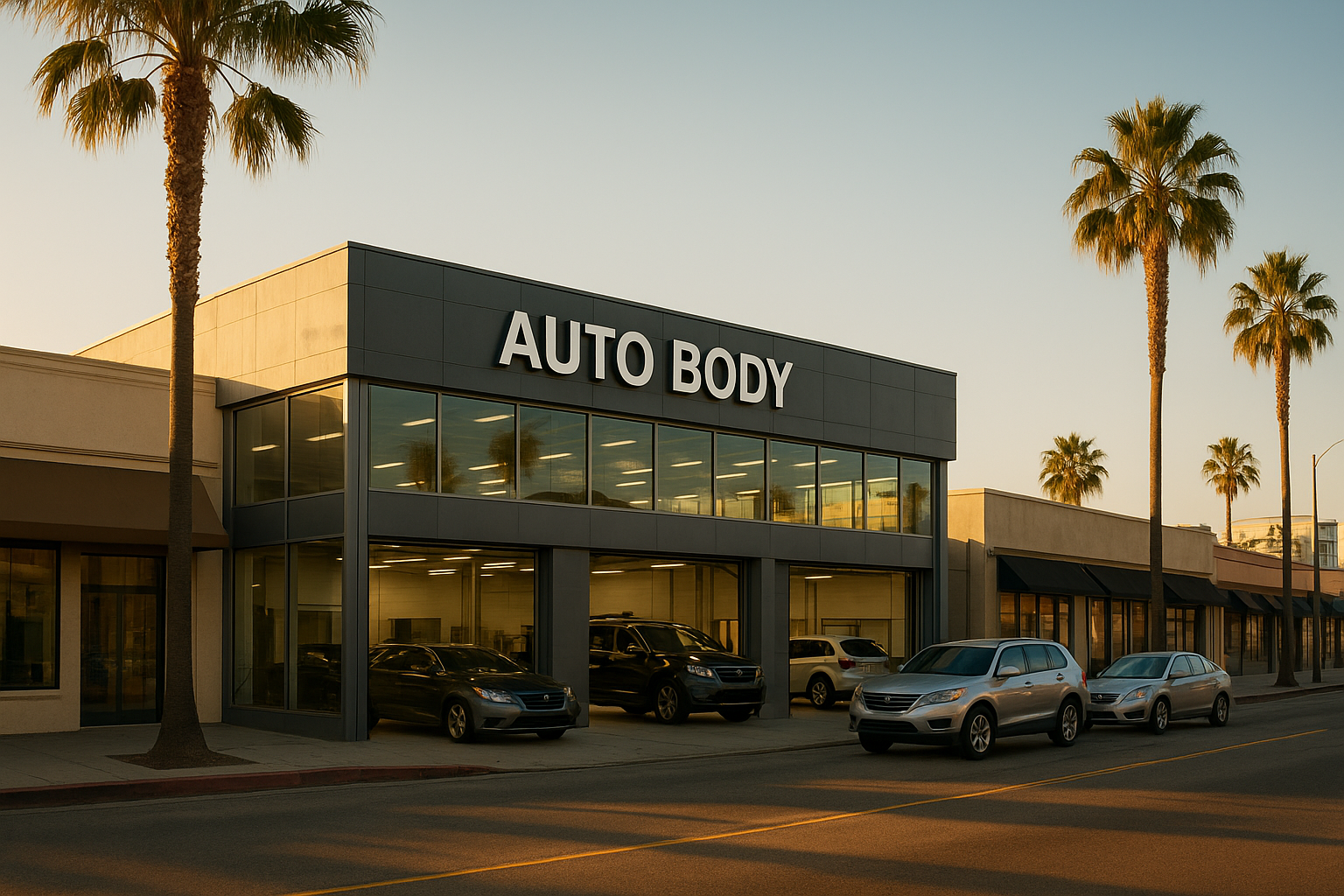
A professional auto body shop in downtown Brea — where precision collision repair meets local convenience.
Whether you’ve just been in a fender-bender or a serious collision, choosing the right auto body shop in Brea shapes every aspect of what comes next — your safety, your wallet, your time, and your confidence in the finished result. This guide is the most thorough resource available for Brea drivers: what a full-service auto body shop actually does, how estimates and supplements work, how California law protects your rights, what certifications prove, how to compare shops accurately, and how to inspect your vehicle before you accept it. Read this once and you’ll make the best possible decision — no guesswork required.
Why Your Auto Body Shop Location in Brea Matters More Than You Think
Choosing an auto body shop close to downtown Brea isn’t simply about saving a drive — it changes the entire repair experience in concrete ways. Downtown Brea is a walkable, service-rich area where proximity to your shop allows you to make mid-repair visits, get in-person updates, and swing by before paint goes on to verify structural work. That kind of oversight is simply not feasible when your shop is across the county.
Local Brea shops also develop specific expertise in the damage patterns Southern California drivers encounter most. Low-speed parking lot scrapes are the dominant collision claim in dense SoCal corridors. Sun exposure at this latitude accelerates clearcoat oxidation, which means color-matching a vehicle that’s been driven in California sun for three years demands a different technical approach than matching a garaged vehicle — a detail that experienced local shops account for in their paint formulation process.
The Proximity Advantage: Accountability and Access
When your auto body shop is nearby, you can physically confirm ADAS calibration documents, inspect repaired panels before final paint, and ask in person whether a supplement was approved. Local shops also depend on neighborhood word-of-mouth — which is the most powerful quality-control incentive in the industry. A negative Google review from a Brea neighbor carries more operational weight for a local shop than for a regional chain that draws customers from a 40-mile radius.
Post-repair issues — a sensor warning light, wind noise from a reseated door seal, a paint edge at a blend — are resolved in minutes when your shop is close. Distance converts minor inconveniences into multi-day scheduling problems. Choosing a Brea-based auto body shop collapses that friction entirely.
What a Full-Service Auto Body Shop in Brea Actually Does — Every Discipline Explained
The term “full-service auto body shop” is used broadly, often without meaning much. Here’s what it should mean at a professionally run Brea facility — broken down by discipline so you know exactly what’s included and what to ask if a quote omits something critical.
1. Structural Assessment and Frame Straightening
Structural integrity is the foundation every other repair is built on. Before any cosmetic work begins, a qualified auto body shop measures your vehicle’s frame geometry using a computerized measuring system referenced against the manufacturer’s published specs for your specific year, make, and model. If your unibody or frame rails were deflected in the collision, that deviation must be corrected to tight tolerances — otherwise panels won’t fit correctly, doors won’t seal right, and your vehicle won’t absorb energy as designed in a future impact.
Frame correction uses hydraulic straightening equipment with calibrated pull points, and every measurement is documented before and after. Always ask your auto body shop for the pre- and post-repair measurement reports — reputable shops produce them as a standard deliverable, not an extra.
2. Panel Repair vs. Replacement: How the Decision Is Made
Not every dented panel needs to be replaced. Some outer-panel damage with no crease at a structural bond line can be corrected using conventional bodywork or paintless dent repair (PDR). Your auto body shop should explain the rationale for every panel decision. Replacement is required when:
- The panel is a structural component (floor rail, pillar reinforcement, rocker)
- Damage affects the substrate in ways that compromise corrosion resistance
- PDR cannot achieve factory-level surface geometry
- Repair cost exceeds replacement cost after labor is factored in
- The original panel has been previously repaired and the substrate is compromised
When replacement is the right call, the shop should specify whether parts are OEM (original equipment manufacturer), OEM-equivalent aftermarket, or recycled OEM — and the difference matters for fit, finish, and warranty implications. Under California law, you must provide written authorization before any non-OEM parts are installed on a vehicle covered by an active manufacturer warranty.
3. Paintless Dent Repair (PDR): When It’s the Right Tool
Paintless dent repair is a specialized technique where technicians use precision metal rods and body picks to massage a dent out from behind a panel without disturbing the factory paint finish. PDR is ideal for hail damage, minor door dings, and shallow creases that haven’t cracked the clearcoat. It is significantly faster and less expensive than conventional repair and refinish when the conditions are right. A capable Brea auto body shop will accurately assess whether PDR is appropriate for your specific damage — and won’t push you toward a more expensive conventional repair when PDR is the correct solution.
4. Paint and Refinish: The Science Behind a Flawless Match

A spectrophotometer reads your existing paint’s light-reflectance profile to formulate an accurate match — critical in California’s strong UV environment.
Paint matching is one of the most technically demanding parts of auto body work — and one of the most visible if done poorly. Every vehicle has a paint code, but that code is a starting point, not an endpoint. Pigment batches shift between production runs, and years of UV exposure in Southern California change a vehicle’s actual color from its original code. A professional auto body shop uses a spectrophotometer — a device that reads the light-reflectance profile of your existing paint — to formulate a blend that accounts for real-world pigment shift.
Beyond formula accuracy, the application process must replicate the factory stack: primer sealer, base coat, clear coat, and in many cases a specialized mid-coat for tri-stage or pearl finishes. All work is done in a climate-controlled, filtered spray booth to eliminate contamination. Panel blending — extending the refinish into adjacent panels for an invisible color transition — is sometimes necessary when an exact formula match is mathematically impossible. Ask whether blending is included in your estimate and which panels it affects.
5. Bumper Repair and Replacement
Bumpers are among the most commonly damaged components in low-speed collisions and parking lot incidents. A quality auto body shop evaluates whether a bumper cover can be repaired using plastic welding, adhesive bonding, and refinishing — or whether replacement is the correct call. The decision depends on whether the structural reinforcement behind the cover was impacted, whether the mounting points are intact, and whether the cosmetic repair can be made invisible. Critically, any bumper work on a vehicle equipped with front or rear sensors must be followed by a sensor verification and, where required, recalibration.
6. Corrosion Protection: The Step Most Shops Rush Through
Any time a panel is welded, bonded, or replaced, the factory corrosion barrier is broken. A quality auto body shop re-applies cavity wax, seam sealer, and epoxy primer to replicate — or exceed — factory protection levels. This is especially relevant for Brea residents who drive to beach areas or through coastal air corridors. Skipping corrosion treatment turns a structurally repaired panel into a rust incubation zone within a few years. The specific question to ask every auto body shop: “What corrosion protection is applied to welded seams and panel edges, and is it listed on the estimate?”
7. ADAS and Electronics: The Repair Step Most Shops Underestimate
Advanced Driver Assistance Systems (ADAS) — including forward collision warning, automatic emergency braking, lane keep assist, blind spot monitoring, backup cameras, and adaptive cruise control — rely on cameras, radar, lidar, and ultrasonic sensors calibrated to precise angular and positional tolerances. Any collision that moves a bumper cover, windshield, mirror housing, or radiator support can throw these systems out of specification, even if the sensor itself is undamaged.
A professional auto body shop performs a pre-repair diagnostic scan to identify active fault codes before work begins, completes all mechanical and structural repairs, then performs a post-repair scan and — where required by the manufacturer — a static or dynamic ADAS calibration. This is not optional. A forward collision system that isn’t recalibrated after a front-end repair may not activate when you need it. The specific question to ask: “Will you perform pre- and post-repair OBD scans, and is ADAS calibration included or separately itemized in my estimate?”
8. Mechanical Repairs Connected to Collision Damage
Many collisions that look purely cosmetic involve underlying mechanical damage. A front-end impact can push a radiator into a fan, bend a steering tie rod, or knock a wheel out of alignment. A qualified auto body shop inspects for mechanical damage in the collision zone and either performs repairs in-house or coordinates sublet work with a trusted mechanical partner. Shops that do both auto body and mechanical repair under one roof can often resolve collision-related mechanical issues without routing your vehicle to a third facility — saving both time and coordination headaches.
9. Final Detailing and Delivery Walkthrough
A professional auto body shop doesn’t hand you dusty keys at a front counter. Delivery includes a full detail so repaired areas are visible, clean panel gaps can be confirmed, and paint transitions can be checked in natural light. The walkthrough should cover what was repaired, what was replaced, any supplements that were approved, and aftercare instructions for new paint — typically avoiding automated car washes for at least 30 days and protecting fresh clearcoat from extended direct sun during the initial cure period.
Auto Body Shop Estimates, Supplements, and Insurance: A Complete Breakdown

The collision repair journey from intake to delivery — made transparent and predictable for Brea drivers.
What an Estimate Really Is — and Isn’t
An estimate from an auto body shop is a documented projection of likely repair costs based on visible damage at the time of inspection. It is not a fixed-price contract. Hidden damage behind bumper fascias, inside door cavities, beneath liners, or behind headlamp housings only becomes visible once teardown begins. This is normal and standard — not a bait-and-switch — and any trustworthy shop explains this clearly before you authorize work.
A thorough estimate should include:
- Each damaged panel or component, with the operation listed (repair, replace, refinish, blend)
- Labor hours per operation at a clearly stated hourly rate
- Part numbers and part type (OEM, aftermarket, or recycled OEM)
- Refinish materials and sublet work (such as alignment, ADAS calibration, or glass replacement)
- Corrosion treatment line items where applicable
- Applicable taxes
If any estimate you receive consists of a single-page summary with only a bottom-line total, request the full line-item breakdown. You are legally entitled to it under California’s Bureau of Automotive Repair regulations.
How Supplements Work — The Most Misunderstood Part of the Process
A supplement is an amendment to the original estimate documenting additional damage or required operations discovered during teardown. When a supplement is submitted, the auto body shop works directly with your insurer to obtain approval — a professional shop handles this communication so you don’t have to play intermediary between the adjuster and the technician. Key points:
- You should be notified before work resumes when a supplement involves substantial additional cost or scope.
- Insurer-approved supplements are added to your existing claim — your deductible does not increase because hidden damage was discovered during teardown.
- Some supplements are partially or fully denied by insurers. A good auto body shop explains the impact on your repair and your options — in plain language, not industry jargon.
- Supplement disputes can delay timelines — ask your shop upfront how they handle insurer disagreements and whether they have experience advocating for customers on denied line items.
How to File a Claim vs. Pay Out of Pocket: Making the Right Call
Not every collision repair should go through insurance. For minor damage where the repair cost is close to or less than your deductible, a cash-pay repair may be the better financial decision — avoiding a potential premium increase that compounds over your policy renewal period. A trustworthy auto body shop will give you an honest assessment of both paths without pushing you toward the more expensive option simply because insurance is involved.
General framework for the decision:
- Repair cost significantly exceeds your deductible: File the claim.
- Repair cost is near or below your deductible: Consider cash-pay to protect your premium history.
- Structural or ADAS damage is involved: File the claim regardless — these repairs are expensive and critical to safety.
- A third party was at fault: Their liability coverage applies — your deductible typically isn’t a factor.
Practical Drop-Off Tips for Brea Residents
Downtown Brea’s walkability makes the drop-off process easier than most cities. You can leave your vehicle at the auto body shop, walk to Brea Mall or dining on Brea Blvd, and arrange a rideshare in minutes. If your vehicle isn’t drivable after a collision, ask your shop about:
- Tow coordination directly from your location to the shop
- Secure after-hours drop-off with key drop box and signed authorization form
- Rental car referrals or partnerships with nearby rental agencies
- Text or email milestone updates so you don’t have to call for status
Your Legal Rights When Using an Auto Body Shop in California
California provides some of the strongest consumer protections in the country for auto body repair customers. Understanding these rights before you walk into any shop gives you real leverage. Here is what the law actually guarantees you:
Right to Choose Your Own Auto Body Shop
In California, you have the absolute legal right to choose any licensed auto body shop for your collision repairs — regardless of which shops your insurance company recommends, prefers, or actively steers you toward. Insurer “preferred” or “direct repair program” (DRP) shops participate in networks structured to benefit the insurer’s cost management. That doesn’t mean they do poor work, but it does mean your selection should be based on quality, trust, and local accountability — not insurance company convenience. A licensed Brea auto body shop can work directly with any insurer to process your claim.
Right to a Written Estimate Before Work Begins
Under California BAR regulations, any auto body shop performing repairs valued at $100 or more must provide a written estimate before beginning work, unless you explicitly waive this right in writing. The estimate must itemize parts and labor. No shop may exceed the written estimate without your written authorization.
Right to Authorization Before Parts Decisions
California law requires written disclosure and your authorization before an auto body shop installs non-OEM parts on a vehicle covered by an active manufacturer warranty. If a shop installs aftermarket parts without your knowledge on a warranted vehicle, that is a BAR violation. Always review the parts section of your estimate explicitly — don’t assume OEM is the default.
Right to Your Replaced Parts
You have the right to request and receive the parts that were removed from your vehicle during repair — with limited exceptions for parts subject to warranty or core return programs. This is especially relevant when you want to verify that new parts were actually installed. A reputable auto body shop will honor this request without pushback.
Right to File a BAR Complaint
If an auto body shop in California violates your consumer rights — overcharging beyond a written estimate without authorization, installing undisclosed parts, or refusing to provide documentation — you can file a complaint with the California Bureau of Automotive Repair at bar.ca.gov. The BAR can investigate, mediate, and in serious cases revoke a shop’s operating license. Knowing this exists is leverage before you sign anything.
How to Compare Two Auto Body Shop Estimates Without Getting It Wrong
Price is the first thing most people look at — and the worst factor to use as the deciding criterion. A lower estimate may mean fewer operations, cheaper part sources, skipped corrosion treatment, or no ADAS calibration line item. A higher estimate may reflect thoroughness — or it may reflect inflated labor rates. The only way to evaluate correctly is to compare operations, not totals.
The Complete Side-by-Side Comparison Checklist
- Compare operations, not totals. Are both estimates repairing the same panels? Is one replacing a part the other is repairing? Different approaches produce very different outcomes — and different safety results.
- Compare parts types explicitly. OEM parts offer factory fit and carry manufacturer warranty support. Aftermarket parts vary widely. Ask each shop to identify every part type in writing.
- Look for pre/post scan and ADAS calibration line items. If one estimate omits scanning and calibration and your vehicle has ADAS, that’s not a savings — it’s a skipped safety step.
- Check for panel blend notation. Adjacent panels often need to be blended for an invisible transition. An estimate that omits blending will likely produce a visible color mismatch in sunlight.
- Confirm corrosion treatment is itemized. Epoxy primer, seam sealer, and cavity wax should be specified wherever panels are welded or replaced — not assumed.
- Compare warranty terms explicitly. What does each auto body shop guarantee — and for how long? Lifetime warranties on workmanship and paint are the industry benchmark. Ask what the claims process looks like if something fails post-repair.
- Evaluate communication, not just price. Did the estimator explain every line item? Did they walk you through the repair plan? Transparency at the estimate stage predicts transparency throughout the job.
Red Flags in Auto Body Shop Estimates
- No line-item breakdown — only a total figure
- No mention of scanning or calibration for a vehicle with ADAS features
- All parts listed as aftermarket with no discussion of OEM alternatives
- No notation of primer, seam sealer, or corrosion protection
- Unrealistically short timeline that doesn’t allow for parts ordering and proper paint curing
- Pressure to sign immediately or lose a “special” rate
- Verbal-only commitments — nothing confirmed in writing
How to Inspect Your Vehicle at Pickup — Before You Drive Away From the Auto Body Shop
The moment you sign the completion paperwork and drive away, you’ve established your acceptance of the work. Inspecting thoroughly before you leave gives you the leverage to get things right without scheduling a return visit or arguing over what was present at delivery. Here’s how to do it systematically.
Exterior Inspection: Five-Point Sequence
- Check all panel gaps. Every repaired panel should sit flush with adjacent panels, with consistent gap spacing around the perimeter. Uneven or pinched gaps indicate a fitment problem or incomplete structural correction.
- Inspect paint quality at a low angle in direct light. Move the vehicle outside and check repaired panels at a low sidelight angle. Look for texture differences (orange peel), paint runs, dry spray at blend edges, or a “bull’s-eye” distortion pattern indicating poor technique.
- Check color match in full sunlight. Step back 10–15 feet and view the vehicle from the same angle you’d see it in a parking lot. Repaired and adjacent panels should read as a single continuous color in full sun — not just in the shade of a shop bay.
- Open and close every door, hood, and hatch in the repair zone. Latching and sealing should feel factory-smooth. Wind noise on the drive home often traces to a door seal that wasn’t fully reseated during reassembly.
- Check all lamp and trim fitment. Headlamps, taillamps, fog lights, and any trim pieces in the repair zone should be flush, gap-free, and fully secured with no loose clips or misaligned mounting tabs.
Interior and Electronics Check
- Start the vehicle and scan for warning lights. No new warning lights should appear. If any ADAS, airbag, or sensor warning is present, do not accept the vehicle until it is fully resolved and documented in writing.
- Test every feature in the repair zone. If a mirror was replaced, test its adjustment and heating function. If a camera was disturbed, verify its display image. If airbag sensors were in the affected area, confirm the airbag indicator is clear.
- Request the post-repair scan report in writing. Ask for a printed or emailed copy of the post-repair diagnostic scan showing clear fault codes across all relevant systems. This document protects you if an electronic issue surfaces later.
- Check interior trim reassembly. Door panel clips, pillar trim, and sill covers should be fully snapped in, with no rattles or loose edges. Shops that disassemble interiors for repair access sometimes don’t clip every fastener back on delivery day.
What to Do If You Find a Problem at Pickup
Don’t drive away hoping it resolves itself. Note the issue with the shop representative present, photograph it with your phone, and get a written commitment on the resolution timeline and method before you sign anything. Reputable auto body shops in Brea welcome this — it’s far easier to correct something before you leave than to handle a warranty return visit after the fact. If a shop resists or dismisses a legitimate concern at delivery, that response reveals their post-repair service culture clearly.
Auto Body Shop Repair Timelines: Every Phase Explained Honestly

Downtown Brea’s accessible layout makes check-ins, drop-offs, and pick-ups easy to fit around a full work day.
Timeline estimates from auto body shops are frequently oversimplified. Here is an honest phase-by-phase breakdown of what each stage involves and what factors can extend it — so you can plan around reality rather than an optimistic guess.
Phase 1: Intake, Documentation, and Initial Estimate (Day 1–2)
Photo documentation, damage notation, pre-repair diagnostic scan, and estimate writing. If your insurer requires an adjuster for a direct inspection, add 2–5 business days. Many insurers now use photo-based virtual inspection, which compresses this phase significantly. A good shop initiates parts ordering concurrently with insurer approval to avoid losing time.
Phase 2: Parts Ordering (Days 1–10, Concurrent with Approval)
Parts availability is the single most variable factor in any auto body repair timeline. Common domestic and Japanese vehicle parts often arrive within 1–3 business days from dealer stock. European luxury vehicles, specialty trim, electronic modules, or parts on national backorder can add 1–3 weeks. Ask your shop at intake whether parts have been ordered, what the current ETA is, and whether any items are flagged as low availability. A proactive shop tracks this and updates you at each milestone without waiting for you to call.
Phase 3: Teardown and Supplement Discovery (Days 2–3 of Shop Time)
Once the vehicle is disassembled to the full damage extent, any hidden damage is documented and submitted to your insurer as a supplement. Insurer review typically takes 1–3 business days. Disputes or re-inspection requirements can extend this further — ask your shop how they handle supplement disagreements and whether they have a track record of successfully advocating for customers on disputed items.
Phase 4: Structural and Body Repair (1–5 Shop Days by Scope)
Minor bumper and single-panel repairs may wrap in a single shop day. Multi-panel structural jobs involving frame straightening, welded panel replacement, and extensive body preparation routinely take 3–5 shop days before paint begins. Complex structural repairs — full front clip replacement, A-pillar work, or roof panel replacement — may take longer.
Phase 5: Paint and Refinish (1–3 Shop Days)
Primer application, sealer, base coat, clear coat, and required flash and cure time between stages. Complex colors — tri-stage pearl, matte finishes, or factory special-order colors — add time. Clearcoat must reach a minimum cure level before reassembly begins, or the film can be scratched or deformed during panel installation. Shops that rush through cure time create paint quality issues that only become visible weeks later.
Phase 6: Reassembly, Scanning, Calibration, and QC (1–2 Shop Days)
All trim, hardware, and electronic components are reinstalled. Post-repair diagnostic scan is run across all relevant systems. ADAS calibration is performed per manufacturer specification — static target calibration for many systems, or a dynamic road-speed calibration for others. Quality control checks panel gaps, paint finish quality, lamp alignment, seal function, and component operation. Final detail and delivery walkthrough with the customer.
Realistic Total Timeline Ranges
- Minor cosmetic repair (single panel, no structural damage): 3–5 business days
- Moderate multi-panel repair (no frame damage): 7–14 business days
- Major structural repair with ADAS calibration: 15–30 business days
- Parts-delayed scenarios: Add 1–4 weeks to any of the above categories
- Supplement disputes with insurers: Add 3–10 business days in contested cases
Auto Body Shop Certifications: What They Mean, What They Prove, and What to Ask
Certifications are how the auto body industry communicates technical competency, equipment investment, and adherence to documented repair procedures. Not all credentials are equal — here’s what each one actually represents and why it matters for your repair.
I-CAR Gold Class
I-CAR (Inter-Industry Conference on Auto Collision Repair) Gold Class is the most widely recognized credential in the collision repair industry. It requires that all roles within the shop — estimators, structural technicians, non-structural technicians, and refinish specialists — maintain current training in their specific discipline through ongoing coursework. Gold Class is not a one-time test; shops must maintain annual training to retain the designation. This matters because a technician trained on 2016 vehicles may not understand 2024 high-strength boron steel repair procedures, multi-material bonding requirements, or current ADAS calibration protocols without continued education. Ask any shop whether their I-CAR status is current — not just whether they’ve ever held it.
OEM Certifications (Brand-Specific)
Many manufacturers — including Tesla, Ford, GM, Honda, Nissan, Stellantis, Volkswagen, BMW, Mercedes-Benz, and others — operate certification programs that authorize specific auto body shops to perform repairs to the brand’s documented procedures. OEM-certified shops receive access to the manufacturer’s repair procedure database, specialized tooling requirements, and in some cases direct technical support. If you drive a Tesla, BMW, or other brand with documented OEM certification requirements, choosing an OEM-certified shop for that brand is the safest and most defensible repair choice — particularly for structural and ADAS-adjacent work.
California Bureau of Automotive Repair (BAR) Licensing
In California, every auto body shop must hold a valid Bureau of Automotive Repair (BAR) Automotive Repair Dealer (ARD) license. This is a legal baseline, not a distinction — but it’s the minimum threshold for any shop to operate legally. You can verify any shop’s license status at the BAR’s online database at bar.ca.gov before authorizing work. Unlicensed shops operate outside the consumer protection laws governing written estimates, parts disclosure, warranty obligations, and complaint resolution.
ASE Certification for Individual Technicians
Individual technicians can hold ASE (Automotive Service Excellence) certifications in collision repair disciplines. The most relevant for auto body work are:
- B2 — Non-Structural Analysis and Damage Repair: Exterior panels, bumpers, glass, and cosmetic components
- B3 — Structural Analysis and Damage Repair: Frame, unibody, and structural component work
- B4 — Mechanical and Electrical Components: Collision-related mechanical and ADAS-adjacent repairs
- B5 — Damage Analysis and Estimating: Accurate written assessment of collision damage scope
A shop whose estimators and technicians hold current ASE credentials demonstrates investment in individual competency — not just shop-wide ratings. Ask which certifications your assigned technician currently holds.
What to Ask About Certifications Before You Commit
- “Is your I-CAR Gold Class status current, and when was it last renewed?”
- “Do you hold any OEM certifications for my vehicle brand?”
- “Can I see your BAR license number?”
- “Which ASE certifications do your technicians currently hold?”
- “Do your technicians have access to OEM repair procedures for my specific model year?”
Auto Body Repair Cost Breakdown: What You’re Actually Paying For
Understanding where collision repair costs come from helps you evaluate estimates intelligently and avoid being surprised. Here’s how auto body shop pricing is actually structured:
Labor: The Largest Variable
Labor rates at auto body shops in the Brea and greater Orange County area typically range from $65 to $120+ per hour depending on specialization, certification level, and shop overhead. Body labor (structural and panel work), paint labor, and mechanical labor are often billed at different rates. Labor hours per operation are standardized through estimating guides like CCC, Mitchell, or Audatex — though shops may adjust hours for operations that take longer on specific vehicle configurations.
Parts: OEM vs. Aftermarket vs. Recycled
Parts costs vary significantly by type:
- OEM parts are priced at dealer retail — typically highest cost but best fit, finish, and manufacturer warranty support.
- Certified aftermarket parts (CAPA or NSF certified) are less expensive and meet quality standards for structural equivalence — acceptable for many non-structural applications.
- Non-certified aftermarket parts are the lowest cost and the highest risk — fit and material quality vary dramatically by supplier.
- Recycled OEM parts (LKQ) come from salvage vehicles and can offer factory fit at reduced cost — appropriate for older vehicles where new OEM parts are cost-prohibitive.
Paint Materials and Refinish Costs
Refinish materials — primer, base coat, clear coat, and blending solvent — are typically billed as a percentage of paint labor or as a flat rate per refinished panel. Complex colors (tri-stage, pearl, matte) cost more in materials and more in labor hours due to the additional application stages required.
Sublet and Specialty Services
Services that require specialized equipment or expertise — wheel alignment, ADAS calibration, windshield replacement, airbag module programming, or wheel repair — may be performed by sublet partners. These should be explicitly listed in your estimate. Reputable auto body shops coordinate sublet work transparently and don’t mark it up without disclosure.
Typical Cost Ranges for Common Repairs in Brea
- Minor bumper scuff or scratch repair (PDR or spot refinish): $150–$450
- Single panel repair and repaint: $400–$900
- Bumper replacement (parts + paint + installation): $800–$1,800
- Door panel replacement with paint: $900–$2,200
- Multi-panel front-end collision repair (no frame damage): $2,500–$6,500
- Major structural repair with frame straightening and ADAS: $6,000–$15,000+
Note: These ranges reflect current Southern California market rates and are intended as planning references. Your specific estimate will depend on your vehicle’s year, make, model, and the nature of the damage.
20 Questions to Ask Every Auto Body Shop Before You Authorize Work
The right questions reveal whether a shop is technically capable, honestly run, and genuinely accountable. Use this list at every shop you evaluate — the answers will differentiate good shops from great ones immediately.
Technical Questions
- Do you perform a pre-repair diagnostic scan, and will I receive a copy of the results?
- Do you have ADAS calibration capability — static targets and/or dynamic road calibration?
- Do you use a computerized frame-measuring system, and will I receive pre- and post-repair measurement documentation?
- What corrosion protection do you apply to welded seams and replaced panel edges?
- Do you have access to OEM repair procedures for my vehicle’s make, model, and year?
- Is your spray booth climate-controlled and filtered?
- Do you use a spectrophotometer for paint color formulation?
Parts and Estimate Questions
- What type of parts are specified in this estimate — OEM, certified aftermarket, or recycled?
- Can I upgrade to OEM parts, and what is the cost difference?
- Are ADAS calibration and post-repair scanning included or separately itemized?
- Does this estimate include panel blending where necessary for color match?
Process and Communication Questions
- How will you notify me when supplements are discovered, and will work stop until I approve?
- How often will you proactively update me on repair status and timeline changes?
- What is the current parts ETA for my repair, and are any items on backorder?
- Can you coordinate towing, rental car referrals, or after-hours key drop?
Credentials and Warranty Questions
- Is your I-CAR Gold Class status current?
- Do you hold OEM certifications for my vehicle brand?
- Can I verify your BAR ARD license number?
- What warranty do you offer on workmanship and paint, and how do I make a warranty claim?
- Will you provide a post-repair scan report in writing at delivery?
Frequently Asked Questions: Auto Body Shop in Brea, CA
How do I know if an auto body shop is doing quality work on my vehicle?
Request pre- and post-repair scanning reports, review the line-item estimate in detail before authorizing anything, and inspect the vehicle in daylight before accepting it at pickup. Quality shops photograph every stage of the repair, welcome your questions without defensiveness, and explain every panel decision and parts choice made throughout the process. Google and Yelp reviews that mention specific technicians, proactive communication, and on-time delivery with clean work are stronger signals than star ratings alone.
Can my insurance company force me to use a specific auto body shop?
No. In California, you have the absolute legal right to choose any licensed auto body shop for collision repairs — regardless of which shops your insurer prefers, recommends, or actively promotes. Insurers may recommend preferred or direct repair program shops, but they cannot legally require you to use them as a condition of claim coverage. A licensed Brea auto body shop can process your claim directly with any insurer. Your policy covers the repair cost — not the insurer’s choice of shop.
What is a supplement and does it change my deductible?
A supplement is additional repair work discovered after your vehicle is disassembled, submitted to your insurer as an amendment to the original estimate. If the supplement is approved by your insurer, it is added to your existing claim — your deductible does not increase because hidden damage was found during teardown. Your deductible is based on the claim itself, not the total repair cost. A professional auto body shop handles supplement communication with the insurer directly and notifies you before resuming work on substantially changed scope.
How long does auto body shop repair take in Brea?
Minor cosmetic repairs involving a single panel and no structural damage typically take 3–5 business days. Moderate multi-panel repairs without frame damage run 7–14 business days. Major structural repairs with ADAS calibration can take 15–30 business days. Parts availability is the most common cause of delays — ask your shop at intake whether any ordered parts are flagged as low availability or on backorder. Request proactive milestone updates so you’re not calling for status.
Do auto body shops handle ADAS calibration after collision repair?
They should — but not all do. Any collision affecting a bumper cover, windshield, mirror housing, radar sensor mount, or radiator support can throw ADAS systems out of calibration, even when the sensors themselves are undamaged. A professional auto body shop performs a pre-repair diagnostic scan to identify existing fault codes and a post-repair scan to confirm clear codes after reassembly, followed by manufacturer-required static or dynamic ADAS calibration where applicable. Always verify that pre/post scanning and ADAS calibration are explicitly included — or itemized — in your estimate before authorizing work.
What is the difference between OEM and aftermarket parts at an auto body shop?
OEM (Original Equipment Manufacturer) parts are produced by or for the vehicle manufacturer and match factory specifications for fit, finish, material composition, and safety performance. Aftermarket parts are made by third-party suppliers and vary significantly in quality — CAPA- or NSF-certified aftermarket parts meet tested quality standards, while non-certified parts carry higher risk of poor fit and durability issues. California law requires your auto body shop to disclose the type of parts being used and obtain your written authorization before installing non-OEM parts on a vehicle covered by an active manufacturer warranty.
Should I file an insurance claim or pay out of pocket for auto body repair?
The answer depends on your deductible, the repair cost, and your premium history. If the estimated repair cost is at or below your deductible, a cash-pay repair avoids a claim that could raise your premium at renewal. If the repair significantly exceeds your deductible, filing the claim is usually the right financial decision. Structural damage, ADAS-related repairs, or any safety-critical work should generally be claimed regardless of cost — the stakes are too high to cut corners. A trustworthy Brea auto body shop will help you evaluate both paths honestly.
What should I look for when picking up my car from an auto body shop?
Before signing, inspect panel gaps for consistency and flush fitment. Check paint color and surface texture in direct sunlight — not just under shop lighting. Open and close every door, hood, and hatch in the repair area. Look for any new warning lights on the dashboard. Request the post-repair scan report in writing. Check interior trim reassembly for loose clips or rattles. If anything is not right, note it with the shop representative present, photograph it, and get a written commitment on resolution before you sign the completion paperwork.
How do I care for my car’s paint after auto body shop repair?
Fresh clearcoat needs a minimum of 30 days to fully cure before going through an automated car wash with brushes or high-pressure contact. Hand washing with a pH-neutral soap is safe within a week of delivery. Avoid parking in direct sun for extended periods during the first month, and hold off on applying wax, sealant, or polish for 60–90 days to allow the clearcoat to fully outgas and harden. Your auto body shop should provide specific aftercare instructions at delivery — if they don’t, ask before you drive away.
What is paintless dent repair and when is it the right choice?
Paintless dent repair (PDR) is a technique where trained technicians use precision metal rods and body picks to massage dents out from behind a panel without disturbing the factory paint finish. It’s ideal for hail damage, minor door dings, and shallow creases where the clearcoat is unbroken. PDR is significantly faster and less expensive than conventional repair and refinish when the damage qualifies. A capable auto body shop will assess your specific damage honestly and recommend PDR when it’s appropriate — rather than defaulting to a more expensive conventional repair.
How to Choose the Right Auto Body Shop in Downtown Brea
Everything in this guide has built toward this decision. The right auto body shop for your vehicle combines deep technical capability, transparent communication, and genuine accountability for results. Here is the complete framework for making that final call with confidence.
Technical Capability Checklist
- Computerized frame-measuring system with pre- and post-repair documentation
- Climate-controlled, filtered spray booth
- Spectrophotometer for precision paint color formulation
- Full-system OBD scan tool (not just powertrain codes)
- ADAS static target and/or dynamic calibration capability
- Manufacturer subscription access for current OEM repair procedures
- I-CAR Gold Class certification — current, not lapsed
- OEM certification for relevant vehicle brands
- PDR capability for appropriate cosmetic repairs
Communication and Process Checklist
- Written, itemized estimate provided before any work begins
- Clear explanation of what the estimate includes — and what hidden damage scenarios could trigger a supplement
- Proactive supplement notification — work stops, you approve, then resumes
- Regular milestone updates: parts arrival, body completion, paint start, reassembly, QC, ready date
- Delivery walkthrough that covers every repaired area with a shop representative
- Post-repair scan documentation provided to you in writing at delivery
- Clear warranty terms with a straightforward claims process — in writing
- Honest guidance on insurance vs. cash-pay decision without pushing you toward a higher bill
Your Next Step
You now have the most complete framework available for choosing an auto body shop in Brea. When you’re ready to work with a trusted downtown Brea auto body shop that meets every standard in this guide — precision structural work, accurate paint matching, full ADAS calibration, transparent insurance handling, and a genuine commitment to your vehicle’s safety — request your estimate at Brea Auto Body. Schedule a drop-off that fits your day, ask about ADAS calibration for your specific vehicle, or get your questions answered by someone who knows what they’re doing.

