

Hail Damage Repair Orange County: The Complete 2025 Guide — Costs, Methods, Insurance, and Fastest Turnaround

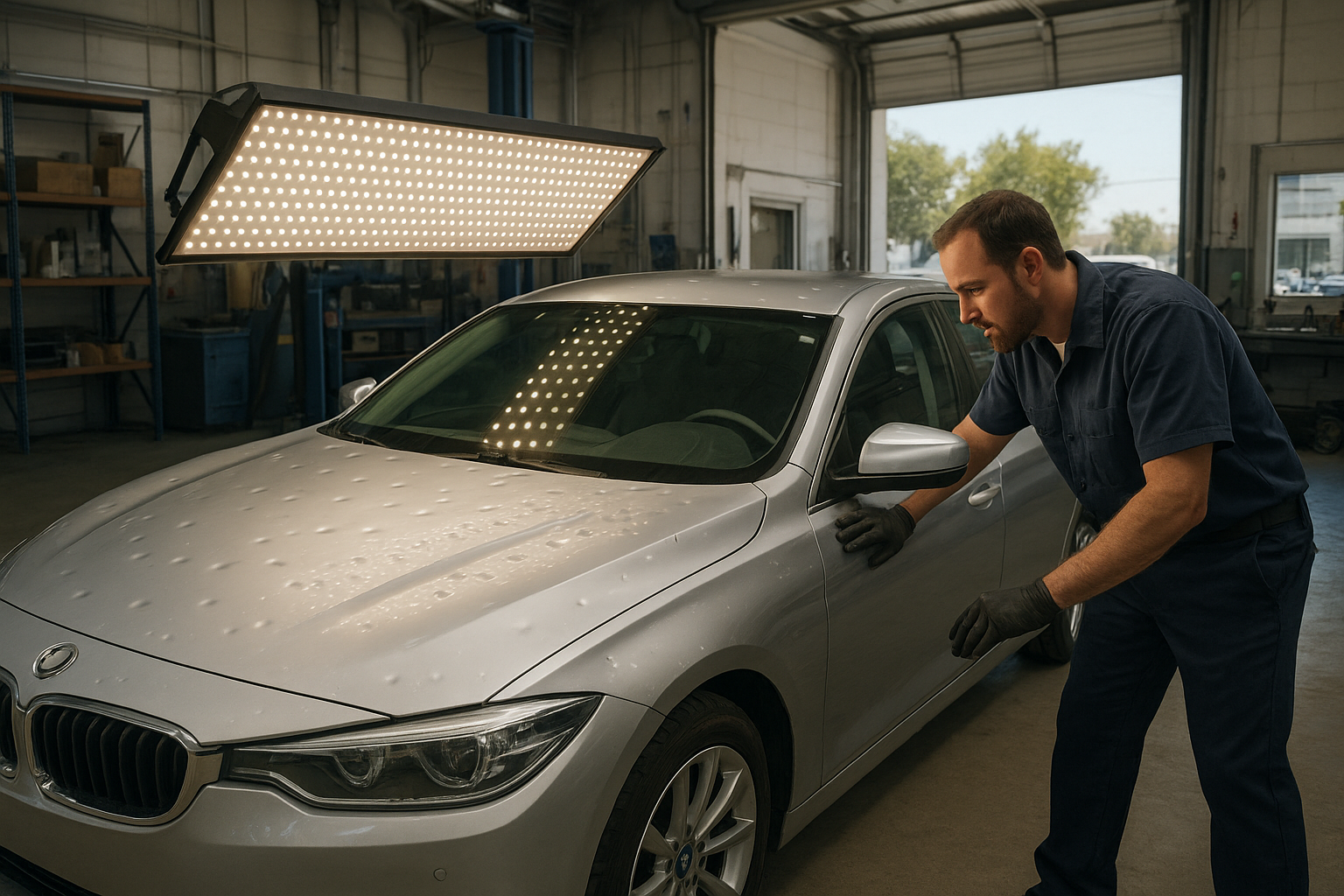
A certified technician uses LED hail inspection lights to map every dent before hail damage repair begins in Orange County.
When an unexpected Southern California storm drops ice, hail damage repair in Orange County jumps to the top of every driver’s search. This guide covers everything you need to make a confident, informed decision: how paintless dent repair (PDR) and conventional bodywork differ, realistic cost ranges, how comprehensive insurance claims work, what your repair timeline looks like, and red flags to avoid when choosing a shop. Whether you’re dealing with a handful of small dings or a hood blanketed in dents, this is the most thorough resource you’ll find for hail damage repair in Orange County.
Ready to act now? Schedule a free hail inspection with the certified team at Brea Auto Body — serving all of Orange County from Brea, Anaheim Hills, Yorba Linda, Fullerton, Placentia, and beyond.
Why Hail Damage in Orange County Is Different From Other Regions
Most people associate hail with Texas or Colorado, but Orange County hail events are deceptively damaging. Because they’re rare, many local drivers don’t recognize the scope of the damage until a proper inspection reveals it. Key characteristics of OC hail damage include:
- ?Spotty storm patterns — A hail cell may affect one neighborhood and skip the next block entirely, making insurance documentation critical.
- ?High concentration of new vehicles — Orange County has a higher-than-average density of late-model luxury and leased vehicles, where dent restoration must meet strict OEM tolerances.
- ?Aluminum-intensive modern panels — Many post-2015 vehicles use aluminum hoods and doors, which require PDR-certified technicians trained in aluminum-specific techniques.
- ?Lease return requirements — Lessees face penalty charges for unrepaired hail damage. PDR performed correctly keeps you within lease return standards.
How Hail Damage Is Assessed: The LED Inspection Process
Before any hail damage repair in Orange County begins, a professional shop completes a controlled-light inspection. This is not a walkthrough with a flashlight — it’s a systematic, panel-by-panel damage mapping process:

LED reflection boards make shallow hail dents visible that are completely invisible in standard daylight.
- ?LED hail boards and fluorescent reflection tools cast angled light across each panel to make even sub-5mm dents appear as ripples in the reflection.
- ?Panel-by-panel dent mapping catalogs each dent by location, diameter (in millimeters), and depth — the basis for any accurate insurance estimate.
- ?Paint integrity verification determines whether the clearcoat or color coat has cracked. Cracked paint triggers a different repair path entirely.
- ?Supplemental damage identification — mirrors, moldings, sunroof frames, and antenna bases often sustain damage that a casual visual check misses.
- ?ADAS sensor review — If roof or windshield areas were affected, camera and radar sensors may need recalibration as part of the repair.
Pro Tip: Never accept an estimate based solely on a parking-lot walk-around. Insurers routinely undercount dents by 30–50% without a controlled-light inspection. A thorough LED hail map protects you in supplement negotiations.
Hail Repair Methods Explained: PDR vs. Conventional Bodywork vs. Hybrid
Not every dent is the same, and not every repair method is right for every vehicle. Here’s a detailed breakdown of your options for hail damage repair in Orange County:
Paintless Dent Repair (PDR) — The Gold Standard for Hail
PDR is the preferred method for hail damage when paint remains intact. Certified technicians use specialized metal rods to work behind the panel and gently massage the metal back to its factory contour from the inside. On exterior surfaces without access, glue-pulling systems can lift dents without touching the paint surface at all.
PDR advantages:
- ? Preserves your original factory paint — no repainting, no color-match risk
- ? Maintains manufacturer’s paint warranty on new vehicles
- ? No filler, no bondo — structurally superior restoration
- ? Faster turnaround — days instead of weeks
- ? Protects vehicle resale value — no disclosed paint work on Carfax
- ? Most insurance carriers prefer PDR for cost efficiency
When PDR Is Not an Option
PDR has real limitations, and a trustworthy shop will tell you honestly when conventional repair is necessary:
- ?Cracked or chipped paint — Larger hailstones (1 inch+) often break the clearcoat or color layer. PDR will restore the metal, but cracked paint requires sanding, priming, and refinishing.
- ?Stretched or overstressed metal — When thin roof or hood skins take repeated large impacts, the metal loses memory and won’t return to contour, requiring panel replacement.
- ?Edge and body-line dents — Dents on sharp creases or panel edges cannot be massaged back without risking the surrounding metal.
- ?Previously repaired areas — Panels with existing filler don’t respond predictably to PDR tools.
- ?Inaccessible backside panels — Some structural or inner panels don’t permit rod access, though glue-pull PDR often bridges this gap.
The Hybrid Approach — Most Common for Significant Hail Events
The majority of vehicles brought in for hail damage repair in Orange County after a significant storm benefit from a hybrid plan: PDR handles the bulk of clean dents on the hood, roof, trunk, and doors, while conventional refinishing is applied only to the panels where paint is cracked or metal is overstretched. This minimizes cost, preserves as much OEM finish as possible, and produces the fastest overall completion time.
Hail Damage Repair Cost in Orange County: Real Numbers
One of the most searched questions around hail damage repair in Orange County is simply: what does it cost? The honest answer depends on three variables — hail size, number of panels affected, and whether paint was broken. Here are realistic ranges:
| Damage Level | Description | Typical Cost Range | Typical Timeline |
|---|---|---|---|
| Light | 1–2 panels, <50 dents, paint intact | $300 – $800 | 1–2 days |
| Moderate | 3–5 panels, 50–200 dents, paint intact | $800 – $2,500 | 2–5 days |
| Severe (PDR) | 5+ panels, 200+ dents, paint intact | $2,500 – $6,000+ | 5–10 days |
| Hybrid / Paint Damage | Mixed PDR + conventional refinish | $3,000 – $10,000+ | 1–3 weeks |
| Total Loss Threshold | Repair cost exceeds ~70–80% of ACV | Insurer declares total loss | Varies |
Note on Total Loss: If hail damage is extensive enough — particularly on older vehicles with lower actual cash value (ACV) — your insurance company may declare the vehicle a total loss rather than authorize repairs. A thorough LED inspection and supplement-ready estimate from an experienced shop can often support a repair path when initial insurer assessments are incomplete.
Insurance and Hail Damage Claims in Orange County: A Step-by-Step Walkthrough
Hail damage is almost always covered under comprehensive insurance — not collision. This distinction matters because comprehensive claims are typically treated as “no-fault” events, which generally do not raise your rates the same way a collision claim would. Here’s how to navigate the process effectively:
-
1
Document immediately after the storm. Photograph every panel in daylight and, if possible, at an angle. Include close-ups of individual dents and wide shots showing the full panel. Note the date, time, and your vehicle’s location during the storm.
-
2
File your comprehensive claim promptly. Call your insurance carrier or use their app. Reference the storm date and mention “hail damage.” Get a claim number before going to a shop.
-
3
Choose your repair shop before the insurance adjuster visits. In California, you have the legal right to select any licensed body shop. You are not required to use an insurer’s “preferred” or “direct repair” shop.
-
4
Get a complete LED-light inspection estimate. The shop’s documented hail map becomes the foundation for your insurance claim. Initial adjuster estimates almost always require supplements once a controlled inspection is complete.
-
5
Authorize the supplement. A reputable Orange County hail repair shop will communicate directly with your adjuster, submit the hail map and photos, and handle the supplement negotiation on your behalf.
-
6
Activate rental coverage. If your policy includes rental reimbursement, request it when you drop off your vehicle. Many carriers will activate a rental from the first day of repair.
-
7
Pay your deductible at pickup. Your deductible is paid to the shop; the insurer covers the remainder minus any depreciation on non-OEM parts (if applicable). Review your policy for deductible amounts before authorizing repairs.
Will my insurance rates go up? Comprehensive claims for weather events like hail are classified as “not-at-fault” incidents in California. While individual policies and carriers vary, comprehensive claims typically do not impact your rates the same way an at-fault collision would. Confirm with your agent before filing if you’re uncertain.
Hail Damage Repair Timelines in Orange County
One of the biggest stressors after a storm is wondering how long you’ll be without your vehicle. Here’s a realistic breakdown by damage severity for hail damage repair in Orange County:
- ?Light hail (under 50 dents, 1–2 panels): 1–3 business days. Pure PDR with no R&I (remove and install) required.
- ?Moderate hail (50–200 dents, 3–5 panels): 3–7 business days. PDR with some trim, headliner, or weatherstrip R&I for panel access.
- ?Severe hail (200+ dents or broken paint on 1–3 panels): 7–14 business days. Hybrid PDR plus refinish, paint cure time, and possible parts sourcing.
- ?Extensive paint damage, panel replacement, or ADAS recalibration: 2–4 weeks. Parts lead times and insurer approvals can extend this range.
What shortens your timeline: Booking a same-day inspection, having your claim number ready, pre-approving a supplement range with your insurer, and selecting a shop that does both PDR and conventional refinishing in-house — eliminating the need to subcontract work.
Step-by-Step: Your Complete Hail Repair Experience at an Orange County Shop
Here is exactly what to expect from drop-off to delivery when you bring your vehicle in for hail damage repair in Orange County:

A structured repair process minimizes delays and ensures nothing is missed from inspection through final delivery.
-
1
Check-in and storm documentation. Provide your claim number, storm date, and a description of where your vehicle was during the hail event. Photos you took immediately after the storm are extremely helpful here.
-
2
LED inspection and panel mapping. Each panel is inspected individually under controlled lighting. Every dent is counted, measured, and documented by panel and location. This becomes your official hail map.
-
3
Repair plan and written estimate. PDR-only, conventional, or hybrid — explained clearly with a timeline and your out-of-pocket cost after insurance. No surprises.
-
4
R&I (Remove and Install) for panel access. Headliners, trim panels, weatherstripping, and inner panels are carefully removed so technicians can access dent backsides for PDR.
-
5
PDR metal reshaping. Technicians work methodically across each panel, starting with the largest dents and finishing with shallow impressions. Glue-pull systems supplement rod work where access is limited.
-
6
Conventional refinishing (where required). Panels with cracked paint are prepared, primed, color-matched, and clear-coated. Proper blending ensures an invisible transition to adjacent panels.
-
7
Final quality control inspection. Every panel passes back under LED lighting. Reflections must show zero rippling, waviness, or residual dimpling before the vehicle is approved for delivery.
-
8
ADAS recalibration (if applicable). If roof repairs, windshield work, or sensor-adjacent panels were involved, forward-facing cameras, radar, and LiDAR sensors are recalibrated per manufacturer specs before delivery.
-
9
Delivery and documentation. You receive a clean, detailed vehicle along with complete repair documentation for your insurer, your records, and future resale purposes.
Before and After: What Quality Hail Damage Repair Looks Like
The standard for quality hail damage repair in Orange County is simple: when you’re done, it should look as though the storm never happened. Here’s what that means in practice:

Before and after: properly executed PDR removes every visible dimple and restores clean, factory-accurate reflections.
- ?PDR result: Zero dimpling visible under LED lights or in direct sunlight. Reflections are smooth and consistent across the entire panel surface.
- ?Refinish result: Color match is accurate within a tolerance that is indistinguishable in normal viewing conditions. Gloss level is consistent with adjacent panels.
- ?No filler under PDR panels: Unlike conventional body repair, PDR restores metal without fillers that can eventually crack or telegraph through paint over time.
Red Flags to Avoid When Choosing a Hail Repair Shop in Orange County
After a significant storm event, pop-up “storm chasers” — traveling hail repair crews — appear in Orange County parking lots and offer quick quotes. While some are skilled, this sector has a documented history of problems. Know what to watch for:
- ?No permanent local address — If the shop has no verifiable local presence, there’s no accountability if issues arise after you pick up your vehicle.
- ?Pressure to sign quickly — Legitimate shops don’t need you to sign before completing a thorough inspection. High-pressure urgency is a sales tactic, not a service signal.
- ?Promises to “waive your deductible” — In California, this practice is illegal insurance fraud. Any shop that offers it is putting you at legal risk.
- ?No written estimate before work begins — Any shop that starts repairs without a written, itemized estimate is not operating to professional standards.
- ?No mention of ADAS or calibration — A shop that doesn’t ask about your vehicle’s safety systems when discussing roof or windshield-adjacent damage is not following manufacturer-recommended procedures.
- ?No warranty on workmanship — Established shops stand behind their PDR and refinish work. Always ask for a written warranty before authorizing repairs.
Why an Established Orange County Shop Outperforms Storm Chasers
Choosing an established, permanently located hail damage repair shop in Orange County offers meaningful advantages over temporary operators:
- ?Local accountability: You know exactly where to go — in person — if questions or issues arise weeks or months after repair.
- ?OEM procedures and late-model expertise: Orange County has a high concentration of late-model luxury and near-luxury vehicles that require brand-specific OEM repair procedures — something an established local shop is practiced in daily.
- ?In-house calibration coordination: ADAS systems must be recalibrated after certain repairs. Local shops have established relationships with calibration specialists and can coordinate this without subcontracting delays.
- ?Supplement experience: Local shops that work with Orange County insurance adjusters regularly have established working relationships that make supplement approval faster.
- ?Lease and dealer standards: Shops that regularly work on leased vehicles understand the condition thresholds required for lease return, so PDR meets the exact standard needed — no more, no less.
- ?Easy drop-off and communication: With a shop a short distance away, dropping off, checking status in person, and picking up is far less disruptive to your week.
For all of these reasons — accountability, expertise, insurance efficiency, and OEM standards — we recommend booking your hail damage repair in Orange County with Brea Auto Body. Their team serves Brea, Fullerton, Anaheim Hills, Yorba Linda, Placentia, and all surrounding Orange County communities.
Hail Damage Repair and Vehicle Resale Value in Orange County
Many Orange County drivers underestimate how significantly unrepaired hail damage affects their vehicle’s market value — especially when trading in or selling privately in a market accustomed to pristine vehicles.
- ?Trade-in penalties: Dealers routinely deduct $1,500–$5,000+ from trade-in offers for visible hail damage, often well above the cost of a PDR repair.
- ?PDR preserves clean vehicle history: Because PDR doesn’t repaint panels, no paint work is disclosed on a vehicle history report — maintaining the vehicle’s original-paint advantage in private sales.
- ?Lease return protection: PDR brings the vehicle to lease-return acceptable condition, avoiding end-of-lease damage charges that can run $800–$3,000+.
- ?Insurance-paid repairs retain value at your expense otherwise: If you skip a hail claim and leave damage unrepaired, you’ve paid your premiums for comprehensive coverage you didn’t use — and taken the resale hit too.
Frequently Asked Questions: Hail Damage Repair Orange County
Book Your Hail Damage Repair in Orange County Today
Southern California storms are unpredictable — your recovery doesn’t have to be. If you’re dealing with hail damage anywhere in Orange County, the right move is a same-day professional LED inspection from a certified, established local shop. You’ll know exactly what you’re dealing with, what it costs, how long it takes, and what your insurance covers — before any work begins.
Schedule Your Free Hail Inspection at Brea Auto Body ?
From a single dimpled panel to a fully storm-battered vehicle, the team at Brea Auto Body delivers factory-accurate hail damage repair across Orange County — with transparent estimates, insurance coordination, and a workmanship guarantee you can count on.

