

Hail Damage Repair Orange County: Everything You Need to Know in 2025
Your complete guide to PDR, insurance claims, timelines, and finding the best local shop.
Hail damage repair in Orange County is best handled with paintless dent repair (PDR) — a technique that restores dented metal to its original shape without repainting. However, the right method depends on your specific damage. This guide explains every option, cost factor, insurance step, and timeline so you can make the best decision fast.
When a rare Southern California storm drops hailstones across Orange County, the calls for hail damage repair start almost immediately. If you’re dealing with a dimpled hood, pitted roof, or spotted trunk lid, you’re not alone — and the good news is that most hail damage is fully repairable, often without a single drop of new paint. This guide covers the entire process, from that first LED inspection to picking up a restored vehicle, so you know exactly what to expect before you book a single appointment.
Need fast help? Reserve your inspection slot at Brea Auto Body — a trusted Orange County shop with deep experience in storm damage restoration.

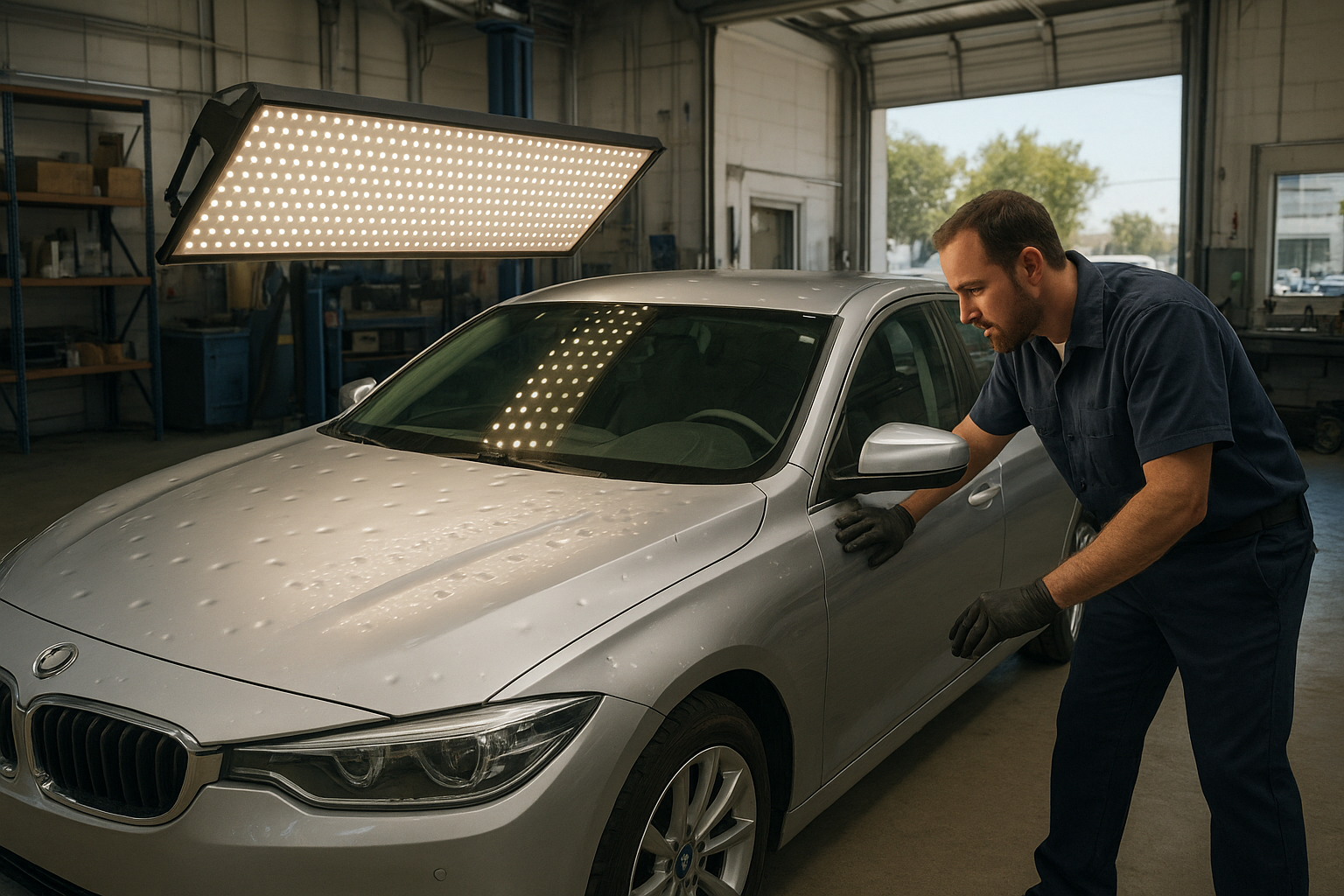
Hail damage repair in Orange County often starts with a meticulous LED light inspection to reveal every dent.
What Is Hail Damage Repair — and Why Does Orange County Need It?
Orange County sits in a region where hail events are infrequent but impactful. When storms do arrive, they tend to be short-lived yet intense, pelting hundreds of vehicles with ice ranging from pea-sized to golf ball-sized hailstones. In contrast to states like Texas or Colorado where hail is a seasonal certainty, Southern California residents are often caught off guard — and unprepared.
As a result, the demand for professional hail damage repair in Orange County spikes sharply after each storm. The thin sheet metal on modern vehicles — particularly hoods, roofs, and trunk lids — is vulnerable to even small hailstones. Each impact leaves a shallow concave dimple that, while not structurally dangerous, degrades your vehicle’s appearance and resale value significantly.
Fortunately, most OC hail damage falls squarely within the ideal range for paintless dent repair (PDR) — a specialized technique where trained technicians massage or pull the metal back to its factory shape without disturbing your original paint. The process preserves your vehicle’s OEM finish, maintains resale value, and typically takes far less time than conventional bodywork.
How Hail Damage Is Assessed: The LED Inspection Process
Before any repair begins, every reputable Orange County shop starts with a thorough inspection. Standard lighting conditions — like a parking lot or showroom fluorescent lights — often mask the true extent of hail damage. Specifically, shallow, wide dents can be nearly invisible in normal light but become immediately obvious under specialized inspection tools.
- LED hail reflection boards: Large LED panels are positioned at an angle to each body panel. The reflections reveal every contour change, making shallow dimples easy to spot and photograph.
- Panel-by-panel dent mapping: Technicians catalog each dent by location, diameter (typically measured in millimeters), and depth. This data drives your repair estimate and insurance claim documentation.
- Paint integrity evaluation: Each impact is checked for cracked clearcoat, chipped color coat, or bare metal exposure. Damaged paint changes the recommended repair method entirely.
- Body line and edge analysis: Dents located directly on a body crease or panel edge require special consideration since PDR is more difficult in these areas.
- Supplemental damage identification: Large storms sometimes crack or chip windshields, damage rubber seals, crack plastic trim, or dent roof rails — all of which need documentation before an insurer signs off.

LED reflection tools reveal shallow hail dents that are completely invisible in normal daylight.
Therefore, always insist on a proper LED inspection — not just a quick visual walk-around. A thorough inspection typically adds 30–60 minutes to your initial visit, but it pays dividends by ensuring no dent is missed, every panel is documented, and the resulting insurance claim reflects the true scope of damage.
PDR vs. Conventional Bodywork: Choosing the Right Hail Damage Repair Method
The single most important decision in any hail repair project is choosing between paintless dent repair and conventional bodywork — or a hybrid of both. Understanding the strengths and limitations of each method helps you have a more informed conversation with your shop and your insurer.
Paintless Dent Repair (PDR) — The Preferred Choice for Hail
PDR is the dominant method for hail damage repair across Orange County — and for good reason. When paint is intact and the metal hasn’t been overstretched, a skilled PDR technician can restore a panel to factory-perfect condition using only specialized tools and lighting. Specifically, the technique works by either accessing the back of the panel to carefully push the metal outward, or using precision glue-pull tabs attached to the exterior surface to gently pull the dent up.
The key advantages of PDR for hail are substantial:
- No paint, no filler, no bondo: Your original factory paint remains completely untouched. This preserves your vehicle’s paint history and helps maintain resale value.
- Faster turnaround: Most PDR-only jobs complete in 1–5 days, compared to 2+ weeks for conventional refinishing.
- Lower cost: Without paint materials, booth time, and color matching, PDR is typically less expensive — especially for multi-panel storm events.
- Insurance-preferred method: Many carriers actively prefer PDR because it restores factory finish without the risks of color mismatch or overspray on adjacent panels.
- Works on aluminum: Modern vehicles use aluminum hoods and doors. PDR works on aluminum panels, though the technique requires a higher skill level due to the metal’s different memory characteristics.
When Conventional Bodywork Becomes Necessary
However, PDR isn’t appropriate for every situation. Certain conditions require conventional repair techniques — and a qualified shop will identify these during the LED inspection. Specifically, conventional bodywork is typically required when:
- Paint is cracked or chipped: Once the clearcoat or color coat breaks, the panel needs refinishing to seal and protect the metal from rust and UV damage.
- Metal is overstretched: Larger or sharper hailstones can stretch the metal beyond its elastic limit. In these cases, pushing the metal back creates a high spot instead of a smooth surface, requiring filler and refinishing.
- Dents fall on body lines or edges: Sharp creases and panel edges significantly complicate the PDR process. Depending on the depth and angle, refinishing may produce a cleaner result.
- Panel is too severely damaged for refinishing: In extreme cases — typically golf ball-sized hail impacts — the panel is beyond practical repair and replacement is the correct solution.
The Hybrid Approach — Common for Major Orange County Hail Events
In practice, many vehicles involved in significant OC hail storms require what’s called a hybrid repair. PDR handles the vast majority of panels where paint is intact, while targeted conventional refinishing addresses the two or three panels where paint was cracked or metal was overstretched. This hybrid approach delivers the fastest, most cost-effective, and most visually consistent outcome. Above all, it ensures that no panel gets repainted unnecessarily — protecting your vehicle’s paint history and future resale value.
How Long Does Hail Damage Repair Take in Orange County?
One of the most common questions after a hail event is simply: how long will I be without my car? The answer depends on three factors — the severity of the damage, the repair method required, and the speed of your insurance approval. Here’s a realistic breakdown:
Repair Timeline by Damage Severity
- Light hail (dozens of small dents, paint intact): 1–3 business days with PDR-only repair.
- Moderate hail (50–200+ dents across multiple panels, paint intact): 3–7 business days. Some trim or headliner removal (R&I) may add a day.
- Severe hail (paint damage, overstretched metal, or panel replacement needed): 7–14+ business days, depending on parts availability and paint booth scheduling.
- ADAS recalibration required: Add 0.5–1 day if windshield replacement or roof work triggers a forward camera, radar, or sensor recalibration.
Furthermore, insurance approval speed has a significant impact on overall repair time. Consequently, the fastest path to getting your car back is to book a same-day or next-day LED inspection, open your insurance claim on the same day, and submit the shop’s detailed dent map and estimate to your adjuster promptly.
Similarly, asking about hail supplements is important. An initial insurance estimate — especially one written by a remote photo adjuster — frequently misses dents. A shop experienced in hail damage repair in Orange County will photograph every dent under LED lighting and submit a comprehensive supplement. This step is critical for ensuring the full repair scope is covered.
Insurance and Costs: What to Expect for Hail Damage Repair in Orange County
Understanding how insurance interacts with your hail repair is essential — especially in Orange County where hail events are rare enough that many drivers have never filed a comprehensive claim before. Here’s a clear breakdown of how the process typically works.
Comprehensive Coverage — The Policy That Pays for Hail
Hail damage is covered under the comprehensive portion of your auto insurance policy — not collision. This distinction matters because comprehensive claims are generally treated as no-fault events, meaning they typically don’t trigger a rate surcharge the way collision claims might. However, always verify this with your specific carrier before assuming.
Your deductible applies to the total repair cost. Common comprehensive deductibles range from $100 to $1,000. If your vehicle sustained light hail with a lower repair cost, it may be worth comparing the repair bill to your deductible before deciding whether to file a claim.
Typical Cost Ranges for Hail Damage Repair
Repair costs vary based on the number of dents, their sizes, the number of panels affected, and whether conventional refinishing is needed. As a general reference:
- Light hail, 1–2 panels, PDR only: $150 – $800
- Moderate hail, 3–6 panels, PDR: $800 – $2,500
- Severe hail, full vehicle, with some refinishing: $2,500 – $6,000+
- Panel replacement (extreme damage): $500 – $2,000+ per panel, plus paint matching
These figures are estimates only. Your specific vehicle, OEM labor times, and regional parts pricing all affect the final number. An experienced Orange County shop will provide a precise written estimate after the LED inspection.
Navigating the Insurance Supplement Process
One of the most important things to understand about hail claims is that the initial estimate is almost always incomplete. Remote photo adjusters working from snapshots frequently miss dents — especially small, shallow ones that only become visible under LED inspection lighting. As a result, supplements are extremely common in hail repairs.
A supplement is simply an updated estimate submitted to your insurer after the shop has completed a thorough physical inspection. Most reputable shops in Orange County handle this process regularly and know exactly how to document and present the additional damage to accelerate approval.
In addition, many policies include rental reimbursement coverage. If your vehicle will be in the shop for several days, verify whether your policy includes rental coverage — it can offset much of the inconvenience. Furthermore, ask your shop whether they can help coordinate the rental directly so you’re not managing multiple logistics simultaneously.
For hands-on help with your claim, Brea Auto Body in Orange County handles insurer communication, supplements, and documentation — so you can focus on your daily routine while they manage the paperwork.
Step-by-Step: What to Expect From Your Hail Damage Repair Visit
Understanding the full repair workflow helps you set expectations, ask better questions, and avoid surprises. Here’s exactly what happens from drop-off to delivery at a professional Orange County hail repair shop:
- Check-in and storm documentation: Provide your insurance claim number (if you’ve already opened one), describe where the vehicle was parked during the hail event, and share any storm photos you captured. This information strengthens your claim documentation.
- Full LED inspection and panel mapping: Technicians systematically inspect every exterior panel under LED lighting, recording each dent’s location, size, and paint condition. The resulting dent map becomes the foundation of your repair plan and insurance estimate.
- Repair method selection and estimate: Based on the inspection, the shop recommends PDR only, conventional refinishing, a hybrid approach, or — in severe cases — panel replacement. A written estimate is provided, including timeline and itemized costs.
- Insurance coordination and supplement submission: If your insurer’s initial estimate differs from the shop’s assessment, the shop submits a supplement with supporting LED photographs and dent counts. Most approvals follow within 24–72 hours.
- Trim and panel R&I for access: Where necessary, technicians remove headliners, interior trim, or inner panels to access the back of dented exterior panels. These components are carefully reinstalled and inspected afterward.
- Metal reshaping and refinishing: PDR technicians work each dent to factory contour using specialized rods and lighting. Where conventional refinishing is required, panels are prepared, primed, color-matched, and clearcoated in a controlled paint booth environment.
- Quality control LED re-inspection: Every repaired panel is re-inspected under LED lighting to verify a smooth, ripple-free surface. No dent is signed off without this final check.
- ADAS calibration (if applicable) and delivery: If roof work, windshield replacement, or camera repositioning occurred, advanced driver assistance system (ADAS) sensors must be recalibrated to manufacturer specification. Your vehicle is then detailed, inspected, and delivered with complete documentation.

A clear, step-by-step hail repair process streamlines insurance approvals and shortens overall repair time.
ADAS Calibration After Hail Repair: A Step Most Shops Skip
Modern vehicles are increasingly equipped with advanced driver assistance systems (ADAS) — cameras, radar sensors, and ultrasonic detectors embedded in the windshield, roof, bumpers, and body panels. These systems power features like automatic emergency braking, lane-departure warning, adaptive cruise control, and blind-spot monitoring.
Consequently, any hail repair that involves windshield replacement, significant roof work, or repositioning of components near these sensors can knock them out of calibration. An uncalibrated ADAS system may provide false alerts, fail to detect hazards correctly, or — in the worst case — fail silently without alerting the driver.
Therefore, a complete hail repair job in Orange County should include a post-repair ADAS check as a standard step — not an afterthought. Specifically, shops should verify whether any sensor positions were disturbed during repair and whether a static or dynamic calibration is required by the vehicle manufacturer’s service procedure.
An established Orange County auto body shop will either perform this calibration in-house or coordinate it with a certified calibration partner — and include it in the repair documentation provided to your insurer.
Why “Storm Chasers” Are a Risk — and Why Local Orange County Shops Win
After every significant hail event, “storm chaser” repair crews travel from out of state and set up temporary operations in parking lots and hotel rooms. While some of these technicians are skilled, the business model creates real risks for consumers. Specifically:
- No fixed address or accountability: When they leave town, you lose the ability to return for warranty work or corrections. If a problem surfaces two months later, there is no shop to call.
- Unfamiliarity with local OEM requirements: Southern California has a high concentration of luxury and late-model vehicles with specific OEM repair procedures. Storm crews may not follow manufacturer guidelines, voiding warranty coverage.
- Insurance coordination challenges: Local shops have existing relationships with regional insurance adjusters, which often means faster approvals and smoother supplement handling.
- No ADAS calibration capability: Most mobile storm crews don’t have the equipment or certifications to perform post-repair ADAS calibrations.
- High-pressure sales tactics: Some storm chasers offer “deductible waivers” — which is insurance fraud in California — or pressure customers to sign over assignment of benefits before an inspection is complete.
In contrast, an established Orange County body shop offers long-term accountability, familiarity with local insurance adjusters, OEM-compliant repair procedures, and ADAS calibration support. Above all, you know exactly where to go if you have a question six months from now.
Before and After: What a Quality Hail Repair Actually Looks Like
The measure of a great hail repair is simple: a properly repaired panel should be indistinguishable from a panel that was never damaged. Specifically, quality PDR leaves:
- No residual dimples or high spots — the metal returns to true factory contour
- Clean, straight reflections — no waviness visible under overhead lighting
- Original factory paint — completely untouched, with full paint history preserved
- No filler beneath the surface — PDR is a pure metal reshaping process, not a fill-and-sand repair
Where paint damage required conventional refinishing, a high-quality color match and clearcoat blend should produce consistent gloss, matching texture, and no visible panel transitions between repainted and original areas.

Before and after: quality PDR erases every dimple and restores clean, factory-perfect reflections.
Will Hail Damage Repair Affect My Car’s Value?
This is one of the most important questions Orange County vehicle owners ask — and it deserves a direct answer.
Unrepaired hail damage will reduce your vehicle’s resale and trade-in value. Dealers and private buyers discount hail-damaged vehicles significantly — often more than the actual cost of repair. Therefore, repairing hail damage is nearly always the financially sound choice, particularly when insurance covers most of the cost.
Furthermore, PDR preserves your vehicle’s original factory paint — which is important for buyers, dealers, and vehicle history tools like Carfax. Since PDR doesn’t add paint to the vehicle, a paint thickness gauge used during a pre-purchase inspection will show factory-original readings. This means a well-executed PDR repair is effectively invisible to future buyers from an inspection standpoint.
In contrast, conventional refinishing — even if executed perfectly — will show on a paint thickness gauge and may prompt questions from buyers. However, it’s still far preferable to leaving cracked or chipped paint unaddressed, which creates rust risk and a permanently obvious cosmetic defect.
Local Service Area: Hail Damage Repair Across Orange County
Brea Auto Body serves drivers throughout Orange County and the surrounding communities. Whether your vehicle was caught in a hail event while parked in Anaheim Hills, Fullerton, Yorba Linda, or anywhere else in the region, local professional service is within easy reach.
Fullerton
Anaheim Hills
Yorba Linda
Placentia
La Habra
Orange
Tustin
Anaheim
Frequently Asked Questions: Hail Damage Repair in Orange County
Will hail dents lower my car’s value if I skip repairs?
Yes — significantly. Dealers and private buyers typically apply a discount to hail-damaged vehicles that exceeds the cost of repair. PDR is specifically a cost-effective solution because it restores the original factory finish without affecting your paint history, making the repair essentially invisible to future buyers.
Is PDR always an option for hail damage?
Not always. PDR works when paint is intact and the metal hasn’t been overstretched. If paint is cracked, if dents fall on body lines, or if the metal was damaged by large hailstones, conventional refinishing or panel replacement may be required. However, the majority of Orange County hail events produce exactly the type of damage that PDR handles best.
How do I speed up my hail damage repair claim?
Book your LED inspection as soon as possible after the storm — ideally the same day. Open your insurance claim immediately, noting the exact storm date and time. Provide your claim number to the shop so they can submit a comprehensive dent map and estimate directly to your adjuster. Shops experienced in hail damage repair in Orange County know how to expedite supplement approvals and get your car into the repair schedule faster.
Will filing a hail claim raise my insurance rates?
Comprehensive claims are generally treated as no-fault events — meaning they typically don’t increase your premium the way an at-fault collision claim might. However, policies differ. Contact your insurance agent directly to understand how a comprehensive claim may affect your specific rate.
What if I have multiple hail events in the same year?
Each hail event can be claimed separately under comprehensive coverage, subject to your deductible each time. Some policies have diminishing deductibles or other provisions for multiple events — your agent can clarify what applies.
Can hail dents be repaired on aluminum panels?
Yes. PDR works on aluminum, though it requires a higher skill level than steel panels because aluminum has different elasticity characteristics. An experienced PDR technician familiar with modern vehicle construction will know how to approach aluminum hoods, doors, and roofs correctly.
Do I need ADAS calibration after hail repair?
Only if work was performed near cameras or sensors — most commonly windshield replacement, significant roof panel work, or front bumper repairs. If calibration is required, your shop should coordinate it as part of the repair process and include documentation in the final delivery paperwork.
Ready to Get Started? Book Your Hail Damage Repair in Orange County
Storms are unpredictable — but your repair experience doesn’t have to be. Whether your vehicle has a dozen shallow dents from light hail or hundreds of impacts across every panel, getting a professional LED inspection is the critical first step.
Brea Auto Body provides comprehensive hail damage assessments, expert PDR and conventional repair services, and full insurance claim coordination — all from a fixed Orange County location where long-term accountability is part of the promise.
Don’t let hail damage sit — schedule your inspection today.
Conclusion
Hail damage repair in Orange County is a well-defined process when handled by an experienced local shop. From the initial LED inspection through PDR or conventional refinishing, insurance coordination, and final quality control, every step has a clear purpose and a predictable outcome. The key is acting quickly — booking your inspection early, opening your claim promptly, and choosing a shop with the equipment, certifications, and local accountability to see the job through completely. A properly completed hail repair restores your vehicle to factory condition, preserves its resale value, and — when insurance covers the bulk of the cost — makes financial sense in almost every scenario.

