

Collision Repair Guide — By Brea Auto Body. Last updated: 2026-07-07.
Your bumper’s outer shell is only half the story. The steel bar behind it is what truly keeps you safe — and most drivers never know it’s been compromised. See our bumper repair guide for repair costs and the full repair process.
Bumper reinforcement repair is the process of inspecting, restoring, or replacing the rigid structural bar that sits directly behind your vehicle’s plastic bumper cover. Unlike the cover itself — which is designed mainly for aesthetics — the reinforcement bar is an engineered safety component that absorbs and redirects crash energy away from your vehicle’s frame and passenger compartment. Understanding when this part needs attention could be one of the most important automotive decisions you make after a collision. See our bumper repair guide for costs and replacement guidance.
Quick Answer
Bumper reinforcement repair involves assessing and fixing or replacing the structural steel or aluminum bar behind your bumper cover. It is a critical safety repair because a damaged reinforcement bar cannot properly protect you in a future impact — even if your bumper cover looks perfectly fine on the outside.
What Is the Reinforcement Bar?
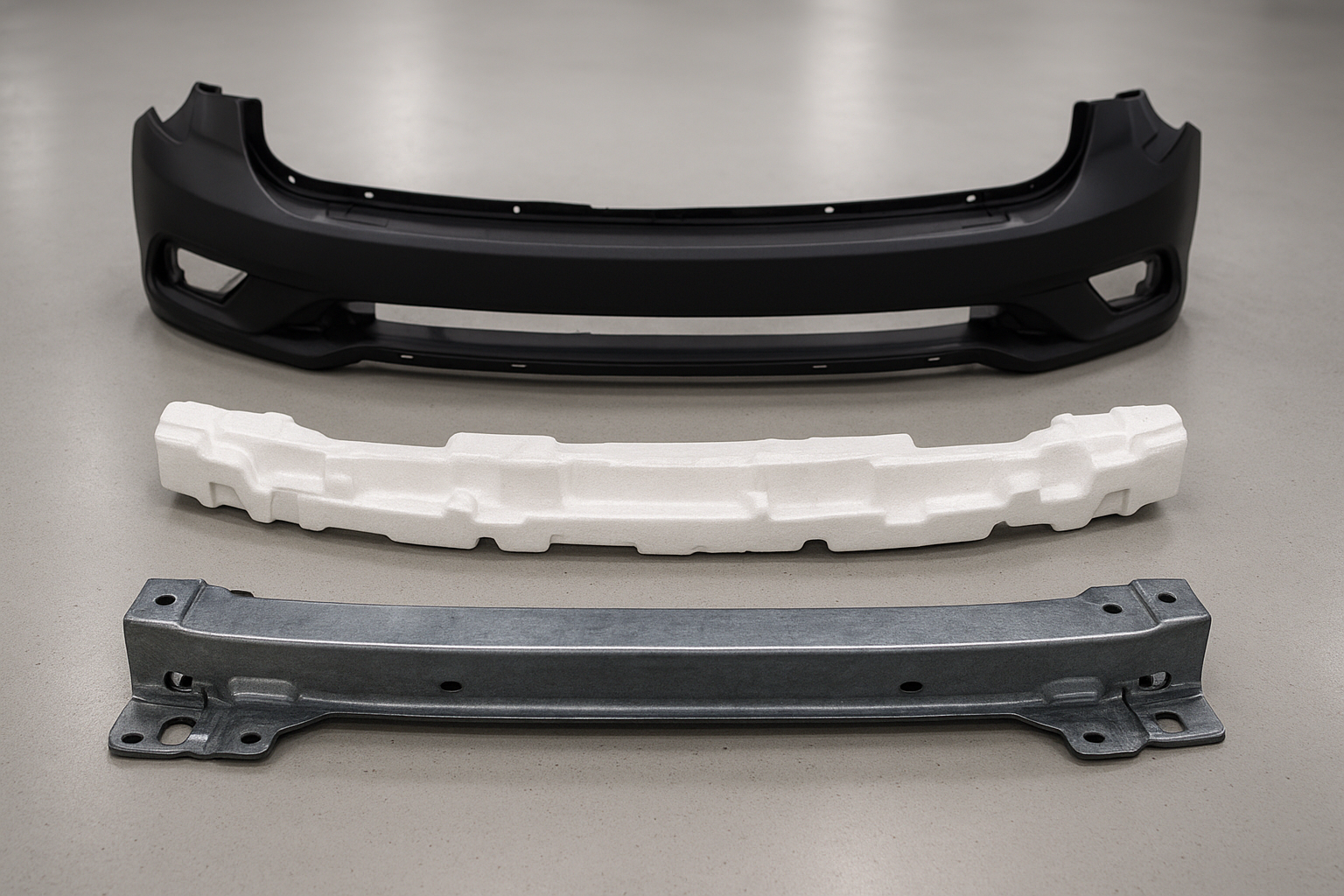
Every modern passenger vehicle is built with a layered bumper system. The outermost layer is the bumper cover — typically made from thermoplastic or polypropylene — which gives the vehicle its finished look. Directly behind it sits the bumper reinforcement bar, usually fabricated from high-strength steel, aluminum, or in some cases carbon fiber composites. Between those two components, many vehicles also include an energy absorber or foam block that compresses on impact before the force reaches the reinforcement bar. See our bumper repair costs guide for detailed pricing and parts information.
According to the National Highway Traffic Safety Administration (NHTSA), bumper systems are federally regulated to minimize damage in low-speed collisions up to 2.5 mph, though modern vehicles are often engineered to far exceed that standard. The reinforcement bar is central to meeting those benchmarks.
Bumper reinforcement repair becomes necessary when this bar is bent, cracked, or deformed — a situation that occurs more often than most drivers realize, because the outer bumper cover can spring back into shape after a minor collision while the structural bar behind it remains permanently deformed.
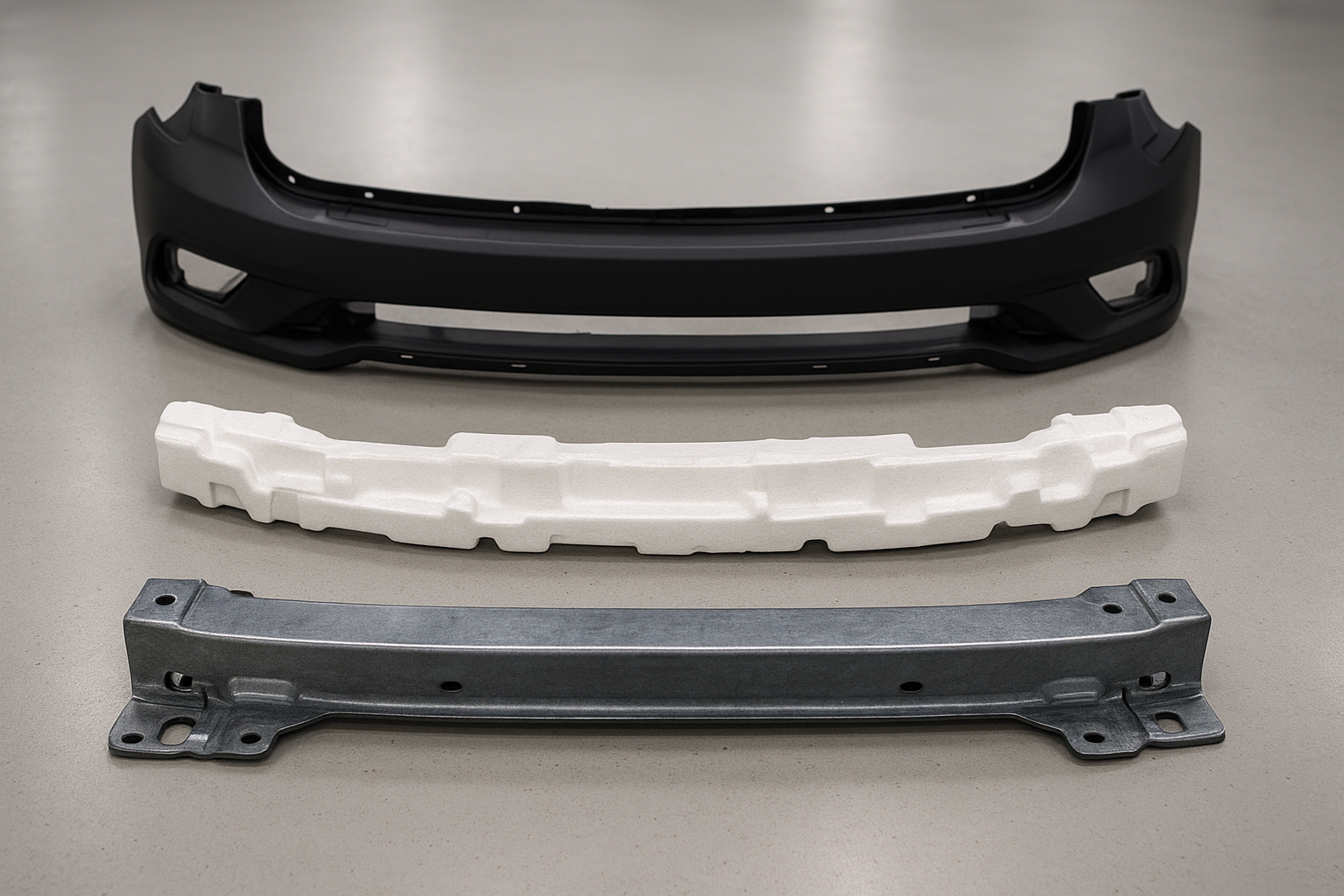
A bumper reinforcement repair starts with understanding the layered system behind your bumper cover — including the structural bar that does the real safety work. For a deeper walkthrough, see our Bumper Repair Cost: 2026 Complete Guide to Prices, Parts, and Smart Decisions.
How Do I Know If My Bumper Reinforcement Is Damaged?
This is one of the most common questions drivers ask after a fender-bender. The deceptive nature of bumper damage is that the cosmetic cover can look completely intact while the reinforcement bar underneath has been significantly compromised. Here are the key warning signs to watch for: For related cosmetic repairs and scuff guidance, see bumper scuff removal.
-
01
Bumper cover misalignment. If your bumper cover sits lower on one side, protrudes outward, or has uneven gaps near the headlights or taillights, the reinforcement bar may be bent out of position. -
02
Visible deformation when you look behind the cover. A quick visual inspection — often possible by crouching and looking under the vehicle or removing the cover — may reveal obvious bending or cracking in the bar. -
03
Rattling or unusual sounds from the bumper area. A reinforcement bar that has shifted from its mounting brackets may produce noise while driving, especially over bumps. -
04
Recent collision, even at low speed. Any impact above approximately 5 mph warrants a professional inspection of the reinforcement bar, even if the bumper cover appears undamaged.
Repair vs. Replacement: Which Does Your Reinforcement Bar Need?
This is where professional judgment matters most. Unlike a plastic bumper cover that can sometimes be reshaped with heat, a bent or cracked reinforcement bar presents a more complex decision. Here is how technicians typically evaluate it:
When Repair May Be Possible
- Very minor surface denting with no structural compromise
- Damage limited to mounting brackets only
- Bar material is aluminum and deformation is minimal
- OEM part is unavailable and a certified repair is the only option
When Replacement Is Required
- Any visible bend, crease, or crack in the bar itself
- High-strength steel bar that cannot be safely re-formed
- Damage that has compromised the bar’s cross-section
- Impact absorber is also crushed or deformed
The general industry consensus, supported by most collision repair certification bodies, is that replacement is almost always the safer choice for a damaged reinforcement bar. The bar is heat-treated and engineered to precise tolerances; attempting to straighten it can create stress fractures that are invisible to the naked eye but will fail catastrophically in a subsequent impact.
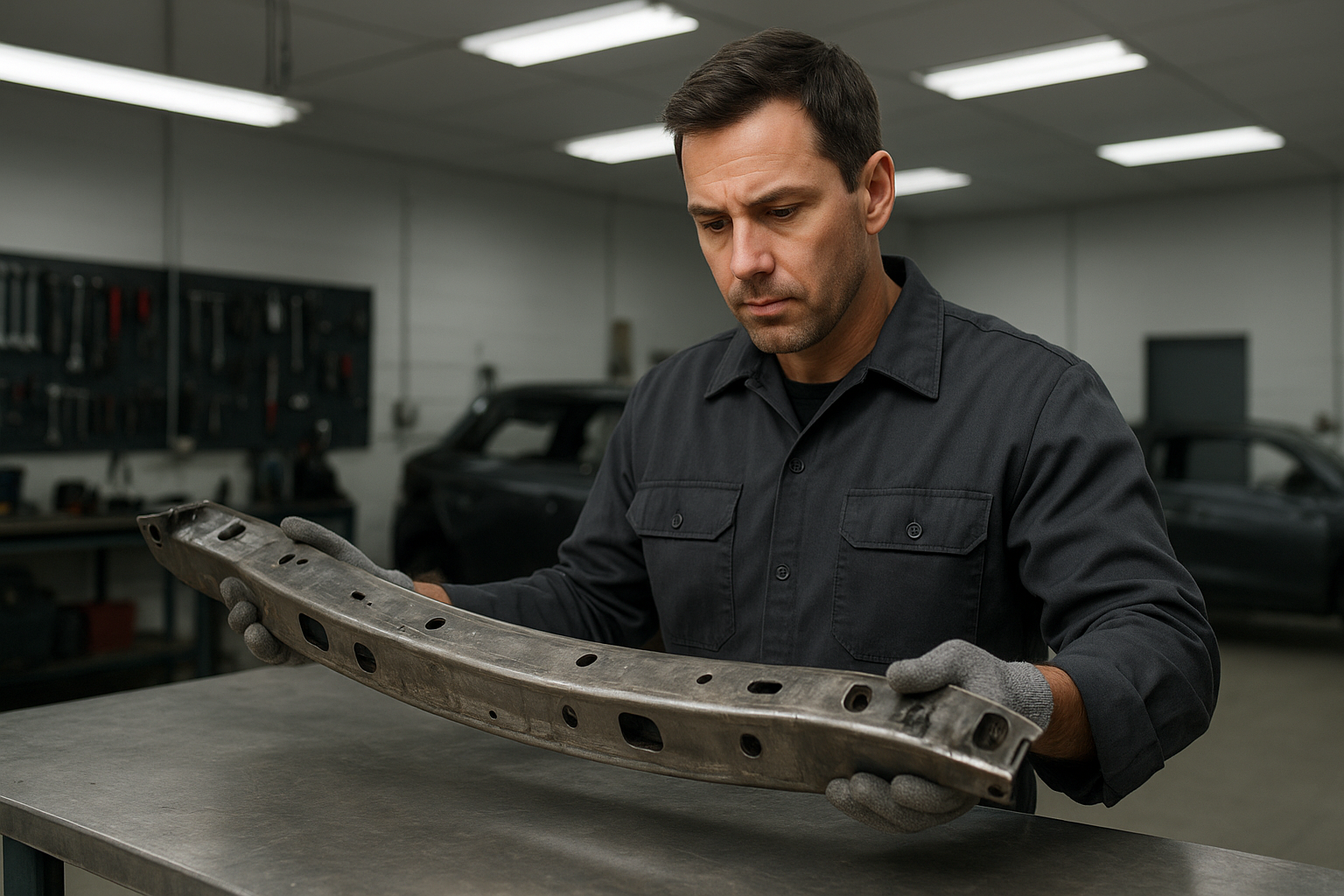
A trained technician carefully examines a removed reinforcement bar — a crucial step in any professional bumper reinforcement repair process. For a deeper walkthrough, see our Bumper Dent Repair: The Complete Guide for Brea & Orange County Drivers.
The Bumper Reinforcement Repair Process: Step by Step
When you bring your vehicle to a qualified collision center, here is what the repair workflow typically looks like:
-
1
Initial damage assessment. The technician removes the bumper cover to expose the reinforcement bar and surrounding components, then documents all damage with photographs for insurance purposes. -
2
Frame and alignment check. Before the reinforcement bar is addressed, technicians use measuring equipment to verify that the vehicle’s frame rails — where the bar mounts — are still straight and undamaged. -
3
Reinforcement bar removal. The damaged bar is unbolted from its mounting points. This is also when the energy absorber, bumper brackets, and any associated sensors (such as parking sensors) are inspected. -
4
New bar installation. An OEM or equivalent-quality replacement bar is installed and torqued to manufacturer specifications. Sensor brackets and mounting hardware are reinstalled or replaced as needed. -
5
Bumper cover reinstallation and finishing. The bumper cover is refitted, any damaged sections are repaired or replaced, and the entire assembly is painted and blended to match the vehicle’s finish.
How Much Does Bumper Reinforcement Repair Cost?
Cost varies significantly based on vehicle type, material of the reinforcement bar, and regional labor rates. The following ranges are general estimates for the United States market: See our bumper repair cost guide for detailed pricing and savings tips.
Is Bumper Reinforcement Repair Covered by Insurance?
In most cases, yes. If the damage resulted from a collision, your collision coverage should apply after your deductible. If the damage was caused by a non-collision event — such as a falling tree branch or vandalism — comprehensive coverage typically applies. It is worth noting that even if you were at fault, your insurer will still cover the repair under collision coverage if you carry it.
Always request a complete written estimate that specifically itemizes the reinforcement bar as a line item. This ensures your insurer cannot later dispute whether the structural component was replaced. A reputable shop like Brea Auto Body will handle the insurance documentation process on your behalf, making the claim as straightforward as possible.
A trusted collision center will walk you through the insurance process and ensure your bumper reinforcement repair is fully documented for your claim.
Frequently Asked Questions
The Bottom Line
Bumper reinforcement repair is not a cosmetic concern — it is a fundamental safety issue. A damaged reinforcement bar that goes unaddressed leaves you and your passengers significantly less protected in any future collision, regardless of how good your bumper cover looks from the outside. Whether you have been in a minor parking lot scrape or a more serious highway incident, having your reinforcement bar professionally inspected is always the right call.
For expert assessment and quality repairs in Southern California, the team at Brea Auto Body brings decades of collision repair experience to every vehicle — ensuring your car is structurally sound, not just visually restored. Written by Fred — see the author bio for credentials, certifications, and experience details.

