

Collision Safety Guide
Frame Damage Signs After Accident: The Complete Guide to Spotting, Understanding, and Acting on Structural Damage
What you can’t see after a collision may be the most dangerous thing of all — and ignoring it could cost you your life in the next crash.
Frame damage signs after accident are the physical, mechanical, and handling indicators that reveal a vehicle’s structural chassis has been bent, twisted, crumpled, or otherwise compromised as a result of a collision. Recognizing these signs early is not just about protecting your financial investment — it is a matter of life and safety. Learn where to find certified repairs and local options at frame repair near me. A damaged frame fundamentally changes how your vehicle absorbs impact in future crashes, putting every occupant at serious risk every time the vehicle moves.
Quick Answer
The most telling frame damage signs after accident include visible bends or kinks in the chassis, misaligned body panels, a vehicle that tracks crooked or pulls to one side, abnormal or accelerated tire wear, doors and windows that no longer operate correctly, unusual structural noises, and a rear end that appears to “crab-walk.” If you notice any of these signs, stop driving the vehicle immediately and have it professionally inspected.
What Are Frame Damage Signs After Accident?
A vehicle’s frame — also called the chassis — is its structural backbone. According to the National Highway Traffic Safety Administration (NHTSA), modern vehicles are engineered with precisely calculated crumple zones designed to absorb collision energy and funnel it away from the passenger cabin. When a crash overwhelms those crumple zones, the primary structural frame deforms — and that deformation creates a cascade of symptoms throughout the entire vehicle.
Frame damage signs after accident range from dramatic visual cues you can spot in a parking lot to subtle handling changes that only reveal themselves at highway speed. Knowing both categories is essential, because insurance adjusters, resale buyers, and — most importantly — your own physical safety all depend on an accurate, complete picture of your vehicle’s condition after any collision.
It’s also important to understand that frame damage does not always mean a violent, high-speed crash. A seemingly minor rear-end collision at 15 mph can produce enough force to compress frame rails, shift structural mounting points, or crack welds at critical junctions. Speed alone is not a reliable indicator of whether frame damage has occurred.
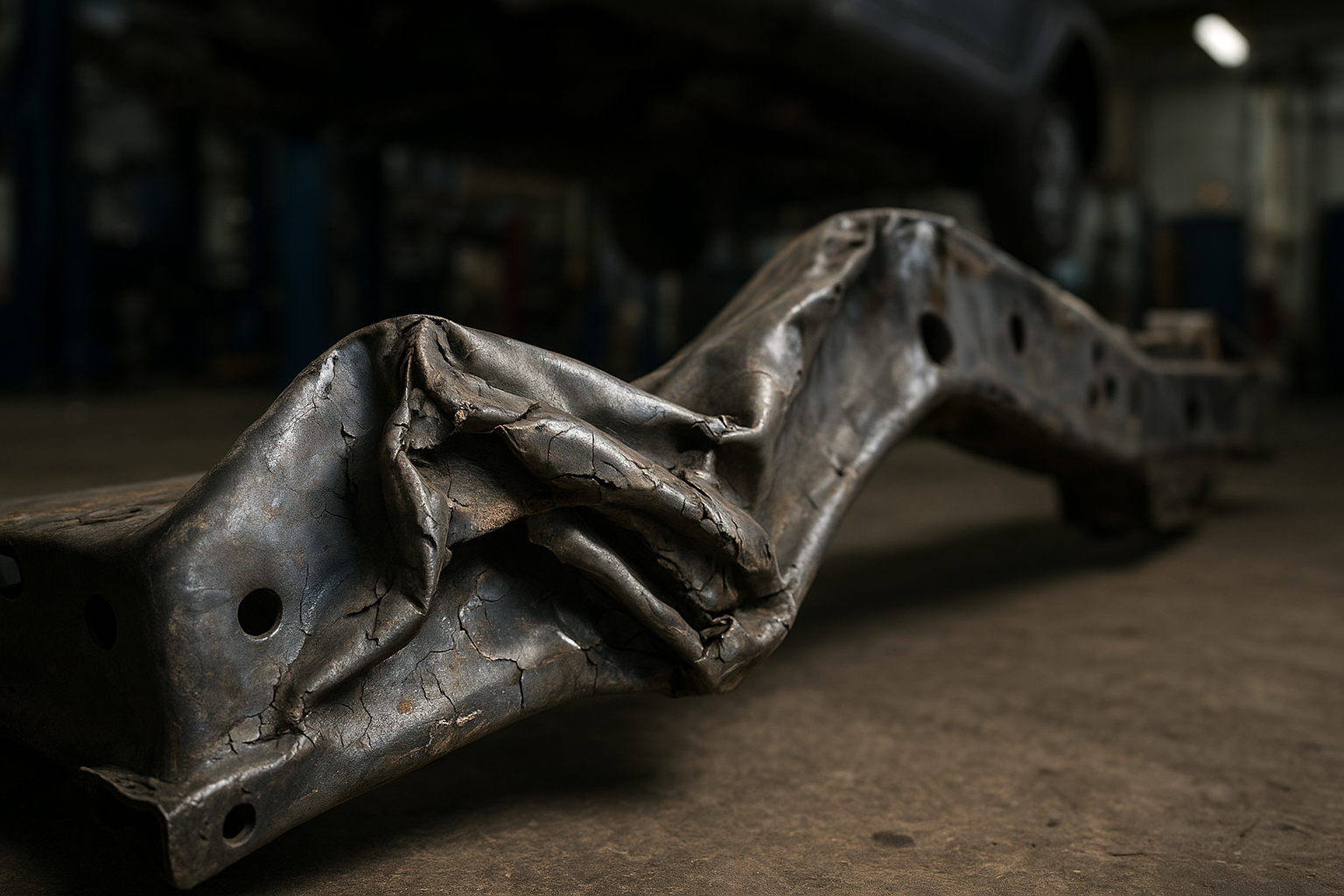
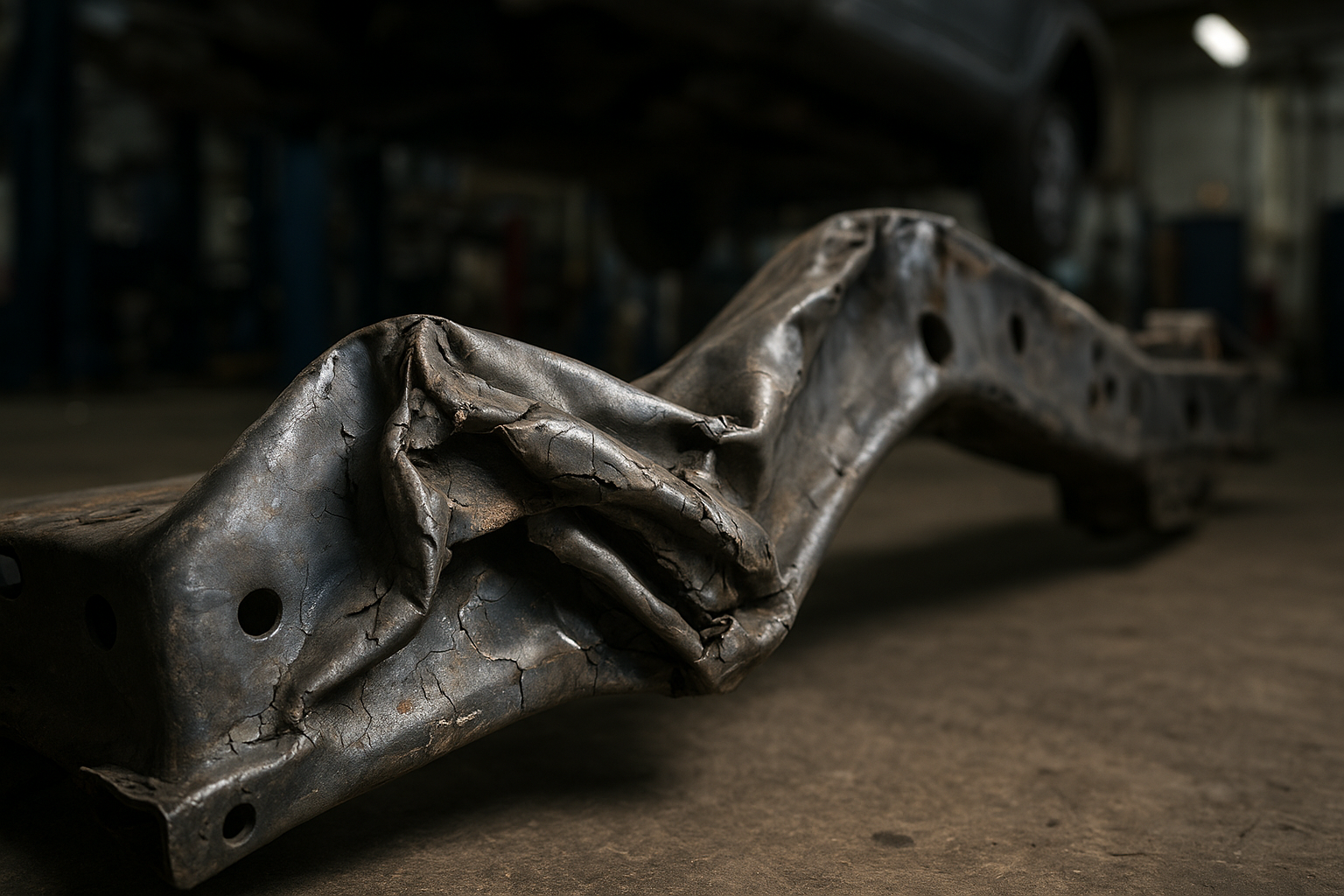
Visible bending and crumpling in a chassis rail are among the most definitive frame damage signs after accident.
10 Critical Frame Damage Signs After Accident You Must Know
The following warning signs cover both the obvious indicators visible during a walk-around inspection and the subtler symptoms that emerge while driving. Take every one of these seriously — even a single confirmed sign warrants immediate professional inspection.
1. Visible Bends, Kinks, or Creases in the Chassis Rails
Get down low and look underneath the vehicle, particularly along the main frame rails that run front-to-back beneath the cabin. Any visible bending, rippling, crimping, or buckling in the steel is a direct and unambiguous indicator of structural compromise. Even a minor kink concentrates stress at that exact point and dramatically weakens the metal’s ability to absorb further impact. Also examine the rocker panels — the structural sections along the bottom of the door openings — for similar deformation.
2. Uneven or Misaligned Body Panels
Stand at the front and rear corners of the vehicle and look along the full length of the body. Panel gaps that are noticeably wider on one side than the other, hood or trunk lids that don’t sit flush with surrounding bodywork, or fenders that appear pushed forward or backward relative to their factory position all suggest the underlying frame has shifted out of its original geometry. These gaps are visible because the body panels are mounted directly to frame points that have moved.
3. Doors, Windows, or Trunk That Don’t Operate Properly
If a door suddenly feels stiff, requires extra force to latch, creates an unusual gap when closed, or doesn’t seal properly against weatherstripping, the door frame opening has likely changed shape due to frame distortion. This is a particularly classic sign after side-impact or rollover collisions, where the B-pillar or rocker panel sections absorb force and distort. The same logic applies to trunk lids that no longer align or sunroofs that bind in their tracks.
4. Vehicle Pulls to One Side While Driving
A car that consistently drifts left or right on a straight, flat, level road — even after a fresh professional wheel alignment — may have a frame that is no longer symmetrical. When frame geometry is altered, the suspension pickup points move with it, changing camber, caster, and toe angles permanently. A wheel alignment machine adjusts the angles at each corner, but if the structural foundation those corners attach to has shifted, true alignment is impossible without first correcting the frame. Persistent pulling after a post-accident alignment is a strong indicator of underlying structural damage.
5. Abnormal, Accelerated, or Uneven Tire Wear
Tires that wear unevenly — feathering on one edge, cupping across the tread face, or wearing significantly faster on one axle compared to the other — are downstream symptoms of misaligned suspension caused by a distorted frame. If new tires are installed after an accident and show rapid or asymmetric wear within the first few thousand miles, the underlying cause is almost certainly structural rather than just a simple alignment issue. This sign is particularly important because it develops gradually and is easy to dismiss as normal tire variation.
6. Unusual Noises — Creaking, Popping, or Rattling
A bent frame places abnormal stress on every component it connects to. Listen for metal-on-metal creaking during turns, suspension popping when traversing bumps or dips, and structural rattling or groaning that was not present before the accident. These sounds indicate that components are moving or flexing in ways they were never designed to, or that stress is being transferred through metal-to-metal contact where there should be a cushioning layer. New noises that appear specifically after a collision should always be treated as a structural warning signal.
7. Cracked Welds, Paint Bubbling, or New Rust at Frame Joints
Impact forces concentrate most intensely at welded joints — the points where frame sections are joined together. After a collision, carefully inspect these areas using a flashlight for cracked welds, paint that has bubbled or flaked away from the metal surface, or fresh rust streaks that weren’t present before. For guidance on cosmetic and structural paint work, see paint repair after a car accident. Cracked welds and paint failure at joints indicate metal fatigue or micro-fractures that can’t be seen from the surface but significantly compromise the frame’s tensile strength. These are especially common where the front cradle meets the main frame rails.
8. Crab-Walking or “Dog-Tracking”
If the rear of the vehicle appears to travel at a slight angle relative to the front — so the car looks like it’s moving diagonally even when pointed straight — the frame’s rear section has shifted laterally relative to the front section. This is most visible when following the vehicle from directly behind on a straight road. Dog-tracking is a classic symptom of sidesway or diamond damage (explained in the damage types section below) and is almost impossible to correct with a wheel alignment alone.
9. Vibration or Shaking at Speed
A vehicle that vibrates through the steering wheel, seat, or floor at highway speeds after an accident may be experiencing suspension components fighting against a misaligned structural foundation. While wheel balance issues can cause similar symptoms, vibration that appears or worsens specifically after a collision — and does not resolve after balancing and alignment — is a strong indicator that the frame itself has shifted and is transmitting abnormal forces into the body and drivetrain.
10. Wheels That Are Not Centered in Their Wheel Wells
Stand in front of or behind the vehicle and look at the distance between each tire’s outer edge and the wheel well opening. If one tire sits noticeably closer to the front or rear of its wheel well than the opposite side, a suspension mounting point has moved — almost certainly because the frame section it attaches to has been displaced. This asymmetry is one of the clearest visual indicators of structural shift and should never be dismissed as cosmetic.
Frame Damage Signs by Collision Type
Not all collisions produce the same frame damage signs. The direction and angle of the impact determines which part of the frame absorbs force — and therefore which symptoms are most likely to appear. Understanding this connection helps you know exactly where to look after a specific type of crash.
Head-On Collision
Look for compressed front frame rails (mash damage), hood misalignment, front suspension binding, and steering that feels heavy or off-center. The firewall may also show distortion where it meets the front frame structure.
Rear-End Collision
Trunk misalignment, rear bumper support damage, fuel tank proximity concerns, and rear suspension geometry changes are primary indicators. Dog-tracking is especially common after significant rear impacts that push one rail farther forward than the other.
Side-Impact Collision
Door binding, B-pillar deformation, rocker panel crushing, and floor pan distortion are the primary signs. Side impacts often damage high-strength steel sections that cannot be safely repaired, making professional assessment critical.
Rollover Collision
Roof pillar deformation, multiple door binding, twist damage across the entire chassis, and A/B/C-pillar cracking are common. Rollover damage is among the most complex to fully assess because forces act on the frame from multiple angles simultaneously.
The 5 Types of Frame Damage Explained
Collision repair technicians classify structural damage into five distinct types based on the direction and pattern of deformation. Knowing which type of damage your vehicle has sustained helps you understand the repair complexity, the equipment required, and the likely outcome.
Unibody vs. Ladder Frame: How Frame Type Changes What You Look For
The type of frame your vehicle has significantly affects how frame damage signs after accident appear and where to look for them. Most modern passenger cars and crossovers use unibody construction, while full-size trucks, SUVs, and body-on-frame vehicles use a traditional ladder frame.
Unibody Construction
The body and frame are a single integrated structure. Damage to one section is transmitted and distributed throughout. Frame damage signs in unibody vehicles include panel misalignment, firewall distortion, floor pan buckling, A/B/C-pillar deformation, and rocker panel crushing. Damage is often harder to see but easier to measure with computerized equipment.
Common in: sedans, coupes, hatchbacks, most crossovers
Ladder Frame Construction
Two parallel rails (the “rails” of the ladder) are connected by crossmembers. The body sits on top and is separate. Frame damage signs include visible rail bending, crossmember damage, cracked body mounts, and visible gaps or steps at body-to-frame contact points. Damage is often easier to see but more localized to specific rails.
Common in: full-size pickups, traditional SUVs, vans
How Do Professionals Diagnose Frame Damage After an Accident?
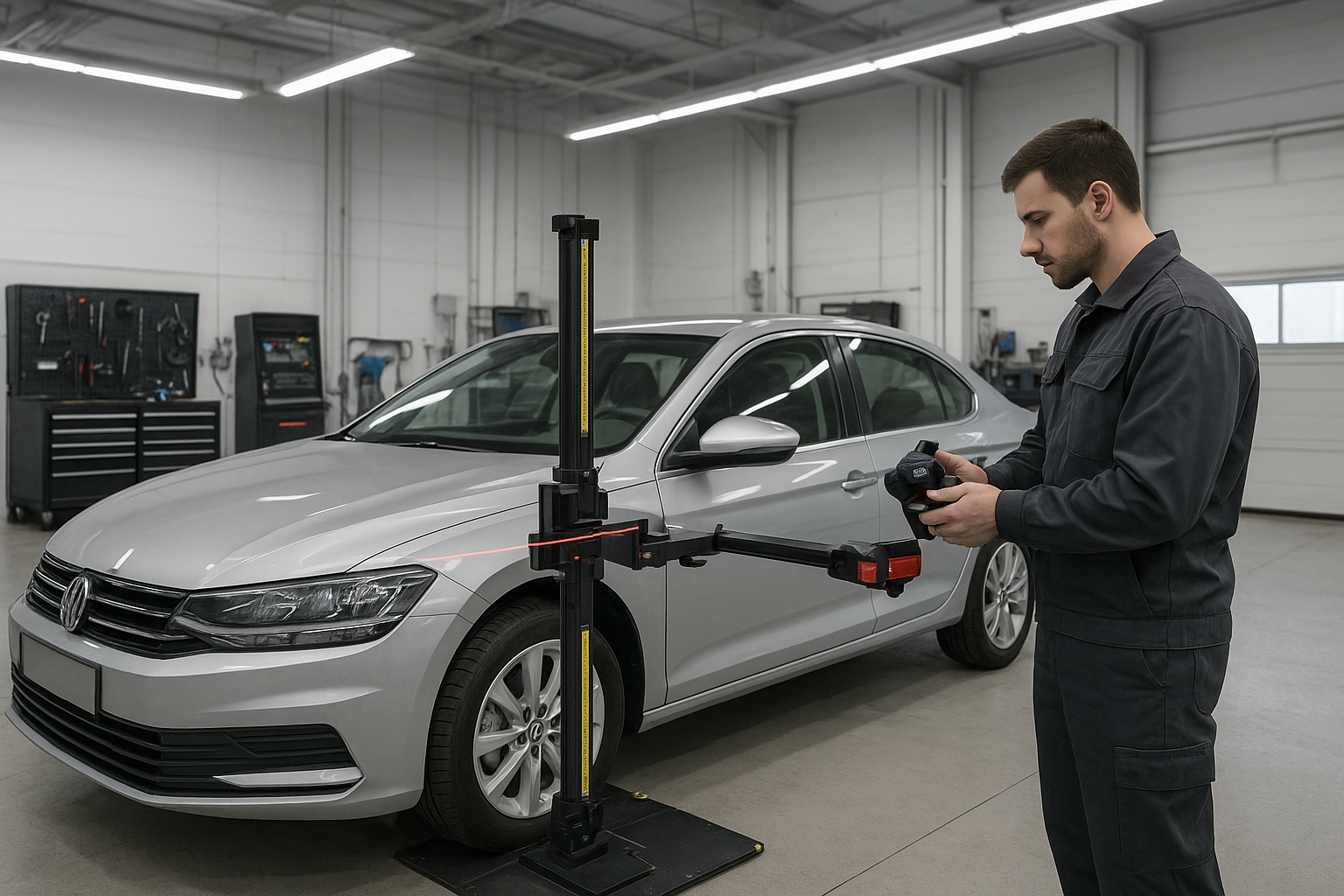
Certified technicians use computerized laser measuring systems to detect structural damage invisible to the naked eye.
Visual inspection is the starting point, but it is rarely sufficient on its own. Certified collision repair technicians use a combination of tools and techniques to produce an accurate, complete diagnosis:
Computerized 3D Measuring Systems
These systems map dozens of reference points across the vehicle’s underbody and compare them to original manufacturer specifications stored in a database. Any deviation — even a few millimeters — is flagged for correction. This is the gold standard of frame damage diagnosis and the only method that provides objective, documented proof of structural integrity.
Laser Alignment Racks
Laser alignment systems check frame straightness from multiple angles simultaneously. They can detect twisting (torsional damage), sagging (vertical displacement), and sidesway (lateral displacement) that would be completely invisible during even a thorough visual inspection. Some systems generate printable reports that can be shared with insurance adjusters.
Tram Gauges and Diagonal Measurements
In the absence of computerized systems, experienced technicians use tram gauges — precision measuring bars — to compare diagonal distances between reference points on the frame and body. If diagonals from opposite corners of the vehicle are different lengths, the frame is no longer rectangular. This technique dates back decades but remains useful as a quick initial check.
Visual Inspection with Proper Lighting
A trained eye with a flashlight, an inspection mirror, and a creeper to get under the vehicle can catch obvious kinks, cracked welds, stressed paint, and displaced components. This is always performed first to guide where the measurement systems need to focus.
The team at Brea Auto Body uses industry-standard frame measuring and straightening equipment to provide a full structural assessment after any collision, ensuring repairs meet or exceed factory specifications before the vehicle returns to the road.
Is It Safe to Drive With Frame Damage?
? Critical Safety Warning
No. Driving a vehicle with unrepaired frame damage is unsafe under any circumstances. If you suspect frame damage after any collision — even a minor one — do not assume the vehicle is safe simply because it starts, moves, or drives without obvious problems. Get it professionally inspected before driving it again.
There are three distinct reasons why driving with frame damage is genuinely dangerous, not merely inadvisable:
- Depleted crumple zones: The crumple zones that absorbed energy in your first collision are now spent or deformed. In a second impact, the vehicle can no longer absorb energy the way it was engineered to, dramatically increasing injury severity to occupants.
- Unpredictable handling: Altered suspension geometry caused by frame deformation can produce sudden, unexpected handling behavior — especially during emergency maneuvers like swerving or hard braking — when you least expect it and most need your vehicle to respond correctly.
- Progressive deterioration: Structural weaknesses worsen over time as road vibrations, load cycles, and thermal expansion/contraction continue to fatigue the already-stressed metal. A frame that is driveable today may fail at a critical moment weeks later.
- Airbag and safety system compromise: Many airbag sensors, seatbelt pre-tensioners, and ADAS (advanced driver assistance system) components are mounted to or calibrated against specific structural points. Frame deformation can cause these systems to malfunction or fail to deploy correctly in a subsequent collision.
Can Frame Damage Be Repaired After an Accident?
In many cases, yes — but the answer depends heavily on the type of damage, the location on the frame, the materials involved, and how severe the deformation is.
When Frame Repair Is Possible
Modern frame straightening machines use hydraulic rams and pulling chains anchored to precise points on the vehicle’s structure to gradually restore deformed metal to its factory dimensions. This process is guided in real time by the computerized measuring system, giving the technician live feedback as each pull is made. The goal is to return every measurement to within the manufacturer’s specified tolerances — not just close, but exact.
Mild-to-moderate mash damage, sag damage, and sidesway in conventional high-strength steel sections can often be successfully corrected with this equipment. When the repair is complete and measurements confirm factory tolerances, the structural integrity can be genuinely restored to a safe level.
When Frame Damage Cannot Be Repaired
Not all frame damage is repairable to a safe standard. The following situations typically prevent safe repair:
- Ultra-high-strength steel (UHSS) sections: Many modern vehicles use UHSS in the B-pillar, rocker panels, and roof rails. These materials are specifically designed not to be repaired — applying heat or mechanical pulling to UHSS changes its metallurgical properties and destroys its protective characteristics. When UHSS sections are damaged, replacement is mandatory.
- Multiple overlapping damage types: When a vehicle has sustained mash damage, twist damage, and sidesway simultaneously, each correction attempt can interfere with adjacent repairs. At some point, the structure cannot be safely restored.
- Severe crush damage: Areas that have been completely collapsed rather than bent in a controlled manner have lost too much material integrity to be restored by pulling alone.
In these cases, an insurance adjuster will typically declare the vehicle a total loss. Always obtain a professional measurement-based assessment — not just a visual estimate — before making any decisions about repair versus replacement.
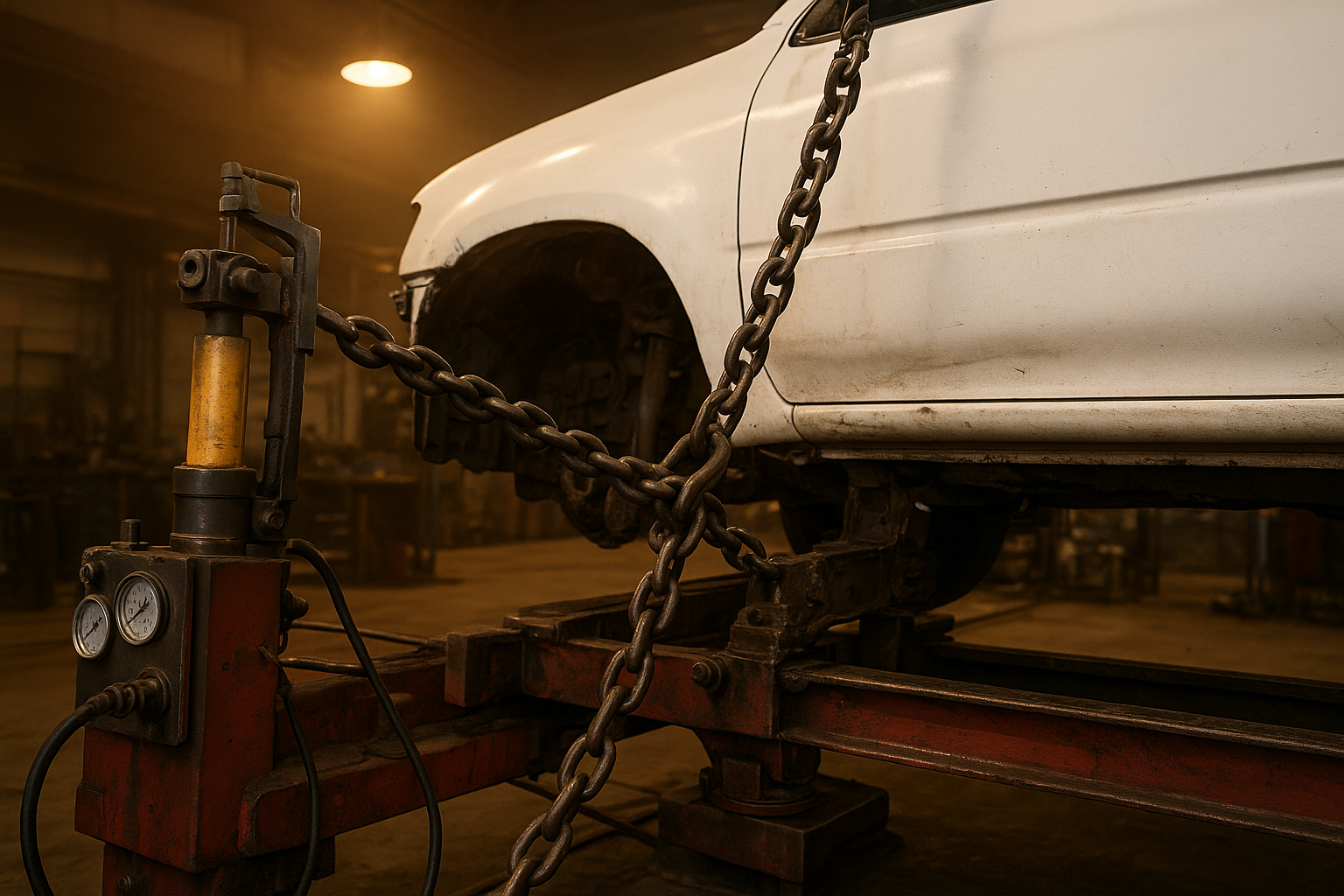
Hydraulic straightening equipment is used to restore bent frames to manufacturer specifications following collision damage.
How Frame Damage Affects Your Vehicle’s Resale Value
Even after a completely successful, professionally executed repair, frame damage has a lasting impact on a vehicle’s market value that cannot be fully undone. Here’s why:
- Vehicle history reports: Services like Carfax and AutoCheck flag structural damage events in their reports. Any prospective buyer who runs a vehicle history check — which most informed buyers now do — will see the damage history regardless of how well the repairs were executed.
- Pre-purchase inspection discovery: A competent independent mechanic performing a pre-purchase inspection will typically identify evidence of prior frame work, including paint overspray patterns, underbody weld quality differences, and measurement asymmetries that indicate prior repair.
- Market value reduction: Industry data suggests vehicles with a documented history of structural damage lose between 30% and 50% of their market value compared to equivalent undamaged vehicles, even after professional repair. This diminished value loss is often partially recoverable through a diminished value insurance claim filed against the at-fault party.
- Financing and insurance complications: Some lenders and insurers treat vehicles with frame damage history differently, which can affect your ability to refinance or obtain comprehensive coverage at standard rates.
This is yet another reason why choosing a qualified, certified repair facility matters. A poorly executed frame repair is detectable by a trained eye, whereas a repair performed to factory tolerances using proper equipment is far more defensible and preserves as much residual value as possible.
What to Do If You Suspect Frame Damage After an Accident
If your vehicle has been in any collision and you observe any of the frame damage signs after accident described in this guide, follow these steps in order:
- Stop driving the vehicle immediately until it has been professionally evaluated. Do not drive it to the shop if you are concerned about safety — arrange for towing.
- Document everything thoroughly — photograph the damage from every angle, including underneath the vehicle if it is safe to do so. Photograph the surrounding area, road conditions, and any other vehicles involved.
- Contact your insurance company and file a claim before authorizing any repairs. Work with your adjuster to understand your coverage, deductible, and rights under your policy. Learn practical steps to get your car fixed after an accident.
- Ask about a diminished value claim — if the accident was the other driver’s fault, you may be entitled to compensation for the reduction in your vehicle’s market value even after it is repaired.
- Choose a certified collision repair shop that uses computerized frame measuring equipment and employs frame repair near me I-CAR trained or ASE-certified technicians. Not all body shops have the equipment or expertise to properly diagnose and repair structural damage.
- Request a written estimate that specifically identifies whether frame repair or section replacement is required, what measurement tolerances will be achieved, and what warranty covers the structural work. For help selecting a shop, see our choose a body shop guide.
- Request post-repair measurement documentation — a reputable shop will provide printouts showing the before and after measurement data confirming the frame was restored to factory specifications.
? Pro Tip: Get a Second Opinion
If your insurance company’s initial estimate does not include frame measurement or structural assessment, request that it be added — or take the vehicle to a certified collision shop for an independent structural repair evaluation before accepting any settlement. Some adjusters perform visual-only estimates that can miss hidden structural damage.
Frequently Asked Questions About Frame Damage Signs After Accident
What are the most common frame damage signs after an accident?
The most common frame damage signs after accident include visible bends or creases in the chassis rails, uneven panel gaps, a car that pulls consistently to one side even after wheel alignment, abnormal tire wear patterns, doors or windows that no longer operate properly, unusual creaking or popping noises, and a rear end that appears to track at an angle (dog-tracking). Any one of these signs warrants professional inspection.
Can frame damage occur in a minor collision or low-speed accident?
Yes. Even impacts at 10–15 mph can produce enough force to compress frame rails, displace suspension mounting points, or crack welds at critical structural joints — especially in modern vehicles designed with increasingly thin, lightweight high-strength steel. Speed alone is not a reliable indicator of whether frame damage has occurred. Always have the vehicle inspected after any collision, regardless of apparent severity.
Is it safe to drive with frame damage after an accident?
No. Driving a vehicle with unrepaired frame damage is dangerous for multiple reasons: the crumple zones that protect you in a future crash are already compromised, the suspension geometry can cause unpredictable handling, safety systems including airbags may not function correctly, and the structural weakness can worsen progressively with continued driving. Have the vehicle inspected — and transported by tow if necessary — before driving it again.
Can frame damage be repaired after an accident?
Yes, in many cases frame damage can be repaired using hydraulic straightening equipment guided by computerized three-dimensional measuring systems. However, not all damage is repairable — sections made from ultra-high-strength steel (UHSS) must be replaced rather than repaired, and severe or multi-directional damage may make the vehicle a total loss. Professional assessment with actual measurement data is essential before making any repair versus replacement decision.
Does frame damage affect a car’s resale value after repair?
Yes, significantly. Even after a professional repair, vehicle history reports will document the structural damage event, and most buyers and their mechanics can identify evidence of prior frame work. Industry data shows vehicles with structural damage history typically lose 30% to 50% of their market value compared to undamaged equivalents. If the accident was caused by another driver, you may be entitled to a diminished value claim to recover some of this loss.
What is the difference between unibody and ladder frame damage signs?
In unibody vehicles (most cars and crossovers), frame damage signs include panel misalignment, firewall distortion, floor pan buckling, and pillar deformation. Damage is distributed throughout the integrated structure and can be harder to spot visually. In ladder frame vehicles (trucks, traditional SUVs), damage appears as visible rail bending, cracked crossmembers, and body-to-frame mount failures — more localized but often more visible to the naked eye.
How does a technician confirm frame damage is fully repaired?
A certified technician uses a computerized three-dimensional measuring system to compare the vehicle’s actual underbody reference points against manufacturer specifications before and after repair. When all measurements fall within the factory tolerance, the repair is confirmed. Ask your repair shop for printed documentation of both the pre-repair and post-repair measurements as proof the structural work was completed correctly. For guidance on when structural work is required and what to expect, see how to tell if your car needs structural repair.
Final Takeaway
Recognizing frame damage signs after accident early — and acting on them immediately — can mean the difference between a fully restored, safe vehicle and one that fails catastrophically in a future collision. Never assume a car is structurally sound based on appearances alone. The signs are often subtle, sometimes invisible without professional equipment, and always worth taking seriously.
Always insist on a measurement-based structural inspection from a certified collision repair facility — not just a visual walk-around. Demand documentation that repairs were completed to factory specifications. And remember: the safety of every person in that vehicle in every future drive depends on the structural integrity of the frame beneath them.
For residents in the Southern California area, Brea Auto Body offers comprehensive post-collision structural inspections and frame repair services backed by certified technicians and precision measuring equipment. Article by Brea Auto Body certified technicians. Last updated: 2026-07-22. This guide should be linked from related service and advice pages to improve discovery and help local drivers find certified structural repair resources.

