

Bumper Repair Cost: 2026 Complete Guide to Prices, Parts, and Smart Decisions
Last updated: January 2026 | Reading time: ~12 minutes

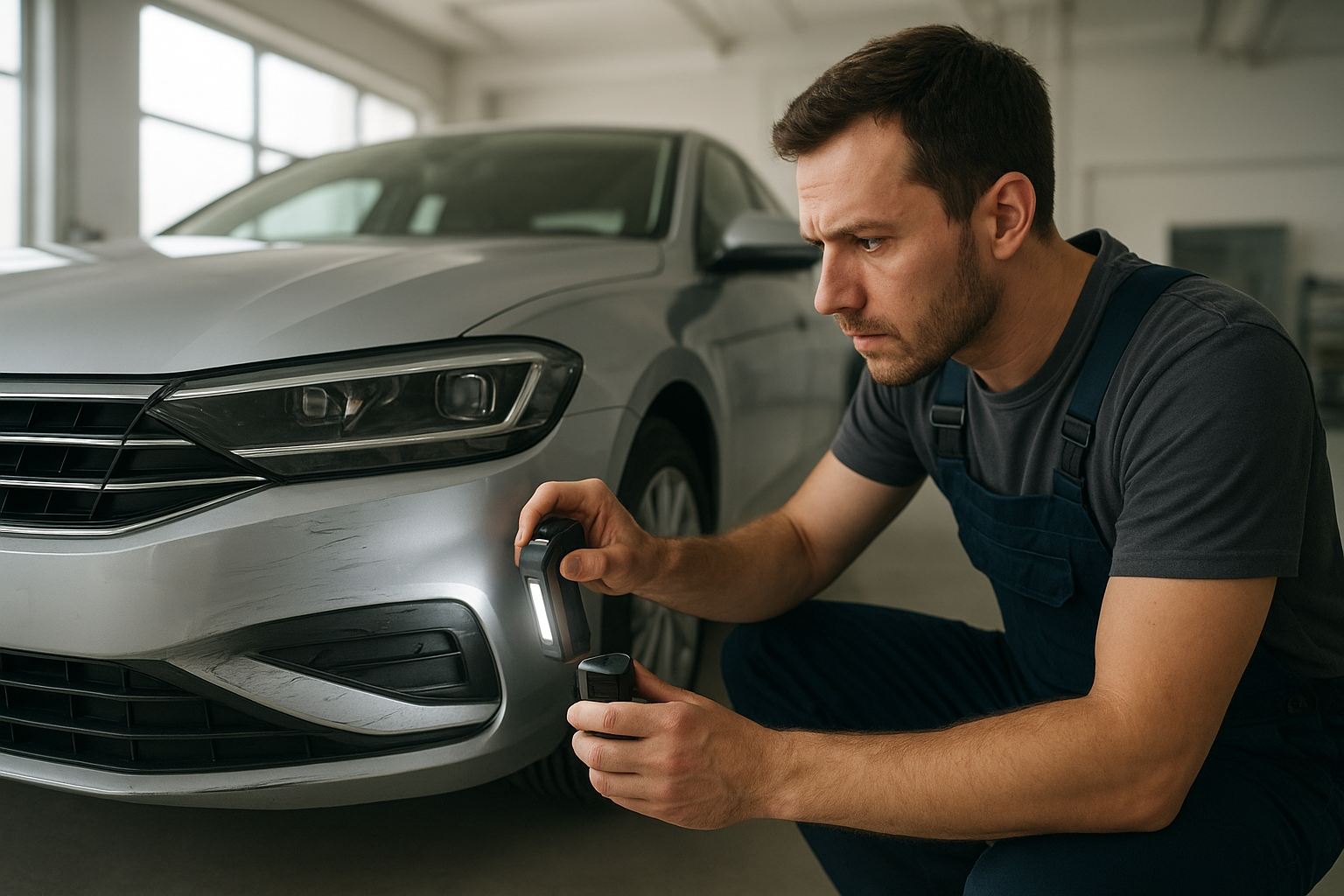
Professional inspection is the first and most critical step to an accurate bumper repair cost estimate.
A parking-lot tap, a low-speed fender bender, or a mystery scrape discovered in the driveway — whatever the cause, your first question is almost always the same: what is the bumper repair cost going to be? The honest answer is that it depends on several overlapping factors, but this guide gives you every number, every variable, and every strategy you need to walk into a shop fully informed.
Below we cover realistic 2026 price ranges for every scenario, explain how shops build estimates, break down front vs. rear differences, address ADAS sensor costs, compare repair vs. replacement economics, walk through the insurance decision, and answer the most common questions drivers ask before authorizing work.
Quick-Reference: Bumper Repair Cost Ranges at a Glance
Before diving into detail, here is a snapshot of typical 2026 U.S. body-shop pricing. These are full-repair costs — parts, labor, and refinish combined — not estimates for labor alone.
Ranges reflect typical U.S. rates as of January 2026. Luxury brands, complex paint codes, and regions with high labor rates trend toward the upper end.
What Is Actually Inside a “Bumper” — and Why It Matters for Cost
Most drivers think of the bumper as one piece. It is actually a system of four to six distinct components, and damage to any one of them changes your repair bill. Understanding the anatomy helps you evaluate any estimate you receive.
The Bumper Cover
The plastic shell you see. It absorbs cosmetic hits — scuffs, scratches, minor dents, and cracks. This is the most commonly repaired or replaced part and the primary canvas for paint work. Material is usually TPO (thermoplastic olefin) or SMC on older vehicles.
The Energy Absorber
Foam or honeycomb plastic that sits between the cover and the reinforcement bar. It crushes on low-speed impacts to limit damage to structural components. Damaged absorbers are invisible from outside but must be replaced to restore crash performance — which is why a post-impact inspection always involves removing the cover.
The Reinforcement Bar
Steel or aluminum beam bolted to the crash rails. A bent reinforcement bar is a structural safety issue and cannot be hammered back to spec — replacement is mandatory. Costs for the bar itself range from $150–$650 depending on vehicle; labor for R&I adds more.
Hardware, Trim, and Mounting Components
Grilles, fog lamp bezels, tow hook covers, mounting clips, and brackets. These small parts add up. A luxury vehicle may have $200–$600 in trim pieces surrounding the bumper cover.
ADAS Sensors and Cameras
This is the biggest cost variable on modern vehicles. Ultrasonic parking sensors, forward collision radar modules, adaptive cruise radar, surround-view cameras, and cross-traffic sensors are all mounted in or behind the bumper system. Disturbing any of them — even for a routine cover replacement — may trigger a calibration requirement per the vehicle manufacturer’s repair procedures.
The 7 Factors That Determine Your Bumper Repair Cost
No two repair estimates are identical because no two damage situations are identical. Here are the seven variables that control where your bill lands:
- Severity and location of damage. A 2-inch scuff on a flat section is a fraction of the cost of a crack that runs through a mounting point or corner radius where stress concentrates.
- Repair vs. replacement decision. Plastic repair saves money when damage is localized; replacement can be cheaper when labor to repair exceeds the cost of a new or quality used cover.
- Paint color and complexity. Solid white or black is simplest. Two-stage metallics, three-stage pearls, and specialty colors (matte, satin, color-shifting) require additional materials, time, and blending skill.
- Color blending requirements. Adjacent panels (fenders, quarter panels) may need to be blended for an invisible match on complex colors, adding panels to the paint ticket.
- Hidden structural damage. Energy absorbers and reinforcement bars may be compromised even when the cover looks intact. Discovery during disassembly raises costs — but skipping this check is not safe.
- ADAS sensor count and calibration needs. Each sensor type has its own calibration procedure, cost, and equipment requirement. A vehicle with radar + four parking sensors + backup camera has three separate calibration events.
- Vehicle make, model, and parts sourcing. OEM parts for luxury or European brands cost significantly more than aftermarket alternatives. Parts availability also affects how long you’re without your car.
How Body Shops Build a Bumper Repair Cost Estimate
A professional body shop estimate is not guesswork. It follows a documented process, and understanding each stage helps you identify why your quote looks the way it does — and whether it is complete.
Stage 1: Pre-Repair Scan and Check-In
Reputable shops run a diagnostic scan before touching the vehicle. This documents pre-existing fault codes and confirms whether any sensors were already affected by the impact. A scan may cost $50–$150 if billed separately, though many shops include it in the estimate process.
Stage 2: Disassembly and Damage Mapping
The estimator removes the cover to inspect the absorber, reinforcement bar, wiring harnesses, brackets, and sensor mounts. This is where hidden damage is discovered — and why a drive-by quote or phone estimate is nearly always inaccurate. Supplement charges (additional work found after teardown) are a normal part of collision repair, not a bait-and-switch.
Stage 3: Repair vs. Replace Decision
The shop evaluates whether plastic welding, reshaping, and skim-coating the existing cover is structurally sound and cost-effective, or whether a new or quality used OEM cover produces a better result for the money. Neither option is inherently superior — it depends on the specific damage profile.
Stage 4: Refinish and Color Match Planning
The estimator notes the paint code (pulled from the door jamb sticker or VIN data), identifies the finish type, and determines whether adjacent panels need blending. Booth time, primer, base coat, clear coat, flex additives, and polish are all line items. Complex colors can add $200–$600 to the refinish cost alone.
Stage 5: ADAS and Electrical Scope
The estimator identifies every sensor in and around the bumper system and confirms which OEM procedures require calibration after the repair. This is not optional on vehicles where the manufacturer mandates it — and skipping calibration can compromise the safety systems your vehicle depends on.

Visual breakdown of bumper repair cost components: parts, labor, refinish, blending, and ADAS calibration.
Front Bumper Repair Cost vs. Rear Bumper Repair Cost
Front and rear bumpers share the same basic structure, but their sensor profiles differ — and that difference directly affects your final bill.
Front Bumper Repair Cost
Front bumpers typically house the most expensive ADAS hardware:
- Forward collision radar or lidar modules: $300–$900+ to replace; $300–$600 to calibrate.
- Adaptive cruise control sensors: Often integrated with the radar module.
- Active grille shutters: A motorized component on many fuel-efficient models; replacement adds $100–$350.
- Front-facing camera: May be mounted behind the grille or inside the bumper cover on some vehicles.
- Front parking sensors: $50–$150 each to replace; calibration varies by system.
Average front bumper repair cost for a mainstream sedan: $800–$2,000 for cover replacement with sensor reuse; add $400–$1,000+ if radar calibration is required.
Rear Bumper Repair Cost
Rear bumpers are statistically the most commonly damaged end of the vehicle and typically involve:
- Backup camera: Embedded in the bumper cover or handle area; $150–$400 to replace, $200–$400 to calibrate.
- Ultrasonic rear parking sensors: Typically 4 sensors; $50–$150 each; calibration varies.
- Rear cross-traffic alert sensors: Often mounted in rear corners; add $100–$350 per sensor.
- Trailer hitch or tow package integration: Requires additional disassembly/reassembly time.
Average rear bumper repair cost for a mainstream sedan: $700–$1,800 for cover replacement with sensor reuse. Rear bumper damage on luxury SUVs can easily reach $3,000–$5,000+ when sensors, structural components, and complex paint are all involved.
ADAS Sensor Calibration: The Hidden Cost Most Guides Ignore
ADAS calibration has become one of the most significant and least understood additions to bumper repair cost. Here is a frank breakdown of what it is, what it costs, and why it is not optional.
What Triggers a Calibration Requirement?
- Removing and reinstalling a sensor, even if undamaged
- Replacing the bumper cover (changes mounting surface geometry)
- Replacing a sensor or camera unit
- Any work that affects the mounting angle of a radar or camera
- A post-repair scan showing calibration fault codes
Static vs. Dynamic Calibration
Static calibration is performed in the shop with calibration targets placed at precise distances and angles from the vehicle. It requires a level floor, sufficient space, and OEM or OEM-equivalent targets. Time: 45–90 minutes per system.
Dynamic calibration is performed while driving the vehicle at a specific speed on a road with visible lane markings. Some systems require both static and dynamic procedures. Time: adds 30–60 minutes plus shop-specific road access.
Calibration Cost by Sensor Type (2026)
- Individual ultrasonic parking sensor: $150–$300 per sensor
- Backup / surround-view camera: $200–$400
- Forward collision / adaptive cruise radar: $300–$600
- Cross-traffic alert sensors: $150–$350 per side
- Full multi-sensor calibration package: $400–$1,200+ total, depending on sensor count and vehicle
Why skipping calibration is dangerous: An out-of-calibration radar may falsely trigger automatic emergency braking or fail to detect an actual obstacle. Parking sensors that report inaccurate distances create collision risk in tight spaces. These are not cosmetic issues — they are active safety systems.

Modern vehicles may require multiple calibration procedures after bumper repair or replacement.
Bumper Repair vs. Bumper Replacement: Which Is Right for Your Situation?
This is the decision that most significantly shapes your bumper repair cost. Neither option is universally better — the right choice depends on a combination of damage characteristics, parts pricing, and vehicle value.
When Plastic Repair Makes Sense
- Damage is confined to a single zone of the cover (not spreading to mounting points or corners)
- No cracking or tearing — mostly dents, gouges, or paint damage on sound plastic
- The substrate is relatively new and flexible (able to hold a repair long-term)
- Labor hours for repair are clearly less than the cost of a replacement cover plus installation
- Vehicle owner prioritizes cost savings over absolute perfection
When Replacement Is the Smarter Choice
- Cracks radiate from mounting points, corners, or edges — stress areas where repairs consistently fail
- Extensive warping that would cause poor panel fit even after reshaping
- The plastic is brittle, aged, or sun-damaged and unlikely to hold refinished repairs
- Damage area is large relative to the cost of a new or quality used OEM cover
- Insurance is covering the repair and a replacement aligns with OEM procedures
OEM vs. Aftermarket vs. Used OEM Parts
Parts sourcing is a major lever on total bumper repair cost:
- New OEM covers offer guaranteed fit and finish but command the highest price — often $400–$1,500+ for the cover alone on mainstream vehicles, more for luxury brands.
- New aftermarket covers cost 30–60% less but can have fitment, finish, or longevity issues depending on manufacturer quality. Some insurers default to aftermarket on older vehicles.
- Quality used OEM covers (reconditioned and repainted) can pair factory fit with meaningful savings — often $150–$400 less than new OEM. Inspect carefully for prior repairs or fading before approving.
Paint, Color Matching, and Blending: How They Affect Bumper Repair Cost
Paint is routinely the second- or third-largest cost item in a bumper repair, yet many estimates don’t explain exactly what drives the refinish number. Here is what actually matters:
Paint Types and Their Cost Impact
- Solid single-stage colors (white, black, red): Most affordable to match; $200–$500 for bumper refinish.
- Two-stage metallic/pearl: Requires a base coat plus clear coat; $300–$700 for bumper refinish with careful blending.
- Three-stage tri-coat and color-shifting paints: A mid-coat of interference pearl between base and clear creates colors that are exceptionally difficult to match; $500–$1,000+ for bumper refinish, often requiring adjacent panel blending.
- Matte and satin finishes: Specialty clear coats; highly unforgiving of any imperfection; full panel or adjacent blending often required.
What Is Color Blending and When Is It Required?
Blending extends new paint into an adjacent panel so the transition between old and new paint is invisible. It is not always necessary — but when it is skipped on complex colors, the result is a visible color mismatch visible in certain light conditions.
Blending is typically required when:
- The paint code is a metallic, pearl, or tri-coat finish
- The bumper and adjacent panels are visible together in the same sightline
- The vehicle has aged paint that cannot be matched to new factory-standard levels
Each blended panel adds approximately $150–$400 to the estimate. On a vehicle where both quarter panels need blending, that can add $600–$800 to the total bumper repair cost.
Insurance, Deductibles, and When to File a Claim
The financial decision of whether to use insurance for a bumper repair is not always obvious. Here is how to think through it properly:
The Deductible Calculation
If your estimated bumper repair cost is at or below your deductible, filing a claim gains you nothing — the insurer pays zero after the deductible, and the claim still appears on your record and may raise your premium. Pay out of pocket.
If the repair cost significantly exceeds your deductible, insurance typically makes sense — especially on repairs involving structural components, sensors, or blending multiple panels.
What Insurance Covers (and What to Watch For)
- Collision coverage pays for damage from a collision with another vehicle or object, minus your deductible.
- Comprehensive coverage covers non-collision events (falling objects, vandalism, weather, hit-and-run where the other driver is unidentified in some policies).
- ADAS calibration is generally covered by insurance when it is required per OEM procedures — do not let a shop skip it to save the insurer money.
- Aftermarket parts: Some insurers default to aftermarket covers on vehicles over a certain age. You may have the right to negotiate for OEM under your policy terms — check your policy language.
- Right to choose your shop: You are legally entitled to choose any licensed repair facility in all U.S. states. Insurer-preferred (DRP) shops are convenient but you are not required to use them.
Rental Car Coverage
Many comprehensive and collision policies include a rental reimbursement benefit (typically $30–$50/day up to a specified number of days). On repairs involving parts orders and ADAS calibration — which can extend repair time to 7–10 days — this coverage is worth using. Confirm your limits before approving work.
Bumper Repair Cost by Vehicle Type
Vehicle category is a reliable predictor of where your estimate will land. Here are realistic benchmarks by segment:
Economy and Compact Cars
Parts are widely available and affordable. Labor times are moderate. Typical range: $400–$1,500 for cover replacement with paint; $250–$800 for plastic repair and repaint.
Mainstream Mid-Size Sedans and SUVs
Moderate parts cost; sensor packages increase calibration exposure. Typical range: $700–$2,500 for full replacement; repair often $450–$1,200.
Pickup Trucks
Bumper covers can be large and complex; tow package and trailer hitch integration adds disassembly time. Typical range: $900–$2,800 depending on trim level and sensor count.
Luxury and European Vehicles
OEM part prices are significantly higher; calibration equipment requirements can be more specialized; complex paint finishes are common. Typical range: $1,500–$5,500+ for rear or front replacement with sensor handling.
Electric Vehicles (EVs)
EVs frequently have higher sensor density (lidar, radar, multiple cameras) and tighter OEM repair requirements. Charging port integration in front bumpers on some models adds complexity. Typical range: $1,200–$6,000+ depending on damage scope and calibration needs. Parts availability can be a significant delay factor on newer EV models.
Step-by-Step Repair Timeline: Drop-Off to Delivery
Knowing the process helps you understand why repair timelines vary so widely — and what questions to ask your shop at each stage.
- Check-in and pre-repair scan — Confirms existing fault codes and establishes a pre-repair baseline. Protects both you and the shop from disputes about pre-existing sensor issues.
- Disassembly and revised estimate — Cover removed; hidden damage assessed. If the cost changes materially from the original estimate, the shop contacts you for approval before proceeding.
- Repair or parts sourcing — Plastic welding, reshaping, and skim-coating; or new/used cover ordered. OEM parts from dealerships can take 2–5+ business days; aftermarket is often faster.
- Test fitment — Cover is dry-fitted before paint to confirm alignment. Any fit issues resolved before the part enters the booth.
- Refinish — Color matched, primed, base-coated, cleared, and cured in a downdraft booth. Adjacent panels blended if required. Cure time: 2–12 hours depending on system.
- Reassembly and sensor reinstallation — All electrical connections made; sensors reinstalled per OEM torque and positioning specs.
- ADAS calibration — Static targets deployed and/or dynamic drive performed; results logged. All calibration data recorded in the repair file.
- Post-repair scan and quality control — Full vehicle scan confirms zero new fault codes. Cosmetic QC checks paint, panel gaps, and trim alignment.
- Delivery and documentation — Repair documentation, calibration records, and warranty information provided at pickup.
Total time range: 1–2 days for paint-only scuff repairs. 3–5 days for cover replacement with standard sensors. 5–10+ days when parts are backordered, complex blending is required, or multiple calibrations are needed.
Ways to Reduce Your Bumper Repair Cost Without Cutting Safety Corners
Cost reduction and quality repair are not mutually exclusive. These are legitimate strategies to discuss with your estimator:
- Ask for a repairability assessment. Request an honest comparison of repair hours vs. replacement cost. Sometimes a $350 repair is better value than a $900 cover; sometimes it’s the reverse.
- Consider quality used OEM. A reconditioned factory cover can save $200–$600 over new OEM while preserving fitment advantages over aftermarket.
- Evaluate blending necessity by color type. On solid single-stage colors, a skilled painter can often achieve a clean match without blending adjacent panels. Ask whether a test panel is possible before committing to the blend charge.
- Choose a shop with in-house calibration. Shops that sublet calibration to a dealership or third party add markup and cycle time. A facility with certified calibration equipment keeps both cost and repair time lower.
- Schedule around parts arrival. Ask the shop to order parts before your drop-off appointment. Arriving the same day as parts minimizes rental days — an indirect but real cost component.
- Bundle repairs when possible. If there are other minor cosmetic issues on the car, addressing them during the same shop visit can reduce total labor overhead compared to separate appointments.
- Get at least two written estimates. Legitimate estimates will be itemized enough to compare line by line. A significantly lower bid should prompt questions about which line items were omitted (ADAS calibration is frequently absent from low bids).
Real-World Bumper Repair Cost Scenarios
These representative scenarios help you benchmark your specific situation against real-world repair outcomes:
Scenario 1 — Parking Lot Scuff, No Sensors Disturbed
2022 Honda Accord, solid white paint, light surface scuff on rear bumper center. No cracks, no sensors removed.
Estimated cost: $300–$650 | Time: 1–2 days
Scenario 2 — Quarter-Sized Gouge, Plastic Repair and Repaint
2021 Toyota Camry, silver metallic, impact gouge on rear bumper cover. Plastic repair, refinish, and light blend into adjacent quarter panel.
Estimated cost: $650–$1,200 | Time: 2–3 days
Scenario 3 — Rear Cover Replacement, Mainstream Sedan, Reuse Sensors
2023 Nissan Altima, two-stage metallic blue, cracked rear cover, rear parking sensors and backup camera reused. New OEM cover, painted and installed.
Estimated cost: $1,050–$1,900 | Time: 3–5 days
Scenario 4 — Luxury SUV, Full Rear Replacement with Radar and Calibration
2024 BMW X5, tri-coat white, rear impact. Cover, absorber, and reinforcement bar replaced. Backup camera, 4 parking sensors, and cross-traffic alert sensors calibrated. Blending to both rear quarter panels required.
Estimated cost: $3,200–$5,500+ | Time: 7–12 days
Scenario 5 — EV with Front Radar and Camera Replacement
2023 Tesla Model 3, front radar module replaced (earlier production), front bumper cover replaced, forward camera calibration and autopilot camera calibration required.
Estimated cost: $2,400–$4,800 | Time: 5–10 days (parts availability variable)
Red Flags to Watch for When Getting a Bumper Repair Estimate
Not all estimates are equal. These warning signs indicate a shop may be cutting corners or providing an incomplete quote:
- No pre-repair scan offered. On any vehicle with ADAS, a scan should be standard before work begins.
- No line item for ADAS calibration on a sensor-equipped vehicle. Calibration should be explicitly included or explicitly excluded with a reason — not simply absent.
- Quote provided without seeing the vehicle. Phone or online estimates for anything beyond a simple scuff are inherently incomplete without physical inspection.
- Pressure to avoid using insurance. Legitimate shops don’t steer you away from using your coverage. Discount arrangements involving waived deductibles in exchange for steering are red flags — and illegal in many states.
- No mention of OEM vs. aftermarket parts. You have a right to know what kind of parts will be used on your vehicle before authorizing repairs.
- Verbal-only estimates. Always get a written, itemized estimate. This protects both parties and gives you something to compare.
Frequently Asked Questions About Bumper Repair Cost
How much does bumper repair cost for a minor scrape?
For a light surface scrape with no cracks and no sensor disturbance, bumper repair cost typically ranges from $150 to $500 for touch-up, or $300 to $700 for a full panel refinish. If the damage is purely paint with no substrate damage, some shops can address it in a single day.
Is it cheaper to repair or replace a bumper?
It depends on the specific damage. Minor-to-moderate dents and gouges on sound plastic are usually cheaper to repair ($450–$1,000) than to replace ($800–$2,500+). However, cracked mounting points, extensive warping, or aged plastic may make replacement more cost-effective and longer-lasting than a repair.
Does bumper repair cost include ADAS calibration?
It should — but not all estimates include it. Always confirm whether calibration is included when sensors are involved. ADAS calibration adds $250–$1,200+ depending on sensor type and count, and skipping it creates real safety risks. A shop that follows OEM repair procedures will include calibration as a required step.
Will my insurance cover bumper repair?
If you have collision coverage and the repair exceeds your deductible, your insurer will typically cover the remainder. Comprehensive covers non-collision events. If the bumper repair cost is close to or under your deductible, paying out of pocket avoids a claim that could raise your premium. ADAS calibration required by OEM procedures is generally covered by insurance.
How long does bumper repair take?
Simple paint-only repairs take 1–2 days. Plastic repair with full refinish typically takes 2–3 days. Cover replacement with standard sensor reuse takes 3–5 days. Complex jobs involving structural damage, rare parts, multiple calibrations, or blending several panels can take 7–12 days. Parts availability is frequently the biggest timeline variable.
Can I get a bumper repair cost estimate online?
Online calculators can provide rough ballpark figures, but they cannot account for your paint code, substrate condition, sensor configuration, or whether hidden structural damage is present. An accurate bumper repair cost requires an in-person inspection by a qualified estimator who can remove the cover and assess all components.
Why is rear bumper repair so expensive on newer vehicles?
Modern rear bumpers house multiple ultrasonic parking sensors, backup cameras, and cross-traffic alert sensors — all of which may require calibration after the cover is removed. Combined with complex paint finishes, blending requirements, and potentially damaged structural components, rear bumper repair on a 2020+ vehicle with a full sensor suite can range from $1,500 to $4,000+ for a full replacement scenario.
Get an Accurate Bumper Repair Cost Estimate in Brea / North Orange County
Online calculators cannot see your paint code, substrate condition, sensor suite, or whether your reinforcement bar took a hit. For an accurate number — and a repair plan that balances safety, appearance, and cost — an in-person inspection is essential.
If you’re in North Orange County, you can get a bumper repair estimate from Brea Auto Body and have a specialist walk you through every line item: repair vs. replacement economics, used OEM availability, paint complexity, and whether on-site calibration is required for your vehicle’s sensor configuration.
Bringing your VIN and a few clear photos of the damage will help the estimator prepare before you arrive. Prefer to talk first? Visit breaautobody.com to connect with the team and discuss timing, parts availability, and whether an insurance claim makes financial sense for your situation.
Bottom Line: What Drives Bumper Repair Cost in 2026
Your bumper repair cost in 2026 comes down to five core variables: damage severity and location, repair vs. replacement decision, paint color complexity and blending needs, underlying structural condition, and ADAS sensor calibration requirements. For minor surface scuffs, a few hundred dollars is realistic. For a full replacement on a sensor-heavy luxury SUV with complex paint, several thousand dollars is not unusual.
The most important thing you can do is get a thorough, itemized in-person estimate from a shop that follows OEM repair procedures — one that includes a pre-repair scan, checks for hidden structural damage, and doesn’t skip calibration to keep a quote artificially low. That approach protects both your vehicle’s safety systems and your long-term financial interests.

