

Direct Answer
ASE certified collision technicians are the highest-credentialed professionals in the auto body repair industry. Specifically, they are automotive repair specialists who have passed standardized, proctored examinations administered by the National Institute for Automotive Service Excellence (ASE) — a nonprofit founded in 1972 — and who meet a minimum of two years of documented hands-on work experience. Their credentials must be renewed every five years, ensuring they remain current with evolving vehicle technology, new materials, and updated repair procedures. For broader context on required shop certifications see auto body shop certifications.
When your vehicle sustains collision damage, choosing ASE certified collision technicians is the single most important decision you can make. Their certification is not honorary — it is earned through rigorous testing, verified experience, and mandatory renewal. Furthermore, it is the only nationally standardized credential that independently confirms a technician’s competence in collision repair. In short, it is the gold standard by which professional quality in auto body repair is measured. Learn more about ASE Certified Body Shop standards.
What Are ASE Certified Collision Technicians?
ASE certified collision technicians are professionals credentialed by the National Institute for Automotive Service Excellence — a nonprofit organization established in 1972 specifically to raise the quality of vehicle repair nationwide. Before earning this designation, a candidate must satisfy two independent requirements. First, they must document a minimum of two years of relevant, hands-on field experience. Second, they must pass comprehensive written examinations that test their knowledge across specific collision repair disciplines.
ASE itself does not run repair shops or train technicians. Instead, it functions as an independent, objective credentialing body — similar in principle to a professional licensing board. Consequently, when a technician displays the ASE seal, that credential has been verified by a third party with no financial stake in the outcome.
The collision repair track — formally known as the Collision Repair and Refinish (B-Series) certification — covers everything from body panel work and structural frame repair to painting, electrical systems, and damage estimating. According to the U.S. Bureau of Labor Statistics, ASE certification is increasingly cited by both employers and insurers as a meaningful indicator of professional competence. Therefore, it directly influences which shops insurance carriers recommend and which technicians command higher earning potential.
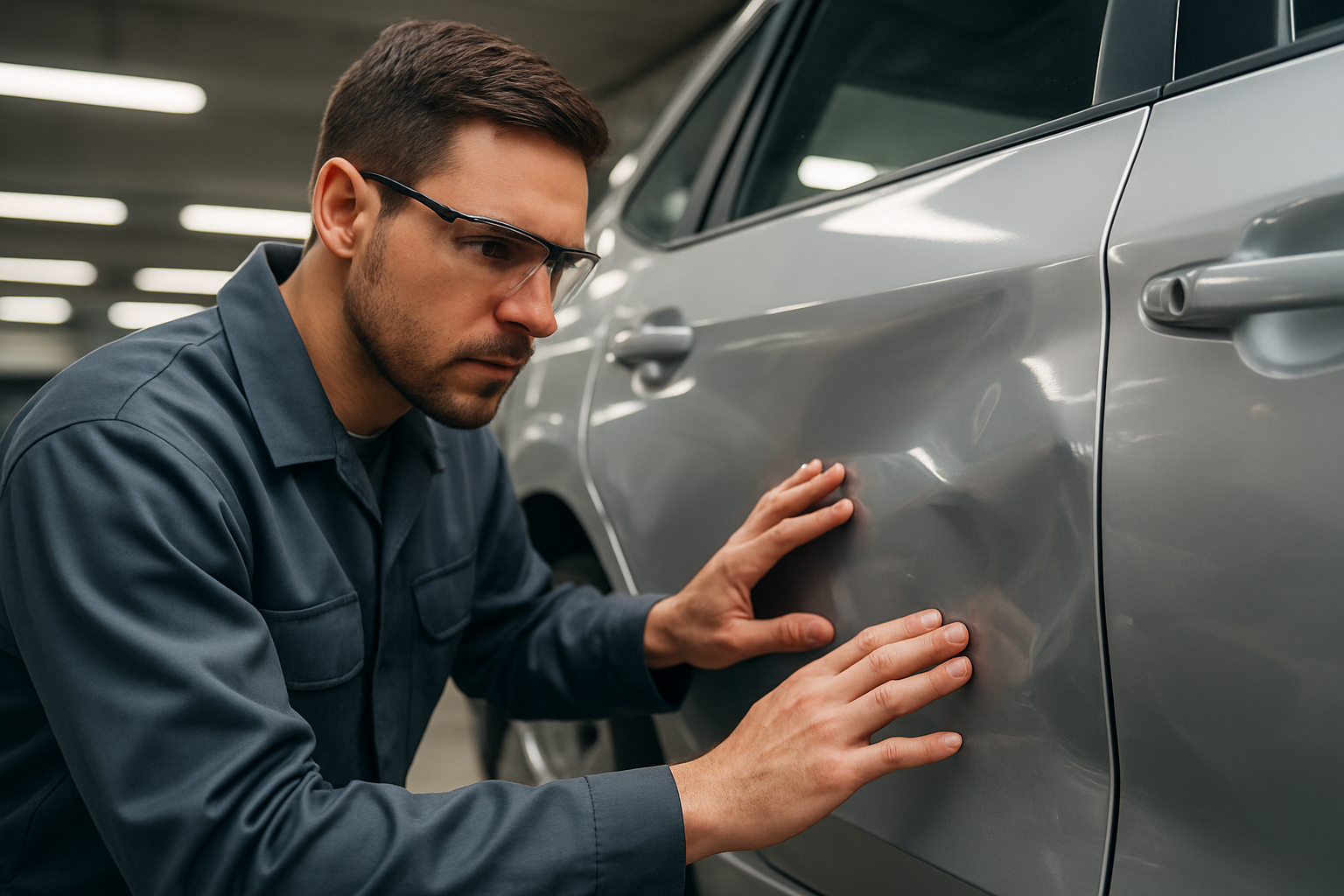
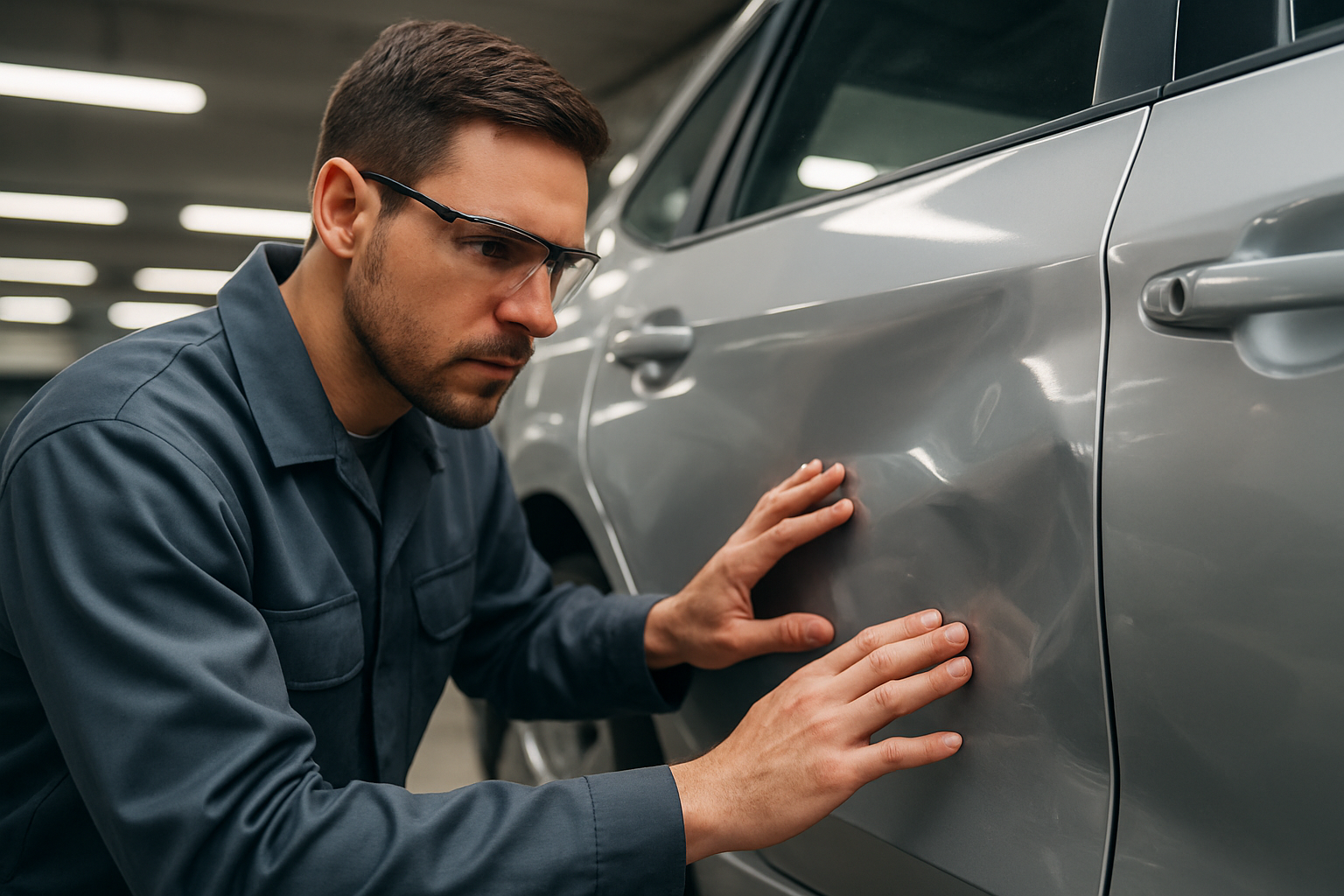
An ASE certified collision technician carefully evaluating structural damage before beginning the repair process. For a deeper walkthrough, see our What Are the Advantages of Paintless Dent Repair?.
The Complete ASE Collision Certification Series: B2 Through B6
The ASE collision certification program is structured as a multi-test series. Each exam targets a distinct skill area, and a technician may hold one or several individual certifications. Those who pass all required tests within the series earn the designation of ASE Master Collision Repair & Refinishing Technician — the highest tier of recognition. Below is a detailed breakdown of each test area and what it demands of the technician.
B2 — Non-Structural Analysis & Damage Repair
Covers the repair of exterior body panels, plastic parts, glass, and cosmetic components that do not affect the vehicle’s structural integrity. In addition, technicians tested in B2 must demonstrate proficiency in metalworking, plastic welding, and adhesive bonding techniques.
Why it matters: Most cosmetic collision damage — door dings, fender damage, bumper cover repairs — falls under this category.
B3 — Structural Analysis & Damage Repair
Focuses on the vehicle frame, unibody structure, and load-bearing components — specifically the elements engineered to manage crash energy and protect occupants. This is the most safety-critical area of all collision repair work.
Why it matters: Incorrect structural repairs can compromise crumple zone performance and airbag deployment in a future accident.
B4 — Mechanical & Electrical Components
Addresses suspension geometry, steering systems, brake components, and electrical circuits commonly affected during significant collision events. Furthermore, this area increasingly covers hybrid and EV high-voltage safety protocols as electric vehicles become more prevalent.
Why it matters: Mechanical damage that goes unrepaired directly affects vehicle handling and safety — even when the exterior looks perfect.
B5 — Painting & Refinishing
Tests knowledge of surface preparation, primer selection, base coat application, computerized color matching, and clear coat finishing. Specifically, technicians must demonstrate understanding of environmental compliance and VOC (volatile organic compound) regulations that govern refinishing operations.
Why it matters: A factory-quality finish requires precise chemistry, equipment calibration, and technique — not merely a spray gun and paint.
B6 — Damage Analysis & Estimating
Covers professional damage assessment methodology, repair cost documentation, parts sourcing decisions (OEM vs. aftermarket vs. recycled), and the communication skills needed to accurately represent damage scope to insurers and vehicle owners. For a deeper walkthrough, see our Aftermarket Parts Repair: What You Need to Know.
Why it matters: Accurate estimates protect consumers from underpaid insurance claims and prevent hidden supplemental charges after work begins.
Why ASE Certified Collision Technicians Are Critical for Vehicle Safety
Modern vehicles are no longer simple steel boxes. They are precision-engineered safety systems. Specifically, today’s cars incorporate high-strength boron steel, aluminum-intensive structures, advanced crumple zones, multi-stage airbag networks, and sophisticated ADAS (Advanced Driver Assistance Systems) — sensors, cameras, and radar modules that control lane-keeping, automatic braking, and blind-spot detection.
As a result, collision repair has become dramatically more complex than it was even ten years ago. A technician who learned their craft in the era of body-on-frame vehicles may be applying outdated techniques to vehicles whose manufacturers specifically prohibit certain repair methods. For example, some high-strength steels cannot be heated during straightening — doing so permanently weakens the material. Similarly, many aluminum components must be replaced rather than welded because the metallurgical properties change irreversibly under heat.
ASE certified collision technicians are trained and tested on exactly these nuances. They understand OEM repair procedures — the manufacturer-published specifications for how each vehicle must be repaired. They use calibrated frame measuring systems to verify structural geometry to within millimeters. Furthermore, they know precisely when a component must be replaced rather than repaired, and they understand the liability and safety implications of that decision.
Consequently, a vehicle repaired by an uncertified technician using improper methods may look completely normal at pickup — while concealing structural compromises that could cost lives in a subsequent collision. Certification is therefore not merely a quality marker. It is a safety guarantee.
ADAS Recalibration: The Hidden Step Most Shops Miss
One of the most critical — and most frequently overlooked — post-repair steps is ADAS sensor recalibration. Modern vehicles rely on front-facing cameras, radar units, ultrasonic sensors, and lidar modules that must be precisely aligned to function correctly. Even minor impacts that shift a bumper cover or windshield by a fraction of an inch can throw these systems out of calibration.
Specifically, a miscalibrated forward collision warning system may fail to activate — or activate too late — in an emergency braking scenario. A lane departure warning sensor that is off-axis may generate false alerts or miss genuine drift events. ASE certified collision technicians with current training understand this recalibration requirement and either perform it in-house or coordinate with specialized recalibration services. In contrast, uncertified technicians often skip this step entirely because they lack the awareness or equipment to perform it.
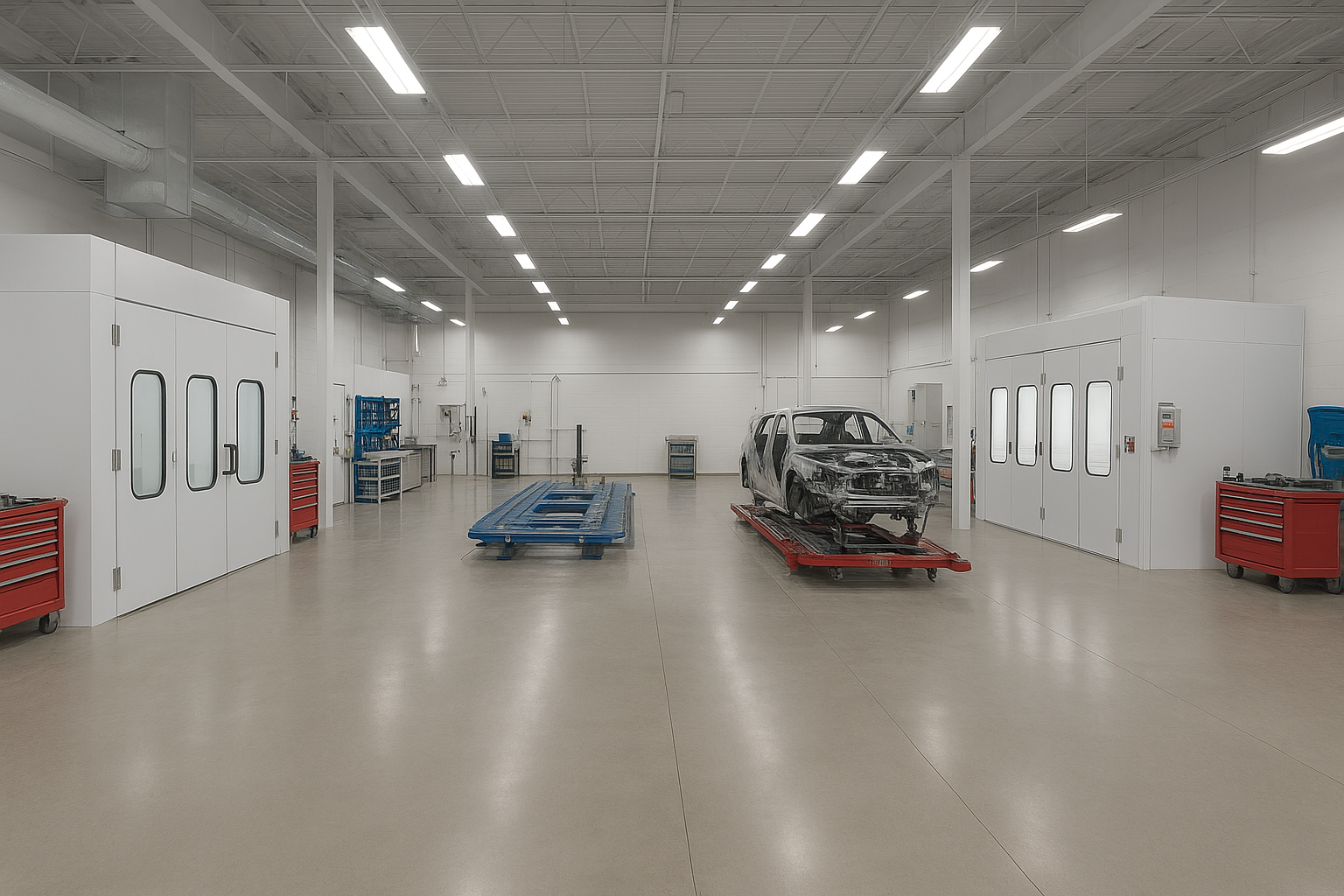
A properly equipped collision repair facility provides the precision tools that ASE certified technicians require to restore vehicles to manufacturer standards.
ASE Certified vs. Non-Certified Technicians: A Practical Comparison
To understand the real-world difference, it helps to compare what ASE certification requires against what the industry baseline looks like without it.
How to Verify ASE Credentials Before Choosing a Collision Shop — see our Collision Repair Experts guide
Verifying a technician’s ASE credentials is straightforward when you know what to look for. Certified technicians receive a wallet card and a shoulder patch that display their active certification areas and expiration date. Reputable shops proudly post their technicians’ ASE certificates on-site — typically in the reception area or service counter. However, a certificate on the wall is not sufficient on its own. You should confirm that the certifications are current, not expired.
Specifically, ask the service advisor which technicians hold active ASE collision certifications and in which B-Series test areas. A shop that employs ASE certified collision technicians will answer this question immediately and with confidence — because those credentials are a core part of their competitive advantage. In contrast, if a shop is evasive or vague about technician credentials, that hesitation is a meaningful warning signal.
Additionally, you can use ASE’s own resources. The ASE website provides a shop locator tool that identifies ASE Blue Seal of Excellence recognized shops — facilities where a minimum percentage of technicians hold active ASE certifications across relevant test areas. This Blue Seal designation adds another layer of accountability beyond individual technician credentials.
For Southern California drivers, Brea Auto Body employs ASE certified collision technicians and makes this information readily available to every customer — because verified expertise should be a baseline expectation, not a pleasant surprise. Brea Auto Body is an ASE Certified Body Shop.
The ASE Blue Seal of Excellence: What It Means for the Whole Shop
Individual technician certification is important. However, shop-level certification takes quality assurance a step further. The ASE Blue Seal of Excellence is awarded to repair facilities where a significant proportion of the technicians hold current ASE certifications relevant to the services offered. This means the standard of certified expertise extends beyond one or two individuals — it represents a culture of professional accountability throughout the operation.
As a result, when you see the Blue Seal displayed, you can be confident that multiple team members — not just a single credentialed figurehead — meet the national standard. This matters particularly for complex repairs that involve multiple technicians working on different systems of the same vehicle simultaneously.
How to Become an ASE Certified Collision Technician
For those pursuing a career in collision repair, understanding the certification pathway is valuable. The process involves several distinct phases.
For a deeper walkthrough, see our Advantages of Paintless Dent Repair: Cost, Speed & Value Explained.
- Gain Foundational Education: Most successful candidates complete a formal automotive or collision repair program through a vocational school, community college, or technical institute. Programs such as those aligned with NATEF (National Automotive Technicians Education Foundation) specifically prepare students for ASE testing.
- Accumulate Field Experience: A minimum of two years of documented hands-on experience in the relevant repair discipline is required before sitting for the ASE exam. Some candidates satisfy this through apprenticeships that run concurrently with formal education, thereby accelerating the timeline.
- Register and Prepare for Exams: Candidates register through the ASE website and select the specific B-Series tests they wish to attempt. Study guides, practice tests, and prep courses are widely available. Furthermore, many employers provide study support as an incentive for technicians to pursue certification.
- Pass the Proctored Examination: ASE exams are administered at authorized testing centers. They are multiple-choice and task-based, designed to test practical knowledge — not theoretical memorization. Consequently, technicians with real-world experience who have studied systematically perform best.
- Maintain Certification Through Renewal: ASE credentials expire every five years. To maintain certification, technicians must pass updated exams that reflect current repair technology and standards. This ongoing requirement is what separates ASE certification from a one-time credential that ages out of relevance.
The Path to ASE Master Technician Status
Above individual certification sits the coveted ASE Master Technician designation. In the collision repair series, this title is earned by passing all required B-Series exams — covering non-structural repair, structural repair, mechanical and electrical systems, painting and refinishing, and damage estimating. Specifically, this means demonstrating verified competence across every major domain of collision repair work.
Master Technicians represent a small percentage of all credentialed professionals. Therefore, when a shop employs one or more ASE Master Collision Repair Technicians, that is a significant differentiator worth asking about directly.
Key Questions to Ask Before Choosing a Certified Collision Shop
Knowing the right questions to ask upfront protects both your vehicle and your financial interests. Here are the most critical inquiries to make before authorizing any collision repair work:
- Which specific technicians hold active ASE certifications, and in which B-Series test areas? Ask for B2, B3, and B5 at minimum — the areas most commonly involved in repair work.
- Do you follow OEM repair procedures for my specific vehicle make and model? Certified shops should answer yes without hesitation and be able to reference the manufacturer repair documentation. If you need help choosing, see how to choose a collision repair shop.
- What frame measuring and structural alignment equipment do you use? Frame straightening requires precision tools — specifically computerized measuring systems — and trained operators.
- Do you perform ADAS sensor recalibration after repairs? Many modern vehicles require static or dynamic recalibration of cameras and radar modules after collision work that affects the front end, windshield, or bumper systems.
- Is your shop an ASE Blue Seal of Excellence recognized facility? This confirms the certification standard extends across the team, not just one technician.
- Do you use OEM parts, and how do you handle supplement claims with insurers? A certified shop with a credentialed estimator will manage this process professionally and transparently. For a deeper walkthrough, see our How Can I Assess the Quality of My Local Body Shop?.
- Is your workmanship guaranteed in writing? Quality collision shops back their repairs with a documented, transferable warranty on both parts and labor.
ASE Certified Collision Technicians and Insurance Claims
One of the most common misconceptions drivers hold after an accident is that their insurance company controls which shop they must use. In most states, this is simply not true. Learn more about how to choose a repair provider in our choose a collision repair shop guide. You have the legal right to choose your own repair facility — regardless of what an insurer’s preferred shop list contains.
In practice, many insurers actually prefer shops staffed by ASE certified collision technicians — because certified repairs produce better outcomes, reduce the likelihood of supplemental claims, and minimize the risk of litigation arising from a repair that fails to restore the vehicle to pre-loss condition. Consequently, choosing a certified shop often streamlines the claims process rather than complicating it.
Furthermore, a shop that employs a B6-certified damage estimator brings additional credibility to the claims process. Their estimates are systematic, professionally documented, and defensible — which means the insurance adjuster is working with a counterpart who speaks the same professional language. As a result, you are less likely to face underpaid claims or arbitrary line-item reductions.
Frequently Asked Questions About ASE Certified Collision Technicians
How long does it take to become an ASE certified collision technician?
Most candidates require at least two years of hands-on field experience before sitting for the exams — and that clock typically starts after formal training is complete. However, some technicians accelerate this timeline by combining vocational or community college programs with concurrent apprenticeships. The most well-rounded certified technicians are those who blend structured classroom instruction with substantial real-world practice across multiple collision scenarios.
How often must ASE certified collision technicians renew their certification?
ASE certifications expire every five years. Renewal requires passing updated examinations — not simply paying a renewal fee. This is critically important because automotive materials, vehicle architectures, and repair procedures evolve rapidly. Therefore, a technician certified in 2018 who does not renew is working with knowledge that no longer reflects current vehicle technology. The recertification requirement is specifically designed to prevent this from happening.
Does insurance cover repairs performed by ASE certified collision technicians?
Yes — in virtually all cases. Insurance companies are required to cover legitimate repair costs regardless of which licensed shop you select. In most states, insurers cannot legally require you to use a specific facility. Moreover, many insurers prefer certified shops because the quality of repairs reduces supplemental claim risk. Your right to choose a shop staffed by certified professionals is protected, and exercising that right often produces a smoother claims experience overall.
What is the difference between an ASE certified technician and an ASE Master Technician?
An ASE certified technician has passed at least one exam within a certification series — for example, B5 (Painting & Refinishing) alone. An ASE Master Technician, by contrast, has passed every required exam within a complete series. In the collision repair track, this means achieving certification in all B-Series areas: non-structural repair, structural repair, mechanical and electrical components, painting and refinishing, and damage estimating. Master Technicians represent the highest tier of ASE-recognized expertise in the field.
Can I verify a technician’s ASE credentials myself?
Yes. You can ask to see the technician’s ASE certification card, which lists their active credentials and expiration date. Additionally, the ASE website provides a shop locator that identifies Blue Seal of Excellence recognized facilities. If a shop is unwilling to show you technician credentials on request, treat that refusal as a serious red flag.
Does ASE certification cover electric vehicles and modern ADAS systems?
Current ASE certification exams are updated to reflect modern vehicle technology — including high-voltage hybrid and EV safety protocols, aluminum repair procedures, and advanced sensor awareness. However, the depth of EV-specific training varies by individual technician. Specifically, for EV and PHEV collision repairs, it is advisable to ask whether the shop has additional EV-specific credentials or manufacturer authorizations alongside standard ASE certification.
ASE certification credentials are a recognized, independently verified mark of excellence in the collision repair industry. For a deeper walkthrough, see our Auto Accident Repair Brea: Expert Collision Repair Guide.
The Long-Term Value of Choosing Certified Expertise
A collision repair performed correctly the first time has compounding value. It preserves your vehicle’s resale value, maintains the integrity of its safety engineering, and eliminates the hidden costs that come with returning to a shop to fix problems the first repair should have resolved. In contrast, a poorly executed repair — regardless of how affordable the initial price appeared — frequently leads to paint failure, panel misalignment, corrosion at improperly sealed weld points, and in worst-case scenarios, structural failures that manifest only in a subsequent accident.
Above all, the most compelling reason to choose a shop staffed by ASE certified collision technicians is not financial — it is the certainty that the people working on your vehicle are held to a national, independently verified standard. Their knowledge has been tested. Their experience has been documented. Their credentials are renewed regularly to stay current. That combination of accountability and expertise is what separates a repair you can trust completely from one you simply have to hope was done right.
For drivers throughout Southern California, Brea Auto Body combines certified collision repair expertise with transparent, customer-first service on every job — from minor cosmetic repairs to complex structural restorations. When your vehicle’s safety and value are on the line, the right team makes all the difference.
Conclusion
ASE certified collision technicians represent the highest verifiable standard of skill and professional accountability in the auto body repair industry. Their credentials are earned through documented experience, rigorous independent testing, and mandatory renewal every five years — ensuring they remain current with the materials, systems, and procedures of modern vehicle repair. Furthermore, their expertise directly protects vehicle occupants by ensuring that safety-critical systems are restored to manufacturer specifications. When your vehicle — and the safety of everyone in it — depends on the quality of a collision repair, choosing a shop staffed by ASE certified professionals is not merely the smart choice. It is the only defensible one.

